Tuesday, September 6, 2011

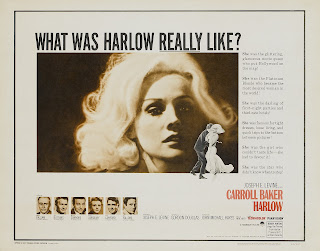
Harlow (1965)

They just don’t make movie trash the way they used to. Hollywood still makes bad movies but today they make boring bad movies. In the 50s and 60s they made gloriously entertaining trash epics like Harlow (1965).

It’s supposed to be a biopic about Jean Harlow. In fact it’s mostly fiction. I presume they were worried about being sued and so the names of just about everything have been changed. Not just the people, but even the names of the studios and the movies she made. The manner of her death has been changed and in the movie she has one disastrous marriage. In real life she was married three times.

So it’s best to simply accept the movie as fiction, as a movie about a star like Jean Harlow. The movie’s approach to the material is sensationalistic, lurid and breathless. And vehemently high camp. Not that I have a problem with any of those things. Fortunately it doesn’t take half measures. It goes wildly over-the-top and succeeds through sheer excess and bad taste.

Carroll Baker plays Harlow and she’s the movie’s single biggest strength. Baker is sexy enough and outrageous enough in her own right to get away with the role. I’ve never understood why Baker didn’t have a more successful career in Hollywood. She’s a whirlwind of misdirected sexual energy, and rather like other notable roles Baker played (such as the title role in Elia Kazan’s Baby Doll) she’s a delirious mixture of innocence and wantonness.

Mike Connors is better than you might expect as a male star who pends most of the movie trying to persuade Harlow to marry him. Red Buttons can be an annoying actor but as her devoted agent he’s well cast. Angela Lansbury and Raf Vallone overact amusingly as her appalling parents. As depicted in this movie her mother is a sex-crazed matron who has married a reckless but good-looking gigolo.

The key character is Paul Bern, played by Peter Lawford. In this biopic Paul Bern is the first husband of a virginal Harlow. In reality he was her second husband but the marriage was every bit as catastrophic, culminating in Bern’s suicide shortly afterwards, presumably unable to deal with his inability to consummate the marriage. For the movie version of Paul Bern the shame of being married to Hollywood’s number one sex goddess and being unable to perform in bed is too much.

And it’s just too much for Harlow, in this movie presented as a woman who has saved herself for marriage and then realises she might as well have not bothered.

Director Gordon Douglas had an interesting career and handles his task pretty well. Apart from Carroll Baker the movie’s other big asset is its visual style. Everything is too bright, too colourful, too garish, too brightly lit, too glossy and too shiny and in thoroughly deplorable taste. This is total kitsch overload. And it works perfectly. It’s Hollywood given the full Hollywood treatment. The sets are like temples dedicated to the gods of camp.

Olive Films have gained the right to release quite a few previously unavailable Paramount movies like this one. There are no extras whatsoever but the transfer is superb.

If you can’t disregard the fact that the movie gets just about everything about Harlow’s life wrong you’re probably well advised to skip this one. But if you can, and if you’re in the mood for trash on the epic scale just lie back and enjoy. Harlow is very highly recommended.

Sunday, September 4, 2011

Yield to the Night (1956)

The 1956 British production Yield to the Night was the most highly regarded of the movies of Diana Dors and is usually considered to be the movie on which her reputation as a serious actress rests. Personally I don’t entirely agree. I have a very high opinion of Diana Dors as an actress but I think she did better movies and gave better performances (such as her performance in Unholy Wife).

It’s not that she isn’t superb in Yield to the Night (and actresses have won Oscars for performances much inferior to this one) but I think she’s done more subtle and more original work than this.

As for the movie itself, your feelings about it will depend almost entirely on your response to the movie’s politics. For this is a very very political movie. Mary Hilton (Diana Dors) is a married woman, but not exactly what you’d call a happily married woman. When she meets good-looking piano player Jim Lancaster (Michael Craig) she needs no persuasion at all to drift into an affair.

The problem is that for Jim this is just a distraction, some recreational sex to keep his mind off his other problems. And he has lots of problems. His biggest problem is Lucy Carpenter. He’s crazy about her but she’s really out of his league. His other problems are a major propensity towards self-pity and self-dramatisation. Unfortunately Mary is hopelessly in love with him. And she can’t quite accept the evidence that he’s not that interested in her for anything other than casual sex.

Mary is not exactly stupid, but she’s a hopeless romantic and she’s convinced herself that Jim is the one man for her. Of course this situation is bound to end badly, and it does. It ends very badly indeed. And rather than just get upset in the short term, Mary broods. She starts thinking about revenge. And she starts thinking about Jim’s gun, the one she took away from him when he was going through one of his major self-pity stages. Mary starts to think that Lucy shouldn’t be allowed to get away with doing what she did. Mary starts to think that Lucy deserves to die. And she has Jim’s gun. And pretty soon Mary finds herself a murderess.

Most of the movie concentrates on her experiences in prison, on the British equivalent of Death Row. The most interesting thing about the movie is the focus on her relationship with the various female prison warders, and in particular with MacFarlane (Yvonne Mitchell). Despite her tendency to shoot people Mary is a likeable rather vulnerable young woman and the warders grow quite fond of her. They get to know her very well, and they like her. Diana Dors wisely doesn’t resort to scenery-chewing. She downplays her performance, and that makes it all the more affecting.

The support cast is very strong, with Geoffrey Keen as the chaplain contributing a sensitive performance. And as mentioned earlier Yvonne Mitchell is extremely good.

The problem with this movie is the problem with all social problem movies. It’s essentially propaganda. Like all such movies it’s deliberately and shamelessly manipulative, willing to go to any lengths to advance its political agenda. And in this case it does so in a breath-takingly dishonest manner. The actual murder victim is dehumanised, depersonalised and marginalised to the point where she scarcely even exists, except in so far as she’s demonised to make us see her as the real villain.

To accept this movie you have to accept wholeheartedly a particular political view of crime, that the so-called victims of crime (such as the wicked Lucy) are the real villains while the criminals (like poor sweet Mary) are the victims and the ones deserving of our sympathy. Not only is Mary much nicer than Lucy, she’s also younger and prettier. And she’s a real person, a person we get to know very well, while Lucy is just a faceless evil woman. I can’t recall ever seeing a movie that uses such techniques quite so blatantly.

None of which detracts from the skill of director J. Lee Thompson or the magnificent performance of Diana Dors, but I couldn’t help feeling a bit of a nasty taste in my mouth after seeing this movie. An extremely well-made and very emotionally powerful movie, but if you don’t buy its political agenda you may well feel uncomfortably that you’ve been used.

Friday, September 2, 2011

Island in the Sky (1953)

Island in the Sky is the fourth movie I’ve seen in the last couple of weeks that was produced by John Wayne’s own production company. And I’m becoming more and more impressed by Wayne’s achievements as a producer.

The four films I’ve seen have all been slightly offbeat and extremely interesting and all represent a perfect combination of commercial appeal and quality film-making.

This is actually the first one I’ve seen where Wayne himself takes the starring role. Actors often turn to producing in order to get more interesting parts and one of the things I admire about Wayne is that he didn’t seem to use his production company that way. His agenda appears to have been simply to make good movies, and if the lead role happened to suit him then he’d take that role.


Island in the Sky is a war movie without any shooting. During the Second World War many commercial airline pilots served in the US Army Air Force’s Air Transport Command while still remaining civilians. They flew cargo planes to and from the various theatres of war often in extremely dangerous flying conditions. One of these pilots was Ernest K. Gann, and he used his wartime experiences as material for several best-selling books, including Island in the Sky.

Many of these wartime transport missions were flown in Arctic conditions where atrocious weather was not the only hazard. There was also the added complication that compasses no longer work accurately that close to the North Magnetic Pole. It was not difficult to become hopelessly lost. This was the fate that befell a C-87 transport aircraft in real life, and Gann’s novel and the film are based on this real-life story.


In the movie a DC-3 piloted by tough Irish pilot named Dooley (John Wayne) loses its way in the frozen wastes of Canada. Dooley makes a successful crash-landing but neither they nor their ground controllers have any clear idea of their location. They have enough food for six days at the most.

A search is immediately instituted. Flying conditions are dangerous in the extreme but there’s no need to call for volunteers. The air crews flying the missions have an incredibly strong camaraderie and they are all determined to find Dooley and his four crew members.


As Leonard Maltin points out on the commentary track a movie like this could never be made today - this is a movie about heroism without any irony or cynicism. In that sense it’s an old-fashioned film, but it’s old-fashioned in the best possible way.

Director William A. Wellman was a flyer himself so he has a kind of personal stake in this picture, and it shows. This is a celebration of the brotherhood of aviators, and while that may sound a little corny the movie has an integrity and an emotional honesty that makes it work.


The huge cast is filled with interesting actors and a notable feature of the film is that even the most minor parts are brought vividly to life. Every actor in the movie gets at last one good scene, and every one of them makes the most of it. And that reflects the message of the movie, because this is a story not so much about individual heroism as collective heroism. It’s also a story about loyalty and comradeship. Again, they’re old-fashioned messages but there was a time when such values were considered to be important, and if we can’t understand that today then it’s our loss.

It’s also a visually stunning movie. One’s first impression is that the miniatures work is incredibly impressive. And then the realisation hits home - there aren’t any miniatures shots. It’s all done for real. When they needed to show a DC-3 crash-landing in the snow, they took a DC-3 and crash-landed it in the snow. William Clothier was in charge of the aerial photography, and he’d been doing this sort of thing for Wellman since they worked together on Wellman’s Oscar-winning Wings back in the 20s.


It’s a movie that is tense, exciting and emotionally involving and always entertaining, a movie obviously made by people who cared about what they were doing. Highly recommended, but you’ll have to leave your cynicism at the door.

Monday, August 29, 2011

You Only Live Once (1937)

You Only Live Once, released in 1937, was Fritz Lang’s second Hollywood film, and it’s also one of his most interesting. And it’s very much a precursor of the American film noir cycle of the 40s and 50s to which Lang would contribute so memorably.

Along with Fury, his first American production, it’s often considered to be one of his more political movies, which may be something of a misunderstanding of the movie. Fury dealt with lynching, while You Only Live Once deals with an ex-convict trying to go straight and (supposedly) being prevented from doing so by a hostile and oppressive society.

What’s often overlooked with Lang is that he was raised a Catholic and always considered himself to be one, and apparently he considered this to be his most overtly Catholic film.


Henry Fonda is Eddie Taylor, newly released from prison. This was his second stretch in prison and now he knows that if he goes back again under the state law at that time he’ll get life. He says that this time he’s definitely going to go straight but adds ominously, “If they’ll let me.”

Joan Graham (Sylvia Sidney) is a very respectable young woman who works for the Public Defender, and she’s in love with Eddie. They’re going to get married as soon as he gets out, much to the horror of both her sister and her boss, both of whom consider Eddie to be a born loser. On their honeymoon they’re kicked out of their hotel room at 4 am when the landlord realises Eddie is an ex-con. To Eddie this merely confirms his belief that society is out to get him. Shortly before this happens Eddie and Joan are watching frogs in the pond near the hotel and Eddie remarks that if one frog dies its mate will die as well. “Just like Romeo and Juliet,” as Joan comments, another fateful statement.


Despite this things go well for the young couple initially. The kindly and idealistic prison chaplain, Father Dolan, organised a job for Eddie as a truck driver. They’re about to take out a home loan, but Eddie is so busy with house-hunting he turns up an hour and a half late for work, and gets fired. To Eddie this is more evidence that everything is against him. And they’re already committed to the new house. Eddie tries to talk his boss into keeping him on but when he refuses Eddie loses his temper and slugs him. Eddie bitterly remarks that the only people who’ll give him a job now are his old pals, and the only work they have on offer involves robbing banks.

We now cut to a bank robbery in progress, a robbery that leaves six people dead. And Eddie’s hat is found at the scene. It seems that he wasn’t able to keep out of trouble after all. Eddie arrives home late that night with a wild story that he’s been framed for the robbery. Joan persuades him that if he’s innocent he should give himself up because he has nothing to fear. Eddie takes her advice, and ends on on Death Row. But the story is not over yet.


This seems to be a movie about the ways different people perceive the world differently, and often misperceive it. The hotel owner, the Public Defender and Joan’s sister see Eddie as an habitual criminal who will never make good. Joan sees him as a good man. Eddie sees the world as a kind of conspiracy against him, Joan sees the world as fundamentally just and fair. Father Dolan sees hope, Eddie sees a system stacked against him and a world of every man for himself.

It’s also very much about faith. That’s the element modern audiences may have trouble with. They may find it difficult to take a character like Father Dolan seriously, or see him as Eddie sees him - as an agent of an oppressive system or even as a figure of fun. But to ignore the theme of faith in this movie is to miss much of its complexity, and much of the ambiguity that makes it so interesting. There’s certainly a political dimension but if that was all the movie was about it would have been as dull as most politically motivated movies of its era. Lang’s movie has a lot more going on.


One of the ironies of the film is that the character who seems most deluded and most naïve, Joan, turns out to be right every time. She is right about Eddie, and in a tragically ironic way she is right about the system. She has absolute faith in the goodness of both people and society, and if only Eddie could have picked up some of that faith he could have avoided disaster. In one fatal moment his only hope is to put aside his accustomed suspicions and anger and make a leap of trust. But he cannot.

Fate is always mentioned in relation to Lang’s films, but in this particular movie the protagonists have the freedom to make choices to avoid their fates. But perhaps being the people they are they were always going to make the choices they made.


I’ve always disliked Henry Fonda but he’s oddly effective here. Given the plot outline you expect Eddie to be sympathetic character but he isn’t. Fonda makes him a rather unpleasant young man with a chip on his shoulder and way too much self-pity but that’s another way in which this movie is more interesting than the story outline would suggest.

Despite being still very much a newcomer to Hollywood production methods Lang is very much in control. He knows what he’s trying to do with this movie and he succeeds brilliantly. Visually it has some nice touches. Darkness and fog would become staples of film noir but rather than use them merely for atmosphere Lang employs them symbolically in several key scenes.

A great movie. The Image Entertainment DVD is adequate although lacking in extras, a pity given that this is such a complex movie.
Friday, August 26, 2011

Macbeth (1971)

When Roman Polanski made his Macbeth in 1971 Shakespeare’s tragedy had already been adapted to film countless times, going back at least as far as 1908. And among those myriad adaptations were two acknowledged masterpieces by very major film-makers indeed. So was another movie version really necessary or justifiable? The answer, surprisingly, was yes.

Those two acknowledged masterpieces were Orson Welles’ version in 1948 and Akira Kurosawa’s 1957 version (Throne of Blood). The Welles version, which I regard very very highly, is perhaps more wells than Shakespeare. And Kurosawa’s version was in Japanese, with a Japanese setting. A definitive English language version was needed and Polanski set out to provide it.

Polanski’s film is in many ways a more traditional and more conventional version than the Welles film. Polanski has tried to stick fairly closely to what Shakespeare wrote and virtually all of the dialogue is straight from the play. Where Polanski’s movie becomes radical is in its tone. Polanski approaches Macbeth with the sensibility of a horror director and the result can be regarded as both a Shakespearian film and a horror film.

This is Shakespeare with copious quantities of graphic violence and gore, and with nudity. This was the 70s, and Polanski doesn’t hold back. He gets all Grand Guignol with the Bard. On the other hand it has to be admitted that all of the violence is right there in the play even if it had never been depicted on screen with such relish prior to this. Macbeth does after all have some claims to being the first masterpiece of gothic literature.

Polanski’s other innovation is to stress the medieval setting. The real Macbeth was High King of Scotland in the 11th century and Polanski treats the story as a medieval story rather than an Elizabethan one. He gives us medieval grime and squalor, but by emphasising the medieval aspects he also emphasises the remorseless medieval view of vengeance, and a medieval enthusiasm for extreme violence. It works pretty well.

The big surprise is Jon Finch, in the title role. This was his first major film role and he’s superb. Finch had in fact done a good deal of theatre work but his performance is very cinematic rather than stagey. He resists the temptation to go for the kind of theatrical overkill that so many actors succumb to when doing Shakespeare on screen.

Even more crucial to the success of any production of Macbeth is the actress playing Lady Macbeth. Francesca Annis handles it pretty well. She also resists the temptation to go over-the-top. Her Lady Macbeth is not overtly monstrous. Like her husband she is simply seduced by the possibilities opened up by the predictions of the three witches.

Polanski’s direction is stylish without being too obtrusive, although the second meeting of Macbeth with the witches does come across as a bit like a bad acid trip.

There’s a theory that the extreme nature of the violence was Polanski’s way of working through his grief over the murder of his wife Sharon Tate at the hands of the Manson Family. It’s also been suggested that the nudity was included at the behest of executive producer Hugh Hefner, this movie being the Playboy mogul’s attempt to movie into serious movie producing. Personally I suspect that a Polanski version of Macbeth was always going to have a bit more in the way of sex and violence than your average Shakespearian adaptation.

The Columbia Classics 2006 DVD release is reasonable compared to the pan-and-scanned VHS versions that used to be around but this is a movie that deserves a more luxurious DVD (or even Blu-Ray) presentation.

On the whole it’s one of the more satisfying attempts to put Shakespeare on the big screen and if you’re a fan of the Bard it’s really a must-see. And if you’re a horror fan you’ll find it works very successfully as an exercise in gothic horror. Highly recommended.

Wednesday, August 24, 2011

Track of the Cat (1954)

William A. Wellman’s 1954 western Track of the Cat suffered a similar fate to Charles Laughton’s 1955 Night of the Hunter. Both were exercises in style for which the movie-going public of the 1950s was not ready, both failed commercially at the time, and both went on to be highly regarded examples of art cinema at its best.

Track of the Cat hasn’t undergone the same degree of rehabilitation as Night of the Hunter but in its own way it’s just as impressive.

The plot is very much a secondary consideration. A painter (puma) has been attacking stock on a remote ranch owned by the Bridges family. The two oldest Bridges brothers, Curt (Robert Mitchum) and Arthur (William Hopper) set off to track down the predator.


The old Indian who lives at the ranch, Joe Sam, believes the attacks are the work of a mysterious black painter, a kind of supernatural beast. To Joe Sam the painter symbolises the violence in the world, the violence that destroyed his own family. It will come to be seen as having much the same significance for the Bridges family.

In fact the movie has nothing whatever to do with hunting marauding pumas. It’s a family melodrama, with the painter being a personification of the passions, jealousies, resentments and hatreds that collectively make up the Bridges family.


Pa Bridges is a hopeless drunk with only the haziest idea of what’s happening. The family has been dominated by two overwhelming personalities, Ma Bridges (Beulah Bondi) and Curt. Ma Bridges is a pious fraud, a controlling monster of a matriarch. Curt easily dominates brother Arthur, and younger brother Harold (Tab Hunter) is practically a nonentity, existing merely to serve as the butt of Curt’s jokes. Harold has fallen in love with Gwen Williams (Diana Lynn) but nobody believes he’ll ever have the courage to ask her to marry him. Harold has never had the courage to do anything. Sister Grace (Teresa Wright) retreats to her room and to her music.

But now the painter has come and Curt is off in the mountains hunting him and the family tensions are coming to the boil.


Director Wellman conceived this movie as a experiment in colour. He’d long had the idea of making a black-and-white movie in colour. His idea was that if a movie were to be shot in mostly monochromatic shades, with stark blacks and whites and otherwise mostly very subdued colours that were almost shades of grey, he could use bright colours very very sparingly for intense dramatic effect. In fact the only bright colours are Curt’s red jacket and Gwen’s yellow blouse. Curt has always been the central figure in the family, the de facto boss and patriarch, while Gwen is the disturbing new element . They’re the two characters with the power to make things happen. Everyone else reacts to what they do.

In practice this visual idea results in a movie with a distinctive and rather disturbing look. And Wellman doesn’t stop with the colour. He uses spectacular location shooting for the scenes in which Curt hunts the cat, but as soon as we move back to the ranch we’re obviously on a sound stage. The exteriors of the ranch are filmed in such a way as to emphasise their artificiality, to make sure we’re in no doubt this is a sound stage. Wellman wants us to see the ranch as something artificial and unnatural, something that doesn’t belong, something that should be alive but isn’t. It’s a kind of surreal doll’s house, and again the resemblances to Laughton’s vision in Night of the Hunter are striking.


Wellman (with the able assistance of his cinematographer William A. Clothier) took huge risks with this film and while they didn’t pay off commercially at the time they certainly paid off artistically. And the movie’s reputation has slowly grown.

Wellman had the advantage of having a fine cast to work with and the performances are uniformly good. The role of Curt required the kind of vaguely sinister charisma that Mitchum could always produce when needed and his presence dominates the film even when he’s not onscreen, just as the personality of Curt dominates this bizarre family even when he’s not there.

It’s a movie that is something of an oddity but it’s well worth seeking out as an example of just how edgy 1950s Hollywood film-making could be. It was produced by John Wayne’s production company which was responsibly for so many interesting and offbeat 1950s movies.

Sunday, August 21, 2011

The Palm Beach Story (1942)

Critics tend to adore the films of Preston Sturges. Perhaps because he started out as a writer and made the transition to directing at a time when that was quite a difficult feat to manage. I had approached my first Preston Sturges movie, Sullivan’s Travels with a good deal of excitement, only to find the movie a muddled bore. As a result I had very low expectations of The Palm Beach Story, but in fact it’s a delight.

While Sullivan’s Travels gave the impression of having been made by a director who changed his mind every few minutes as to what kind of film he was trying to make. The Palm Beach Story in contrast is extremely focused. It’s a screwball comedy. It isn’t trying to say anything profound about the American Dream and it doesn’t have a political agenda. It’s there to provide entertainment and it succeeds admirably.


Tom Jeffers (Joel McCrea) is a spectacularly unsuccessful architect-inventor. His most recent hare-brained scheme is an airport suspended above the city skyline. Not surprisingly he is unable to earn enough money to pay the rent. This is rather embarrassing for his wife Gerry (Claudette Colbert) who has to suffer the double indignity of both eviction and of being present while the landlord shoes prospective new tenants through their apartment. But she gets a lucky break. The old guy who is looking through her apartment is extremely rich, kind-hearted and quite mad. He takes pity on her and gives her the rent money.

Gerry realises this is only a temporary solution. She still has faith that eventually Tom’s genius will be recognised but she feels that having a wife to support is holding him back. So she decides to leave him. She makes a dash for the railroad station but of course she has no money for a ticket. Luckily the members of the Ale and Quail Club (a club formed to celebrate the twin pleasures of shooting and drinking, usually at the same time) are always willing to pay a train fare for a charming lady in distress. The movie now kicks into screwball high gear as the increasingly intoxicated members of this club start shooting up the train while Gerry has a chance encounter in a sleeping car with a rather shy rather bookish young man.


This man turns out to be J. D. Hackensacker III, one of the richest men in the world. He takes quite a shine to Gerry, and Gerry soon finds herself on his luxury yacht. She meets his much-married and joyfully immoral sister the Princess Centimillia (Mary Astor). But husband Tom is in hot pursuit.

Romantic complications and cases of mistaken identity and general confusion and mayhem follow.


This time Sturges keeps everything tightly controlled. The pacing is frenetic and the laughs are there in abundance. His script is witty and there are enough good lines for all of the very talented cast.

Joel McCrea is slightly vague as the well-meaning but somewhat ineffectual Tom. Rudy Vallee is terrific as J. D. Hackensacker. There are some fine supporting performances from minor players (many of whom worked regularly with Sturges). The real star though is Claudette Colbert who is in dazzling form.


The Region 4 DVD includes a lengthy documentary on Sturges but personally I found that if anything it detracted from my enjoyment of the movie. It’s a bit too gushing and Sturges comes across to me as a less than attractive personality. Picture quality is very good though.

An excellent example of the screwball comedy genre and a thoroughly enjoyable movie.