Tuesday, October 11, 2022

Law and Order (1932)

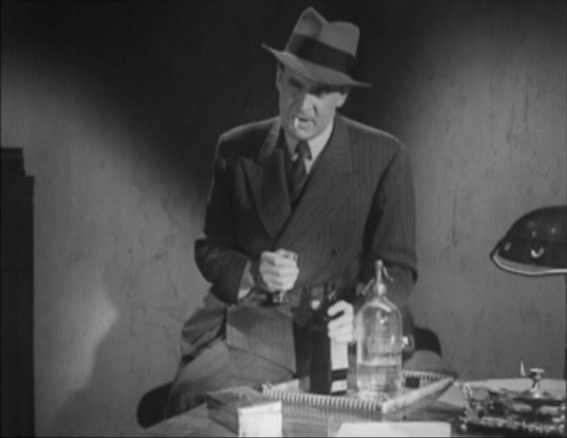
Law and Order (later retitled Guns A'Blazin') is a 1932 Universal western based on W.R. Burnett’s novel Saint Johnson. It stars Walter Huston. One of the writers was John Huston. So that’s an impressive array of talent.

It’s around 1889. Frame Johnson (popularly known as Saint Johnson and played by Walter Huston), his brother Luther (Russell Hopton) and their buddies Brandt (Harry Carey) and Deadwood (Raymond Hatton) have a choice to make. They can take the road to the peaceful but dull town of Alkali or the other road that leads to Tombstone. Tombstone is a much more exciting town but it’s wild and dangerous. They leave the decision to the fall of the cards. They take the road to Tombstone. It’s a fateful decision. Later in the movie there will be another fateful decision decided by a bet.

Frame Johnson is a legendary lawman but he’s determined to hang up his shooting irons. Frame has killed thirty-five men but paradoxically he hates guns and he hates violence. He believes in law and order, but he dreams of a future in which law and order do not depend on the gun.

The last thing Frame wants is to wear a badge again. Tombstone is a lawless town run by the corrupt and vicious Northrup brothers and their cronies, assisted by the equally corrupt sheriff, Fin Elder. Judge Williams wants to appoint Frame a Deputy U.S. Marshal, to clean up the town. Frame wants no part of it. And then fate steps in, in the form of a bet. Frame is soon wearing a deputy marshal’s badge.

Frame and the town council decide to ban guns in Tombstone. Rather daringly, and perhaps rashly, Frame decides that he and his deputies (Luther, Brandt and Deadwood) will give up their guns as well. Law and order will be enforced in Tombstone without guns.

It doesn’t quite work out. There’s another gun killing and Frame has to pick up his shooting irons again. Events are leading inexorably to a showdown with the Northrups and it’s going to be an epic gunfight.

Those who think that westerns didn’t start to become grown-up until John Ford made Stagecoach in 1939 will be very surprised by this movie. Westerns don’t come much more grown-up than Law and Order. Those who think that it was Anthony Mann who first took the western into darker territory will also be in for a surprise. Westerns don’t come much darker than Law and Order.

The tone of the movie is just slightly reminiscent of another Walter Huston movie made in the same year, The Beast of the City. The resemblance is not accidental - The Beast of the City is also based on a W.R. Burnett novel. In that movie Huston is a cop battling gangsters but the thematic similarities are striking.

Walter Huston is superb. It’s a smouldering performance. Frame Johnson is a good man but a dangerous one. When that smouldering fire leaps into flames it would be wise to stand clear.

1932 was an extraordinary year for Huston. He also co-starred with Joan Crawford in Rain, giving a memorable performance as a preacher engaged in a battle of wills with a prostitute.

Among the supporting cast is Andy Devine, looking young and thin! He plays a man accused of murder who is about to be lynched. Frame Johnson intends to put a stop to lynching.

The supporting cast overall is very strong.

Director Edward L. Cahn had an interesting career, becoming best known for schlocky science fiction and juvenile delinquent movies in the 50s. Law and Order suggests that maybe he should have had a more prestigious career. He does a fine job and handles the action scenes well.

This is a very bleak and somewhat gruelling movie. Things are tense from the start and the tension builds steadily.

It has a complicated hero. Frame Johnson is a man with very strong notions but sometimes they’re wrong. Sometimes he’s too idealistic and sometimes he’s too cynical. He believes in law and order but he doesn’t believe that people in general want law and order. He yearns for a better world, a world without constant violence and corruption, a world of peace. But he has doubts as to whether such a world is possible.

Law and Order is an intelligent, provocative, very dark western. Highly recommended.

I picked up this movie in a French DVD release from Sidonis. It’s a pretty good transfer and it includes an unexpected bonus - the 1953 remake of Law and Order starring Ronald Reagan. And both movies are presented in English. I've also reviewed that version - Law and Order (1953).

Saturday, October 8, 2022

The Partner (1963)

The Partner is a 1963 entry in the Merton Park cycle of Edgar Wallace thrillers.

Film director Wayne Douglas (Guy Doleman) is involved in a complex tax avoidance scheme cooked up by his accountant Charles Briers. Three hundred thousand pounds is being shuffled about from one person’s name to another. The money belongs to Wayne Douglas but at the moment it’s in the name of Lin Siyan (Yôko Tani), a starlet he discovered.

Meanwhile his wife Helen (Helen Lindsay) is having him followed by private detective Richard Webb (Mark Eden). She suspects that her husband is having an affair with Lin.

The sudden death of Charles is going to cause problems with that three hundred thousand pounds. Nobody is quite where the money is. There’s another two thousand pounds that is missing as well. And a contract. A very important contract which Wayne now desperately needs.

The police are very concerned about the time factor in this case. The murdered man was seen doing things that he couldn’t possibly have done, owing to the fact that he was dead at the time. They’re certain they’re dealing with a murder but they don’t know the murderer’s identity because they lack vital pieces of evidence.

Helen’s brother Buddy (Anthony Booth) is an artist although mostly he seems to be a layabout. He and his pal Adrian (John Forgeham) are up to something and it probably involves money (you need money to have a nice lifestyle if you’re a layabout artist).

Everybody in this movie is up to something, usually involving money or sex. Or they have something to hide. We’re presented with several plausible suspects fo that murder.

And then there’s a shooting.

Guy Doleman is best remembered for his supporting role in the Harry Palmer movies (as Harry’s smooth slightly sinister boss). He didn’t get too many leading roles but the great thing about B-movies such as the Merton Park Edgar Wallace thrillers is that they gave interesting actors the chance to show what they could do in a leading role. Doleman does quite well here.

It’s also interesting to see young actors like Anthony Booth in their early careers. He was later to be well-known for his television work and for the notorious 1970s Confessions of… sex comedies but here he gets to play it straight and he rally is effectively creepy and sleazy.

French-born Japanese actress Yôko Tani made films in France, Britain and the United States with modest success but her career never really took off simply because there weren’t a great many good parts for Japanese actresses in those places.

Like so many of the writers and directed involved in this cycle of films director Gerard Glaister would achieve most of his success in television. As a director he was competent enough to judge by this film.

John Roddick (who also worked mostly in television) provides a solid enough screenplay although perhaps it needed to be just a bit more devious.

This movie forms part of Network’s Edgar Wallace Collection Volume 5. The transfer is 16:9 enhanced and it looks terrific. All these movies were shot widescreen in black-and-white.

This is a routine entry in the series. It’s a very straightforward murder mystery but the film industry setting adds interest (with film sets used as settings for murder) and like all these movies it’s well-crafted.

The Partner is an enjoyable enough way to spend a hour (in fact it runs just under the hour) and it’s recommended. Even the lesser movies in this series are pretty good.

Monday, October 3, 2022

Here We Go Round the Mulberry Bush (1968)

Here We Go Round the Mulberry Bush is a lighthearted British coming-of-age movie directed by Clive Donner and scripted by Hunter Davies from his own novel. It’s the tale of the misadventures of a young man desperately trying to lose his virginity.

Jamie (Barry Evans) just doesn’t seem to have any success with girls. He tries really hard but something always goes wrong. We assume that he’s around eighteen (he’s still at school) and he’s as obsessed about sex as any other normal teenaged male.

It’s not that girls dislike him. It’s just that the girls he wants seem to be more attracted to other men, and the girls who do like him don’t appeal to him.

He could probably get Linda but she’s too scatterbrained for his tastes. The girl he really wants is Mary (Judy Geeson). Mary is gorgeous and she has class. Unfortunately she also has rich young men pursuing her and she’s a bit out of Jamie’s league.

In desperation he joins a church group where there’s a girl who seems to be quite attracted to him but it all ends in embarrassment rather than the passion he dreams of.

Then there’s Caroline. Caroline is rich but she seems rather keen on him and when she invites him to stay at her parents’ country house for the weekend he’s pretty sure that it’s finally going to happen. And it would have happened except that Caroline passes out dead drunk before it can happen. While Jamie is trying to bed Caroline her father (played be Denholm Elliott) and her brother are busily trying to bed the family’s German au pair Ingrid, and Caroline’s mother seems to have designs on Jamie. It’s all too much for poor Jamie.

There’s also Audrey, but he’s still pining for Mary.

Then he runs into Mary again. He figures he doesn’t have a chance but he might as well give it a try.

Does Jamie eventually get what he wants? Well, in a way, but maybe it wasn’t quite what he wanted after all.

Given the subject matter and the fact that this is a 1960s British movie you might be forgiven for expecting lots of misery and despair but this is not that type of movie. It remains lighthearted and cheerful. This is a comedy. We never believe that Jamie’s situation is hopeless. He’s good-looking, he’s amusing, he has boyish charm and he’s not creepy. We know that it’s just a matter of time before a girl will come along who will decider that he’s just what she’s been waiting for. For Jamie losing his virginity is a challenge but it’s obviously not going to be an insurmountable hurdle.

This is a very 1960s movie, in fact it’s very much a Swinging 60s movie. The Richard Lester influence is very clear. There’s pop music (provided by the Spencer Davis Group and Traffic, both pretty big bands at the time), there are fantasy sequences, everything is bright and colourful and there’s just a slight avant-garde vibe (and a definite Richard Lester influence). The fourth wall isn’t just broken occasionally, it’s never there at all. Jamie spends the entire film speaking directly to the audience.

This is a kind of precursor to the British sex comedies of the 70s (a much despised genre that is nowhere near as bad as pompous critics would lead you to believe). Had it been made just a few years later there would have been copious amounts of nudity but in 1968 British film censorship was still ludicrously draconian. And even a rather tame movie such as this ran into trouble with the censors (they were particular upset by Judy Geeson's nude scene which is possibly the sweetest most tasteful nude scene you'll ever see). This movie is tame, but the tone is definitely somewhat similar to that of those 70s sex comedies.

It’s also, like so many British movies of its era, about class as well as sex. Jamie is working-class (although his family is respectable and by no means poor and could perhaps even qualify for the lowest echelons of the lower middle-class). He could undoubtedly bed Linda but Linda is working class. Jamie is more attracted to middle-class girls with style and grace. Caroline’s family is upper middle class. They’re not exactly portrayed as decadent or degenerate but their morality is rather flexible. They consider that having all the male members of the family bedding the au pair is perfectly normal behaviour. And it has to be said that Ingrid seems totally at ease with the situation. But of course she’s European and doesn’t share the bizarre British attitudes towards sex. Unlike the British characters in the film she seems to think of sex as something that normal healthy girls should enjoy.

At 23 Barry Evans was, on paper, much too old to play Jamie but Evans always had that baby-faced look and he gets away with it. And he’s pretty good - he never makes Jamie seem obnoxious or overly self-pitying or pathetic. Jamie is a nice lad and he treats girls decently and we hope he succeeds in his quest to get laid.

Judy Geeson was 18 at the time, stunning and already an accomplished and experienced actress. She’s always worth watching and she handles her rôle with considerable aplomb. On the whole the acting is extremely good. Special mention must be made of Angela Scoular who is an absolute delight as the wildly eccentric Caroline.

The humour is quite sexual but never crude. This is a good-natured little movie and both the male and female characters are sympathetic. They all have their quirks but they’re all basically pretty nice people. The class element is there but it’s handled with a light touch. This is a movie that has no interest in bludgeoning the viewer with politics.

This movie is the absolute antithesis of the British New Wave with its emphasis on misery and hopelessness. The teenagers in Here We Go Round the Mulberry Bush are not doomed. They’re looking forward to the future. They believe they have a good chance in life and they’re correct. Jamie will be going to university when he leaves school, as will many of his friends. The movie was shot in Stevenage, one of the notorious New Towns, and while it’s a bit soulless and antiseptic it’s also clean, bright and cheerful.

After its moderately successful theatrical release this movie simply vanished until the BFI released it as a Blu-Ray/DVD combo. It’s a lovely transfer. As usual the BFI has thrown in a couple of short films from the period as extras. The Blu-Ray includes both the uncut version and the version that was butchered by the puritanical British censors.

Here We Go Round the Mulberry Bush is a fascinating late 60s time capsule and it’s enjoyable in a totally innocuous way. I liked it. Recommended.

Thursday, September 29, 2022

Jubal (1956)

Jubal is a 1956 western directed by Delmer Daves who also co-wrote the screenplay with Russell S. Hughes.

The classic way to start a western is to have a mysterious stranger ride into town. That’s more or less the way Jubal starts except that it’s an isolated cattle ranch rather than a town and the mysterious stranger, Jubal Troop (Glenn Ford), arrives on foot having lost his horse.

The ranch belongs to Shep Horgan (Ernest Borgnine). When he discovers that Jubal is a cattleman he takes him on as a ranch hand. For some reason this really displeases one of the other hands, a guy named Pinkum although everybody calls him Pinky (played by Rod Steiger). We will soon discover why Pinky immediately sees Jubal as a threat.

Shep Horgan is a bit of a rough diamond but he’s a decent guy and he takes a liking to Jubal. Jubal is a good cattleman and Shep has decided he’s a man who can be trusted. Jubal also takes a liking to Shep. In a way Shep becomes a kind of father figure and we will later find out why Jubal is looking for a father figure.

Pretty soon Shep makes Jubal the ranch foreman, which upsets Pinky even more.

Shep has a pretty young wife, Mae (Valerie French). It’s a lonely life for a woman. There doesn’t appear to be another woman in the entire district or in the neighbouring one-horse town (which is not even a town since the saloon seems to be the only building in the town). Some women may be cut out for the pioneer life in the wilderness but Mae is not one of those women. She’s obviously not very happy in her marriage. That’s what starts the trouble.

The entire plot revolves around Shep Horgan’s marriage and Mae’s dissatisfaction with that marriage.

It doesn’t take long before Mae starts to put the moves on Jubal. Jubal is determined not to get involved with her, partly because he has his own reasons for wanting to avoid any trouble and partly because of his loyalty to Shep. It is however obvious that he’s not entirely indifferent to Mae’s feminine charms.

It slowly becomes clear that there had at one time been something between Mae and Pinky. Now she despises him but Pinky is determined to have her. Pinky sees Jubal as a dangerous rival who must be disposed of somehow and Pinky seems to have some plan in mind for gaining possession of Shep’s wife and Shep’s ranch as well.

There’s a slight complication in the form of Naomi, a girl from a travelling religious sectarian group to whom Jubal is clearly attracted (and the attraction is mutual).

There’s obviously a bit of Iago in Pinky. Pinky clearly resents the fact that Shep has a ranch (and it’s apparently a pretty prosperous ranch) and a young and pretty wife. The parallels with Othello are fairly clear.

Jubal will find himself in a very sticky situation indeed. One of the things I really like about the script is that Jubal lands himself in so much trouble that it’s hard to imagine how on earth the writers are going to get him out of it. He seems to be comprehensively trapped. I found myself desperately hoping that the writers wouldn’t mess things up at the end. In fact I think the ending works fine.

While Jubal is ostensibly the hero the four main characters - Jubal, Shep, Mae and Pinky - are all equally important and all four characters are reasonably well developed. We get enough of a backstory for Jubal and Mae to understand why they act the way they do and the motivations of Shep and Pinky make sense as well.

Jubal clearly intends to be a grown-up western with a willingness to confront grown-up subjects such as female sexuality. It’s female sexuality, in this case Mae’s sexuality, that really drives the plot.

Jubal was made during the Production Code era when grown-up treatment of sex was just about impossible. As far as the Production Code was concerned any woman who had sexual feelings was automatically a wicked woman who would have to be subjected to savage punishment. The Production Code also allowed no flexibility at all when it came to storytelling. The plot had to end with virtue triumphant and the wicked punished.

It’s obvious that this movie could have been a great deal more interesting had it not been constrained by the straitjacket of the Production Code. Having said that, within those constraints it manages to be reasonably successful.

And the characters have real complexity. Shep is a good man and he’s fundamentally kind. He just has no idea about women. He loves Mae and he tries to treat her well. The ranch house, by the standards of ranch houses in the middle of the wilderness, is quite comfortable and cosy. He buys Mae pretty dresses. He really does want to make her happy. Unfortunately he thinks that patting Mae on the bottom in public is a normal way to express husbandly affection, Mae of course finds it humiliating. And Shep just cannot see that Mae feels no sexual attraction towards him (and the movie is pretty open about that). Shep just doesn’t suspect that Mae might try to satisfy her sexual urges elsewhere.

While the movie obviously cannot condone Mae’s actions it does at least make them very comprehensible. Her marriage to Shep was a mistake. She’s a woman with strong sexual feelings and we can see why she finds Jubal irresistible - he’s kind and gentle but at the same time very masculine. We can also see why she made the mistake of having an affair with Pinky (and it’s made quite clear that they did sleep together). Pinky is a pig but he would certainly be more sexually attractive to a woman than Shep would be. We can see why she fell for his sexy bad boy persona. The movie doesn’t demonise Mae quite as much as you’d expect.

Valerie French does the femme fatale thing quite well. Glenn Ford was always a solid reliable actor. Ernest Borgnine is perfectly cast and manages to convey to us the fact that Shep is a good-natured oaf where women are concerned, but Borgnine does it without making Shep seem pathetic. Rod Steiger as usual displays all the weaknesses of Method acting - he’s too hammy and much too stagey in his performance.

Charles Bronson does well in a supporting rôle as as Reb, another mysterious stranger who finds work at Shep’s ranch. Felicia Farr manages to make Naomi not too insipid.

I’d seen a couple of the movies of Delmer Daves but hadn’t really thought much about him until the subject came up on the Riding the High Country blog. Jubal has also been reviewed at that blog.

Jubal succeeds pretty well as a western sex melodrama. There’s hardly any action at all but there’s excellent suspense and lots of sexual tension. Highly recommended.

Jubal has been released on DVD by Umbrella Entertainment in Australia in their excellent Six Shooter Classics series. It cost me just five bucks and the DVD offers a truly lovely 16:9 enhanced transfer. There’s also a hideously expensive US Blu-Ray release.

Monday, September 26, 2022

The Mysterious Mr Nicholson (1947)

The Mysterious Mr Nicholson is a very obscure 1947 British crime thriller. Very obscure indeed.

There’s a bit of a panic in the office of Brown and Waring Solicitors. One of their clients wants to change his will. And when Sir James wants something done he wants it done right now. Somehow they will have to get the will to Sir James this very evening but there’s nobody who can undertake this task. Until Miss Dundas (Lesley Osmond) volunteers to drop it off on her way home.

When she reaches the home of Sir James she runs into a man who is just leaving. And then she stumbles over the body of Sir James. He has been murdered.

The police find a note pinned to the body. The notes is signed VLS. This interests Inspector Morley (Frank Hawkins) very much. He knows of VLS. Before the war VLS had been a notorious Raffles-like thief. He is now reformed and often gives the police a helping hand. Inspector Morley happens to know that VLS is actually a man named Nicholson (Anthony Hulme) who lives quietly in Soho. VLS is like a very downmarket very dull version of Simon Templar, without the wit and the style.

The inspector contacts Nicholson who agrees to help. Morley doesn’t believe for one moment that VLS was the murderer. It’s an obvious and clumsy frame. And in any case Nicholson has a rock-solid alibi (which is a major plot weakness since it means that Nicholson is never in the slightest danger from the police).

Nicholson has helped the police indirectly behind the scenes in the past but this case will give him the chance to play at being a real private detective. Inspector Morley has even hinted that it could lead to an official position with Scotland Yard.

Nicholson suspects that an organised criminal gang, a sort of English version of Murder Inc, is involved.

Then things becomes puzzling. Miss Dundas recognises Nicholson as the man she saw leaving the scene of the crime. And she has seen the man since, entering the offices of the Seymour Employment Agency. But that can’t be. Nicholson has an alibi. It’s all very strange. It’s almost as if there are two men who look exactly alike. So yes, this is a movie about a man with a double.

This is clearly a very low-budget production. In fact it’s probably fair to describe this movie as a genuine example of the notorious quota quickie (movies made on tiny budgets to take advantage of legislation to encourage British film-making). It’s pretty creaky.

The acting isn’t overly impressive. Anthony Hulme is a bit on the wooden side. Lesley Ormond is OK as Miss Dundas. Frank Hawkins is fine as the inspector. The supporting players are pretty terrible.

Oswald Mitchell directed. In the same year he also directed Black Memory which is just as creaky.

The pacing is poor. The action scenes are rather feeble. The screenplay (by Francis Miller who had a brief undistinguished career) is full of holes and lacks any genuine ingenuity. It also doesn’t really exploit the double angle to any great extent. Worst of all the original murder is just too straightforward and uninteresting.

This movie is included in the Renown Pictures’ Crime Collection Volume 4 DVD boxed set. The transfer is reasonably satisfactory. There are no extras.

The Mysterious Mr Nicholson is proof that not all 1940s/1950s British B-movies are neglected gems.

This movie really doesn’t have anything going for it at all. There’s no real mystery, there’s no real suspense, there’s no style. With a modest running time of 78 minutes it still feels padded. I would seriously give this one a miss.

Friday, September 23, 2022

The Rough and the Smooth (1959)

The Rough and the Smooth (AKA Portrait of a Sinner) is an almost entirely forgotten 1959 British melodrama. It was directed by Robert Siodmak, and that’s what is likely to attract most people’s attention to this film. Siodmak was a great director and an extraordinary visual stylist. He made several notable entries in the film noir cycle of the 40s as well as acclaimed thrillers such as The Spiral Staircase. He also directed the best of the 1940s Universal horror movies, Son of Dracula. So Siodmak’s name in the credits is usually an indication that a movie is going to be worth a look.

Michael Thompson (Tony Britton) is an archaeologist and he has a problem. He can’t find a cab. On this particular night cabs are totally unobtainable and he needs one badly, otherwise he’ll be in hot water with his fiancée Margaret (Natasha Perry).

Then he gets a lucky break. He goes into a pub for a drink and Ila Hansen (Nadja Tiller) agrees to let him share her cab. They don’t exactly hit it off but they’re only sharing a cab and at least it means Michael won’t be in too much trouble with Margaret.

Michael doesn’t seem to be all that excited about being engaged to Margaret. Her uncle is press magnate Lord Drewell (Donald Wolfit) and Lord Drewell has agreed to finance Michael’s next expedition (a hare-brained scheme to find Noah’s Ark). Margaret has it all arranged and that’s what bothers Michael. Margaret has Michael’s life all arranged. And both Margaret and Lord Drewell make him feel dependent. He doesn’t like that at all.

Then fate steps in. The following day he runs into Ila at the same pub. Of course it would be very foolish of Michael to start flirting with her. It would be even more foolish to invite her to dinner. It would be quite incredibly foolish to invite her back to his flat afterwards. But Michael does all these things. It’s clear that his intentions are far from innocent. He’s looking to get Ila into bed.

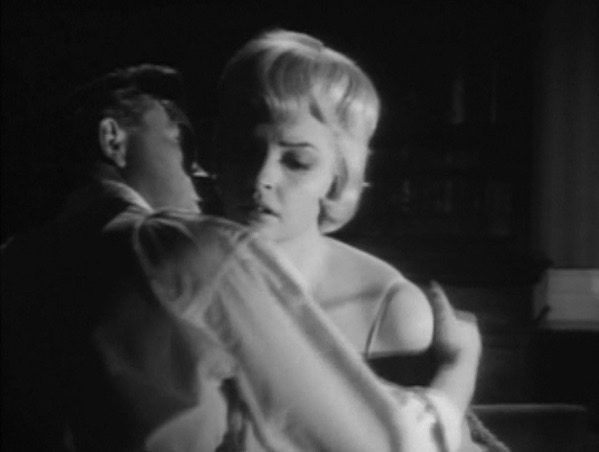
If you’re an ambitious archaeologist totally dependent on keeping in the good books with both your fiancée and her rich uncle then Ila is the sort of young lady you should avoid at all costs. She’s young, blonde, glamorous, very sexy and she’s European. Not the sort of girl you can explain away to a jealous fiancée.

Which could be an immediate problem. At the worst possible moment Margaret arrives on his doorstep. She’s very drunk and very amorous. She insists on staying. She insists on staying the night. That could be awkward since Michael has Ila stashed away in his bedroom. And it’s obvious that Margaret does not intend to spend the night on the couch. She has the bedroom in mind. But it’s Ila who ends up sharing Michael’s bed.

Michael thinks he’s a pretty sophisticated guy. He has no idea what he’s getting into when he steps into Ila’s world. It’s a world of twisted sexuality and he simply had no idea that such things were possible.

The question is whether he can survive Ila’s world. Or find a way back to the familiar comfortable world he knew before he met her.

The acting is pretty decent. Tony Britton went on to have a reasonably successful career as a TV actor and he’s quite good here. He’s very smooth but with a touch of innocence.

Nadja Tiller makes a splendid femme fatale. She’s cool, calculating, sexy and dangerous and she makes Ila believable. She really is superb.

William Bendix is excellent as Reg. Reg is Ila’s friend. Michael is not quite sure exactly what kind of friend Reg is to Ila but he will find out.

This was promoted as a shockingly daring movie and by 1959 standards it really is. There’s plenty of what would at the time have been regarded as illicit sex.It’s obvious that Margaret is accustomed to spending the night at Michael’s flat even though they’re not married yet. In 1959 that would have been considered pretty daring but this movie goes much further. It takes us into a world of sexual perversity. Lots of men have hurt Ila. Not just emotionally but physically. Ila likes it when men hurt her. The more a man hurts her the more she likes it. Not many movies at the time would even have hinted at such things but The Rough and the Smooth is fairly open about it. And there’s more sexual perversity where that came from.

This movie was based on a novel by Robin Maugham (the nephew of W. Somerset Maugham). Robin Maugham was a big deal in the English literary world for decades although he now seems to be forgotten.

Siodmak doesn’t go overboard stylistically but it’s a well-crafted movie with plenty of atmosphere.

I have no doubt that if this movie ever gets a Blu-Ray release it will be marketed as a film noir. I guess it could at a stretch be described as a noir melodrama. It certainly has a classic femme fatale. And a protagonist who finds himself drawn into a world that he just cannot cope with.

The Rough and the Smooth is all about sex and the things that sex makes us do. It tries to deal with sexual subject matter in a grown-up way and it succeeds surprisingly well. It’s an unusual movie and it’s a pretty good movie as well. It’s definitely a much much better movie than its reputation would suggest. Most people seem to think of it as a lesser Siodmak film. It’s different from his earlier better known films but I don’t think that makes it a lesser effort. Highly recommended.

Wednesday, September 21, 2022

The Price of Fear (1956)

The Price of Fear is a 1956 Universal International release which we’re led to believe is going to be a film noir. We shall see.

It’s the story of a chance encounter between a man and a woman, a man and a woman whose paths would never ever be expected to cross.

Dave Barrett (Lex Barker) is the part-owner and operator of a dog track. He’s a tough guy but he’s honest and he runs an honest operation.

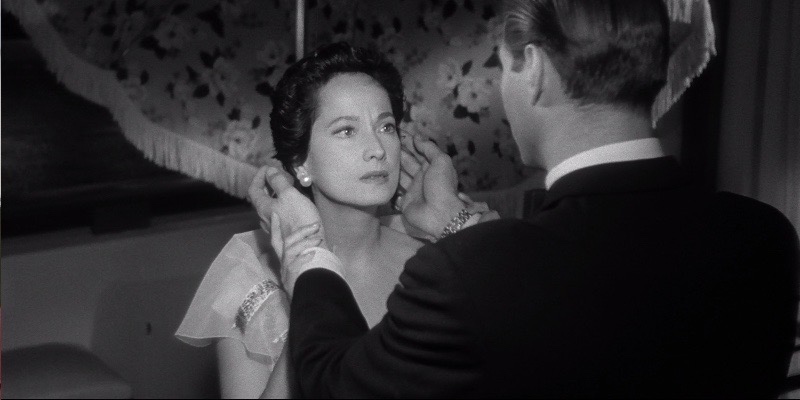
Jesica Warren (Merle Oberon) is a successful investment counsellor. She’s rich, ambitious and totally respectable. She has never been near a dog racing track in her life. She probably has no idea that such things exist.

Two things happen which will bring them into contact. Firstly Dave Barrett discovers, to his horror, that he has a new business partner. His old partner, Lou Belden, has sold out to gangster Frankie Edare (Warren Stevens). Dave threatens to denounce Edare to the Racing Commission. Dave then realises that Edare will now be gunning for him. It might be wise to disappear for a while.

Unfortunately when he leaves the track he is shadowed by two of Edare’s goons. He figures they intend to rub him out. He leaps out of the taxi, sets off on foot, and is pursued on foot by the goons. Then has a stroke of luck. He sees a car sitting by the side of the road, with the keys in the ignition and the motor running. Now he has a chance of escape.

Meanwhile Jessica Warren has been celebrating. She has been celebrating a bit too hard and a bit unwisely and when she gets behind the wheel of her car to drive home she’s as drunk as a lord. She runs over an old man, drives off, and then stops to phone the police. She leaves her car by the side of the road, with the keys in the ignition and the motor running. It’s her car that Dave finds. He jumps in and drives off.

That’s how his nightmare begins. The twist is that he finds himself accused of two entirely separate unrelated crimes and he’s innocent on both counts. But clearing himself of one crime will put him into the frame for the other.

And he and Jessica are now thrown together. Of course an unlikely romance blossoms.

Dave’s buddy Sergeant Pete Carroll (Charles Drake) is convinced that Dave is innocent but he can’t see how he can prove it. The evidence is strong and Pete has to do his job.

It’s a pretty cool plot idea, with one crime providing an alibi for the other. It all seems like a very promising setup for a crime thriller.

It doesn’t quite come off. Abner Biberman was the director and there’s a reason the name Abner Biberman doesn’t come up when people talk about the great Hollywood directors. There’s also a reason why the screenwriter Robert Tallman isn’t included in anyone’s list of great movie writers. The Price of Fear just doesn’t develop the necessary suspense. We should feel like poor Dave Barrett is an animal caught in a trap fighting for survival but we don’t get the necessary sense of urgency or imminent danger. Things get explained too easily.

There’s something really important that Dave should have figured out right at the beginning but he doesn’t and it’s just not plausible that he would fail to do so. If he had figured it out the entire plot would have collapsed so we have to pretend that even though he’s a smart guy he could fail to see something that is blindingly obvious.

There’s zero chemistry between Lex Barker and Merle Oberon. Merle Oberon’s career was winding down by this point and her performance is rather lifeless. There’s also the problem that she doesn’t have the seductiveness and glamour to be a femme fatale (which is basically what Jessica is). A younger more glamorous sexier actress might have been able to persuade us to believe some of the movie’s plot implausibilities.

This movie is included in Kino Lorber’s Film Noir: Dark Side of Cinema 2 Blu-Ray boxed set. The Price of Fear has some very very slight noirish touches, the other two movies are not even remotely film noir. The boxed set is only worth getting for The Female Animal. The other two films are very disappointing.

The Price of Fear is a crime melodrama, not a film noir. It’s a really good idea that is poorly executed. It’s hard to recommend this one.