Thursday, February 20, 2014

Conflict (1945)

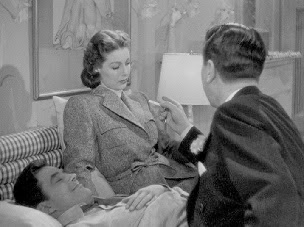
Conflict is a somewhat overlooked movie, which is a bit strange given that it’s a 1945 Warner Brothers film noir starring Humphrey Bogart. The reason it’s overlooked may be that this is not Bogart in tough guy mode. Far from it. This is Bogart in loser mode, but he’s not a glamorous loser. More a sad pathetic loser. Which is probably not what most people want from a Bogart movie, which is probably why this movie bombed at the box office in 1945.

Richard Mason (Bogart) and his wife Kathryn (Rose Hobart) have what most of their friends think is is a perfect marriage. The reality is however far from perfect. They don’t really like each other very much and Kathryn is the sort of woman who just can’t help being critical. Especially when she senses a weakness. And it’s not difficult for her to sense weakness in Richard.

The marriage is certainly less than ideal from Richard’s point of view, and there’s a further complication in the form of Kathryn’s kid sister Evelyn (Alexis Smith). Five years ago, when Richard married Kathryn, he didn’t take much notice of Evelyn. She was just a kid. Now she’s all grown up and Richard is definitely noticing her. In fact he now wishes he was married to Evelyn rather than Kathryn. He’s sure that she feels the same way. Not that she’s ever told him, but he’s still sure she feels that way. As Richard will discover, for a middle-aged man to fall in love with a woman half his age isn’t the cleverest thing to do. But they do say there’s no fool like an old fool.


The problem as Richard sees it is that Kathryn is standing in the way of his happiness. And of Evelyn’s. Kathryn has made it quite clear she will never give him a divorce, and certainly not in order to make such a fool of himself. Richard is convinced however that he and Evelyn were meant to be together. If only there was some way to remove the one obstacle to their happiness.

Their friend Dr Mark Hamilton (Sydney Greenstreet) is a psychiatrist. He’s also a shrewd judge of human nature and he doesn’t miss much. He understands Richard better than Richard understands himself, not that that’s a difficult feat since Richard doesn’t understand himself very well at all. And Richard’s understanding of other people is even more flawed.


This situation is of course going to end in tears. In fact it’s going to end in murder. But Richard will find that things don’t seem to have happened at all the way he thought they had and he is soon one very confused man, a confused man who is unravelling rather rapidly.

Arthur T. Horman and Dwight Taylor wrote the screenplay, based on a story by Robert Siodmak and Alfred Neumann. The plot is extremely contrived but it’s contrived in a clever and entertaining way, as long as you are prepared to accept that things happen in movies in ways that are rather improbably complicated compared to the way things happen in real life. That’s why movies are more fun than real life.

German-born director Curtis Bernhardt made some interesting movies around this time. He wasn’t able to make an implausible story seen plausible but he was able to at least make the movie look good. And it looks very good. There are plenty of the visual touches film noir fans enjoy so much. The crucial scene on the mountain road is particularly good, being both suitably sinister and mysterious, and nicely doom-laden. And since the movie involves psychiatry he throws in some of the psychiatry special effects that so delight fans of 1940s psychiatry movies like myself.


Alexis Smith is wasted in a role that doesn’t really go anywhere. She really gets to do very little other than acting as the catalyst that sets the plot in motion. Sydney Greenstreet makes a fine psychiatrist.

Bogart’s character is the one that really matters and he gives a sensitive and complex performance as a man controlled by his own delusions with a grip on reality that becomes steadily more tenuous. He very wisely underplays the part, avoiding the usual tricks that most actors resort to when playing the role of a man self-destructing. Richard does self-destruct, but Bogart keeps it subtle which makes it all the affecting. There’s nothing twitchy
or mannered in his performance. This also allows him to make a sad and unattractive character oddly sympathetic. Bogart wasn’t happy with the film but he gives one of his most effective performances.


The Warner Archive made-on-demand DVD includes no extras but it does offer an extremely good transfer.

Conflict is not a great movie and is perhaps not a complete success, but it’s stylish and enjoyable and Bogart’s performance alone is sufficient reason to see it. Content-wise it’s more crime melodrama than film noir but it has the style to please noir fans. Recommended.

Saturday, February 15, 2014

Sea Devils (1953)

Sea Devils is a swashbuckling Technicolor adventure romp with Rock Hudson as a smuggler and Yvonne de Carlo as a glamorous spy.

It’s supposed to be set in 1800, although characters keep referring to Napoleon as the Emperor (he did not assume that title until 1805). The internal evidence of the movie suggests that the setting is in fact around 1805.

The wars between England and France have made it difficult for the fishermen of the island of Guernsey (in the Channel Islands) to earn their normal livelihood, but every cloud has a silver lining and they have discovered that smuggling is easier, plays better and is more fun. The most notorious and most skillful of the Guernsey smugglers is Gilliat (Rock Hudson), captain of the Sea Devil. The Sea Devil is a small fast two-masted ship that the Customs men have tried to catch on many occasions, without success.


Gilliatt’s arch rival is Rantaine (Maxwell Reed), another smuggler although a very untrustworthy one even by smuggler standards. Rantaine lands a lucrative job, transporting a woman to France. Before he can make his departure he has an unfortunate encounter with Gilliatt in the local pub and as a result it’s Gilliatt who ends up with the job. The woman, Droucette (Yvonne de Carlo), spins a sob story about trying to rescue her brother, the only other surviving member of her family, her parents having been guillotined during the Terror.

Gilliat soon discovers that Droucette is a spy, but he thinks she is a French spy when in fact she is an English spy. This misunderstanding will cause Droucette a great deal of trouble and danger. Had she told Gilliatt the truth in the first place this could all have been avoided, but in that case we wouldn’t have had a movie.


Droucette’s mission is to discover the details of the French plan for the invasion of England. She intends to get these details from the man most likely to know them, Napoleon himself. She is posing as a French countess who is a real French spy, currently under lock and key in the Tower of London.

She has to work quickly. It is only a matter of time before the cunning French counter-espionage chief, Fouche (Jacques B. Brunius) discovers her real identity.

Gilliatt very nearly manages to sabotage Droucette’s mission, acting under the impression that he is trying to foil the dastardly plans of a French secret agent. He will get his chance to redeem himself however, being the one man capable of carrying out a daring plan to rescue Droucette and thus save England.


I don’t think anyone involved in this movie was taking it too seriously. It’s essentially a light-hearted adventure romp combined with romance, and on its own terms it works quite satisfactorily. Hudson gets to be brave and dashing and take off his shirt a lot and de Carlo gets to be brave and resourceful and beautiful. The movie makes no great demands on the acting abilities of either lead. Their most important tasks are to look good and to avoid being dull and they both achieve these ends without too much trouble. OK, maybe Errol Flynn and Tyrone Power and Stewart Granger were better at doing this sort of thing but Hudson gives it his best shot and he does fairly well. Gilliatt may not be the sharpest knife in the drawer but he’s well-meaning and he’s impossible to dislike, and most crucially Hudson makes sure we’re never tempted to despise Gilliatt even when he gets things hopelessly muddled.

The movie’s biggest asset is its director, Raoul Walsh. Walsh knew how to do action movies and Sea Devils is in very capable hands.


This movie was made by Coronado Productions and released by RKO. It seems to have been fairly modestly budgeted by the standards of 1950s swashbucklers. There are no large-scale action set-pieces but while the action is mostly on a small scale it’s adroitly executed.

Optimum’s Region 2 release is barebones but it’s a decent transfer and it’s absurdly cheap.

Sea Devils is just good old-fashioned fun. It’s not a great movie by any means and it’s not one of the best of the swashbucklers but it’s decent enough entertainment.

Tuesday, February 11, 2014

Loophole (1954)

When Monogram Pictures rebranded themselves as Allied Artists and starting making slightly up-market B-pictures (which they described as B-plus pictures) they produced some quite decent crime movies, including Loophole in 1954.

Loophole lacks a film noir visual style but it does have a story arc with some elements of noir to it although basically it’s a Hitchcock-style “wrong man” movie. Mike Donovan (Barry Sullivan) is chief teller at a bank in Hollywood. He has a nice house and a lovely wife and his life is pretty good. Pretty good, up until the Friday when the bank inspectors arrive.


What Donovan doesn’t know, and what nobody in the Capital National Bank has noticed, is that there are eleven bank inspectors when there are only supposed to be ten. One of them isn’t a bank inspector at all. He’s a bank robber with a very clever plan. He figures that as long as he behaves in the expected way no-one will notice his presence. And no-one will notice when he stuffs $50,000 into his briefcase and then calmly walks out with the other bank inspectors.

The unlucky teller from whose cash drawer he has lifted the 50 grand is Mike Donovan. At the end of the day when he realises he is $50,000 short he panics. He doesn’t tell anybody about the missing money until Monday morning. Naturally Donovan finds himself the obvious suspect. The police investigation uncovers no evidence of his guilt and he isn’t charged but of course his career at the bank is over.


The police actually believe Donovan’s story, that one of the bank inspectors checked his cash a second time, an unheard of procedure. They believe his story that the bank inspector who checked his money the second time must have been a phony and must have been the man who actually stole the money.

But Gus Slavin (Charles McGraw) doesn’t believe Donovan’s story. Slavin is an ex-cop now working as an investigator for the bonding company that is going to have to reimburse the money to the bank. Slavin starts a one-man crusade to prove that Mike Donovan really is the thief. Slavin’s idea is that Donovan is sitting tight, not touching the money until the heat is off. He thinks that if he can get Donovan fired from every job he gets he will eventually lead Slavin to the money.

Donovan meanwhile is working to clear his name by catching the real bank robber. He gets some assistance from the police, but neither Donovan nor the cops can find any leads. And meanwhile Gus Slavin’s campaign of persecution continues.


Donovan’s wife Ruthie (Dorothy Malone) stands by him but things are getting pretty tough for the Donovans. And then finally Donovan stumbles upon what might prove to be the vital lead.

This is a movie that is light on action, relying mostly on suspense as Donovan keeps getting close to finding the real robber but without realising how close he is.

The movie has to rely a good deal on the actors and fortunately they’re very solid. Mike Donovan is a man pushed close to desperation but who refuses to give in and Barry Sullivan’s performance is nicely judged - not too overtly emotional but we’re aware of his frustration and his anguish. Charles McGraw is excellent as the dogged Gus Slavin. His methods are ruthless to an extreme and there are times when the audience is going to hate him but he’s not really a bad guy. He just happens to be absolutely convinced that Donovan is guilty. He’s not evil but he is dangerously obsessive and unwilling to admit the possibility he might be mistaken. McGraw really steals the picture. If there’s a character in this movie who represents the hero with a fatal weakness it’s Gus Slavin rather than Mike Donovan.


Dorothy Malone is very good as the loyal wife who knows that she has to keep herself from breaking because she’s all Mike has. Mary Beth Hughes is excellent as Vera, a blonde from Hell who fulfills the femme fatale role superbly (as this underrated actress did in several other similar roles).

Harold D. Schuster’s career as a director wasn’t particularly distinguished but he does a fine workmanlike job, maintaining the tension and keeping the pacing taut. Warren Douglas’s screenplay skillfully keeps teasing the viewer as Donovan keeps just missing out on finding the man he needs to find.

The Warner Archive made-on-demand DVD is absolutely barebones but it’s a good transfer.

Loophole is fundamentally a movie about human weakness. The entire plot is driven by a series of mistakes that characters make, mistakes that reflect everyday human flaws rather than evil. There’s no truly evil character in the movie, except perhaps Vera although even she is driven by greed, a common enough failing. Mostly the characters are just real people with real weaknesses. This psychological subtlety lifts this movie above the general run of B noirs. A well-crafted and effective movie. Highly recommended.

Friday, February 7, 2014

The Doctor Takes a Wife (1940)

The Doctor Takes a Wife is a 1940 Columbia screwball comedy included in the Icons of Screwball Comedy, Volume 2 boxed set. It pairs Ray Milland and Loretta Young, and rather successfully too.

The first thing you need for a successful screwball comedy is a plot that will set up the necessary misunderstandings and confusions. This one does that quite successfully. June Cameron (Loretta Young) has just written a best-selling book on the joys of spinsterhood. At a hotel she runs into Dr Timothy Sterling (Ray Milland) and persuades him to give her a lift to New York. They don’t exactly hit it off at all but she needs the lift. When they stop briefly for her to send a telegraph they encounter a wedding party. By mistake the Just Married sign gets attached to the back of Dr Sterling’s car. This is spotted by an eagle-eyed reporter who is delighted to have stumbled upon such a scoop - here is the woman who has just written a book telling women they don’t need men or marriage and apparently she has just gone and got married!

This misunderstanding might have been cleared up quickly except for the unfortunate fact that Dr Sterling, after dropping June off at her apartment, gets drunk and passes out in her bed. And this is spotted by another eagle-eyed reporter who has turned up to interview her about her marriage. Now if she explains that she isn’t really married she has to explain the presence of a half-dressed man in her bedroom.

Her publisher is initially aghast. If the public learns that June is married her book isn’t going to sell any further copies and he will be ruined, and June’s career will be ruined. If she denies it there’s the problem of the aforementioned half-dressed man in her bedroom. Then he gets a brainwave. There are more married women than unmarried women in America, so if the author of the book that extolled the joys of spinsterhood now writes a book extolling the joys of marriage it will be an even bigger bestseller.


All they have to do is to persuade Dr Sterling to go along with their newly-hatched plan to pretend that he and June really are married. Once the book has made a mint they can get a quickie divorce in Reno. Persuading Dr Sterling to co-operate will be the awkward part. But not as awkward as they expected. The good doctor, currently a poorly paid lecturer in neuro-psychiatry, is desperate for a professorship. And when the dean, who believes all professors of psychiatry should be married, hears of the marriage Timothy Sterling gets his professorship. So now he has a motive to go along with the pretend marriage as well.

Of course in a screwball comedy you just know that such an intricate plan will go spectacularly wrong. The problem is that Timothy wanted the professorship so he would have enough money to marry his sweetheart Marilyn (Gail Patrick). Trying to keep Marilyn persuaded that his marriage is not a real one while trying to keep the dean and his colleagues at the university convinced that he really is living in connubial bliss is enough to set off the necessary chain of craziness on which screwball comedy depends.


The second requirement for a successful screwball comedy is a screenplay that turns the potentially comedic situations into situations that are genuinely funny. George Seaton and Ken Englund’s screenplay fulfills that requirement very neatly. Having a director who can keep the pacing as tight as possible is obviously essential as well and Alexander Hall does that with ease.

The third necessary ingredient for screwball comedy success is two leads who can exploit all these other advantages and who have the right chemistry. Ray Milland and Loretta Young fulfill both these requirements with considerable aplomb. A screwball comedy needs two leads who start off hating and infuriating each other and they manage that extremely well.


With all these ingredients perfectly combined the result is a delightful example of the genre. To add some further spice there’s a definite Battle of the Sexes angle as well, and there’s the further complication that June’s publisher Johnny (Reginald Gardner) wants to marry her. This creates more opportunities for confusion, and more fun.

Ray Milland and Loretta Young are both in fine form and the supporting players are more than competent. A romantic comedy needs to convince us that even though the two leads are both convinced that they want to marry other people they really belong together. This means that the characters they think they want to marry can’t be too sympathetic - the audience has to want the leads to end up together. Reginald Gardner and Gail Patrick do their bit in that respect - we can’t possibly imagine June will really marry the selfish and self-centred Johnny or that Timothy could seriously want to go ahead with marriage to the rather appalling Marilyn. Gardner and Patrick make sure we won’t be on the side of their characters will still making them delightfully funny.


The Doctor Takes a Wife breezes along to its entirely satisfying conclusion and a great deal of fun is had along the way. It’s a thoroughly enjoyable example of a well-made and well-acted screwball comedy and it all works to perfection.

The DVD transfer is exceptionally good.

The Doctor Takes a Wife is highly recommended.

Monday, February 3, 2014

Pushover (1954)

Pushover is a rather unfairly neglected 1954 Columbia film noir. Perhaps the poster art and the casting of Fred MacMurray has led some to assume this is going to be merely a Double Indemnity imitation but in fact it’s quite capable of standing on its own merits.

MacMurray is Paul Sheridan, a cop who has to make up to glamorous blonde Lona McLane (Kim Novak). It’s all in the line of duty. Lona’s boyfriend Wheeler has just pulled a big bank job and netted himself $210,000. The only lead the police have is that Wheeler has been keeping Lona in high style, paying for her fancy apartment and for all sorts of expensive items like a sporty little coupé and a mink coat. The police figure that if Wheeler is that far gone on her he’s bound to make contact with her. Sheridan’s job is to romance her to try to find out whatever he can, especially if she knows anything about Wheeler’s partner or about where the money is likely to be.

This is pretty routine stuff for a detective, except that Paul and Lona hit it off pretty well. A bit too well in fact. When Lona starts talking about what she and Paul could do with $210,000 he starts to listen. Lona doesn’t care about Wheeler. She never did. All she ever wanted was his money. It’s not that Lona is particularly evil. She’s just terribly afraid of poverty. She wants security. Wheeler had money but he was a crook an how much security does a girl really have with a crook? Paul Sheridan on the other hand is a decent stable sort of guy. With him and the $210,000 she’d have real security. And she’d have a guy she actually likes.

That’s the twist with this movie. Paul is the noir hero tempted by the chance of easy money and a glamorous blonde. Lona is the femme fatale who puts that temptation is his way. But  Paul is not Walter Neff and Lona is not Phyllis Dietrichsen. Paul and Lona are reasonably sympathetic characters. They’re not corrupt to the core right from the start the way Walter Neff and Phyllis Dietrichsen were. They really are in love. They just can’t see that easy money usually turns out not to be easy money after all.

Their plan to get the money seems very simple. Almost fool-proof. Paul is the detective in charge of the stake-out on Lona’s apartment. As long as they time things right nothing can go wrong. But Paul and Lona have fallen into the noir world, and in that world something always goes wrong.

Roy Huggins’ screenplay is beautifully constructed and full of nasty little surprises for Paul and Lona. It also has plenty of classic noir hardboiled dialogue. Director Richard Quine only made a couple of noir movies but he handles this movie very adroitly. He doesn’t try to be too clever but he always keeps things visually interesting. Cinematographer Lester White provides an abundance of classic noir visual iconography. In this movie it always seems to be night and it always seems to be raining.

MacMurray was extremely good at playing morally corrupt characters but his performance in this one is quite different from his Walter Neff in Double Indemnity. Paul Sheridan is corrupted but he’s a decent straightforward guy and being corrupt doesn’t come naturally to him. He just loses control of his life and once he’s taken the first step there’s no going back. It’s another illustration of MacMurray’s extreme versatility as an actor and his ability to play complex and subtle bad guys.

This was Kim Novak’s first major role and she’s terrific. Lona is certainly a femme fatale but she’s motivated by a desperate need for security rather than being a conventional noir spider woman. She’s glamorous and sensual and she’s most certainly a very convincing temptress but she’s a character who would really rather be a good girl than a bad girl. Novak’s performance is thoroughly assured and totally believable.

Being a major studio film Pushover has A-picture production values and a strong supporting cast.

Pushover is included in the Columbia Film Noir Classics II DVD boxed set. Sadly there are no extras but the transfer is excellent. There’s just a little grain but it actually adds to the atmosphere. On the whole picture quality is more than acceptable.

Pushover ticks all the film noir boxes without being merely a formulaic rehash of standard noir tropes. The standard noir tropes are there but they’re handled so well that they seem fresh. An extremely well-crafted film noir with great performances by the two leads - it all adds up to a movie than can be very highly recommended.

Wednesday, January 29, 2014

The Wicked Lady (1945)

Wicked Lady1

England’s Gainsborough Studios enjoyed enormous success in the 1940s with a series of daring melodramas, mostly featuring Margaret Lockwood, the most famous (and the most shameless) being The Wicked Lady in 1945.

Anyone who thinks of 1940s British cinema as being a trifle on the staid side clearly has not seen The Wicked Lady. By the standards of its era it’s totally outrageous. It’s not just melodrama taken to the extreme, it’s extraordinarily sexy. It is very unlikely that any Hollywood movie could have gotten away with the salacious sexual subject matter and the risque dialogue of this movie. How it got past the usually severe British censors remains a mystery.

It is England in the 1680s and Caroline (Patricia Roc) is about to marry Sir Ralph Skelton (Griffith Jones), the most eligible (and most wealthy) young bachelor in the county. They’re not exactly madly in love but it’s a very suitable match for both of them and while passion may be somewhat lacking between them they are very fond of one another. They get along very well. All in all they expect to be quite happy. And then Caroline’s cousin Barbara (Margaret Lockwood) comes to stay.

WickedLady1

Caroline is a practical sort of girl and she’s kind and sensitive, and she’s also very attractive. Barbara is very different. Barbara is the sort of girl men lose their heads over. She’s the sort of girl men kill for, and shoot themselves over. She is wildly impractical and immensely exciting. She’s the kind of woman your mother warned you about.

Barbara is accustomed to getting what she wants. Often her beauty and her rather obvious sexuality are enough to get her what she wants, but if they aren’t enough she’s quite willing to lie, cheat and scheme. In fact, as we will see, she’s quite willing to do a great deal more than that. What Barbara wants is usually something than another woman has. Like a man. In this case she decides she wants Sir Ralph Skelton. This proves to be as easy as taking candy from a baby. When her uncle asks her if she loves Ralph she replies,  “How could you not love a man as rich as that?”

WickedLady2

Barbara marries Ralph but county life proves to be rather a bore. Barbara pines for the excitement of London. She soon finds, to her surprise, that it is actually possible to find excitement in the country. An imaginative woman can find things to do. Like taking up highway robbery. Barbara becomes a highwayman (or highwaywoman if you prefer). This is a dangerous profession but it provides the thrills she craves. Given that we have been told that she and Ralph now sleep in separate beds it’s pretty obvious that there’s a considerable sexual element in her thrill-seeking. It’s a good substitute for sex but pretty soon she finds she can have sex as well, when in the course of one of her robberies she encounters the notorious highwayman Captain Jerry Jackson (James Mason).

Barbara and Jackson are soon partners. They’re a good team, both on the road and in bed.

Some major complications soon arise, complications that throw the lives of all the characters into turmoil. Barbara discovers a new man, a handsome young architect named Kit Locksby (Michael Rennie). Kit can’t decide if he loves Barbara or Caroline. Ralph decides that he loves Caroline. And when Barbara is unable to get away from the house (using the secret passageway conveniently provided by the builders of the Skelton country house) for a few days Captain Jackson finds a new bed partner. Whether Barbara loves the dashing outlaw or not is immaterial - she will not tolerate another woman taking a man who belongs to her. It’s all going to get very messy. Dangerously messy. Maybe even fatally messy for some.

WickedLady3

Leslie Arliss’s screenplay might not be very subtle but it’s deliciously overripe and deliriously melodramatic. Arliss also directed, with considerable panache. He was obviously a film-maker who took to melodrama like a duck to water. The dialogue is sparkling and witty and packed with sexual innuendos. Even the virtuous characters in this movie don’t see adultery as much of a big deal.

In the opinions of most British film critics of the time the Gainsborough melodramas were pure trash. And The Wicked Lady absolutely glories in its own trashiness. This trash, but it’s trash with style and energy to burn.

It’s also a very handsome movie. Gainsborough obviously were aiming to give their melodramas the kind of gloss that Hollywood movies of that era had, and they succeeded admirably. This is a lavish movie with gorgeous sets and wonderfully over-the-top 17th century costumes, all beautifully photographed in black-and-white by veteran cinematographer Jack E. Cox. There are a few dodgy rear projection shots but aside from that it’s a great looking movie. The action scenes are pretty effective and there are plenty of thrills and a great deal of gun play. Everyone seems to have a pistol and no qualms about expending powder and shot.

WickedLady4

Margaret Lockwood plays the femme fatale to the hilt. She radiates sex and wickedness and exciting recklessness. James Mason provides the perfect foil to Lockwood, matching her recklessness with his own devil-may-care fatalism. Jackson is a man who expects to end his life on the gallows but he intends to enjoy every moment until then. Patricia Roc has the thankless role of the good girl up against one of the screen’s most memorable bad girls but she succeeds in making Caroline reasonably interesting. Michael Rennie is quite good. Felix Aylmer, one of my very favourite British character actors, gets to overact wonderfully as the pious old family retainer who is unlucky enough to discover Barbara’s secret life. Enid Stamp-Taylor adds some fun as the cynical and amusingly bitchy Lady Henrietta Kinsclere.

While this is not a movie with any pretensions to historically accuracy it does capture the cheerfully immoral atmosphere of Restoration England rather well.

The Region 2 DVD from ITV DVD is ridiculously cheap, is a bit light on extras but offers an excellent transfer. It’s superb value for money.

This is gloriously excessive melodrama, an unashamed bodice-ripper with lots of shooting as well. The Wicked Lady is non-stop fun and is very highly recommended.

Sunday, January 26, 2014

my new cult television blog

I’ve started a new cult TV blog.

It will be devoted to cult TV series from the 1950s up to the end of the 1970s (with very occasional forays into the early 80s) with most of the emphasis on the 60s and 70s.

Most of the series I’ll be blogging about will be from the science fiction, espionage and action/adventure genres although other genres will be included from time to time.

It will cover pretty much the same ground as my old LiveJournal cult TV community (which still survives).