Showing posts with label marlene dietrich. Show all posts

Tuesday, August 22, 2023

Rancho Notorious (1952)

The period from the late 1940s to the early 1960s was the golden age of the Hollywood western, an age of westerns that were more than just horse operas. Intelligent, emotionally and morally complex grown-up westerns. But parallel to this was the flowering of a much smaller crop of slightly offbeat westerns - overheated western melodramas and westerns that were defiantly unconventional. It started with Duel in the Sun and continued with movies like The Furies, Johnny Guitar and Forty Guns. Another western that seems to belong in this oddball category is Fritz Lang’s Rancho Notorious (1952).

Rancho Notorious gives us the initial impression that it’s going to a straightforward revenge western. Ranch hand Vern Haskell (Arthur Kennedy) is looking forward to marrying his sweetheart in eight days’ time but while he’s out riding the range outlaws arrive in town and rob the assayers’ office where Vern’s fiancée works. She is killed, but before she is killed she is raped (something that is made surprisingly explicit for 1952 Hollywood).

A posse is formed but they are forced to give up the chase. Vern however is determined on revenge even if he has to go it alone. He has one clue, picked up from a dying outlaw. The word chuck-a-luck. Vern knows that this is the name of a popular gambling game but he knows that the outlaw used the term in a more specialised sense. It has to refer to a place, maybe a saloon somewhere, or maybe it refers in some way to a person. He can unravel that clue he’ll find the man who killed his bride-to-be.

He finds some other possible clues. If he can find a woman named Altar Keane and an outlaw named Frenchy Fairmont he may find the answers he seeks. We get a series of flashbacks through the eyes of several different people all of whom have vivid memories of the outrageous Altar Keane.

He finds Frenchy Fairmont (Mel Ferrer) and helps him break out of gaol and he finds Chuck-a-Luck. It’s an isolated ranch, and it’s run by Altar Keane (Marlene Dietrich).

Chuck-a-Luck isn’t so much a ranch as a haven for outlaws. It’s a place they can hide out when they need to. Altar gets a cut of the proceeds of their robberies. There are nearly a dozen outlaws holed up there when Vern arrives. He thinks one of them is his fiancée’s killer but he doesn’t know which one. If he stays long enough he might figure it out.

Complications arise due to a mutual attraction between Vern and Altar. Altar is Frenchy’s girl. Frenchy likes Vern but he has no intention of allowing anyone to take Altar away from him.

The revenge theme and the lust theme (the romantic triangle between Vern, Frenchy and Altar) never lets up in this movie.

Due to budgetary constraints this movie was shot entirely in the studio apart from a few scenes on the backlot. There’s none of the location shooting that was beginning to be seen as absolutely essential in the western genre. This not only makes the film claustrophobic it also makes it seem very artificial. As someone who despises the cult of realism that’s one of the things I love about this movie.

Lang conceived this movie right from the start entirely as a vehicle for Marlene Dietrich.It didn’t work out the way he’d hoped. By the time the movie was finished they weren’t speaking to each other. But Dietrich still dominates the movie and her charisma makes her performance work.

This is a very unusual western. There’s no straightforward hero and no straightforward heroine. Vern seems initially to be set up as a conventional outlaw but he turns outlaw and he isn’t just pretending in order to catch that killer. He happily participates in robberies. His response to the murder of his girl is to reject all the social norms in which he once believed.

Frenchy is an unrepentant outlaw. Altar is a crook as well.

In spite of this all three are thoroughly sympathetic characters and the movie encourages us to take their side. The message seems to be that being an outlaw is a perfectly respectable lifestyle option. Thieves can be really nice people. And here we have a hero who starts out good and comes to realise he can never return to his old life. But being an outlaw isn’t so bad. And there’s no suggestion that we should condemn him for this.

I have no idea how this got past the Production Code Authority. I can only assume that somehow they simply didn’t notice that a movie that is unapologetically on the side of law-breakers was being slipped past them. And in this movie law-breakers don’t necessarily pay for their crimes. Some do, some don’t.

The plot is pretty straightforward but the plot doesn’t matter too much and the movie ends up being a strange very stylised western that makes no concessions to realism. In its own way it’s as bizarre and unusual as Forty Guns (which is pretty much the gold standard for bizarre westerns).

Rancho Notorious wasn’t liked by critics at the time and it’s still generally dismissed as one of Lang’s weakest films but it’s actually a totally fascinating mesmerising movie and I loved it. Highly recommended.

Tuesday, June 28, 2022

Blonde Venus (1932)

Blonde Venus was the fourth of the six movies Josef von Sternberg made for Paramount starring Marlene Dietrich (and the fifth movie they’d made together). It's not a movie that von Strenberg was all that fond of.

Jules Furthman and S. K. Lauren wrote the screenplay but the starting point was a story by Marlene Dietrich.

And just as a reminder that this really is a pre-code movie we start with a nude scene. With not one naked woman, but six. It’s somewhere in Germany and they’re actresses and they’re skinny-dipping when a party of young (male) American tourists happens upon them. One of the nude frauleins is Helen (Marlene Dietrich). It’s a fairly coy nude scene but the girls are quite clearly naked. There’s quite a bit more pre-code naughtiness to come.

The scene immediately shifts to America a few years later. Helen is now married to one of those American tourists. He is Ned Faraday, he is a scientist and he is dying. He has been exposed to too much radium in the course of his work. There is one chance for him. A brilliant doctor in Germany, Professor Holzapfel, may be able to cure him.

The cure will be expensive. Ned can no longer work full-time and they have a small son. Money is tight.

The treatment will cost $1,500. Ned doesn’t need the full amount all at once but he needs $300 upfront. Now $300 is a trivial sum today but in 1932 it was a vast sum of money. Helen persuades Ned that she will have to go back to the stage.

Under the name the Blonde Venus she is an immediate success (and when we see that Hot Voodoo number we can see why she would be a hit).

She attracts the attention of up-and-coming tycoon Nick Townsend (Cary Grant).

After a couple of weeks she is able to give Ned the three hundred dollars. Had Ned been less of an innocent he might have wondered how on earth a woman could earn so much money so quickly. But the thought never enters his head. He packs his bags and sets off to Germany for his medical treatment which is expected to take six months.

Nick instals Helen in a swanky apartment as his mistress. Helen is able to send Ned the rest of the money he needs.

There’s nothing very startling in any of this. In the pre-code era when movies were made for grown-ups most people would figure that while Helen is certainly being unfaithful she’s doing it for the best of motives, to save her husband’s life.

But there’s a complication. Nick is no Boy Scout but he’s no sleazebag. He’s pretty nice. He treats Helen (and her son) extremely well. He’s awfully good-looking and very charming. Helen is only human. In such a situation it isn’t very surprising that a woman would fall in love with a man like Nick. And he’s genuinely crazy about her.

Things are going to be awkward when Ned gets back to America.

After 1934 the Hollywood Production Code would not even have allowed this movie to be made, or if it were made then obviously it would have to be made clear that Helen is a very wicked woman who must be punished for her sin. Under the Production Code the standard punishment for a woman who commits adultery was the death penalty. Only by dying could she be grudgingly forgiven. But this was 1932, and in Blonde Venus it’s made clear that Nick and Helen are just human beings who cannot help the fact that they’ve fallen in love.

The movie dares to do something that would become totally impossible after 1934 - sympathetically treating an adulterous woman who at no point in the story apologises for anything she’s done and who does not believe that she has to destroy herself to wipe out her sins. Of course she really has no reason to apologise - she was unfaithful in order to save her husband’s life. But she does not try to manipulate Ned into forgiving her for this reason. She accepts what she has done and if he won’t forgive her then she’s not going to beg. Equally daring is the unsympathetic portrayal of the wronged husband.

Dietrich called her original story Mother Love and that’s to a large extent what the movie is about. She will make significant sacrifices for her husband, but she is prepared to make any sacrifice for her child.

The ending is a bit contrived but the nice thing is that Helen still does not beg for forgiveness. She still will not apologise for anything she’s done. Whether Ned will in fact forgive her is something she leaves up to him (and I’m not going to spoil the film by telling you whether he does forgive her or whether the film ends happily or unhappily).

It’s pure melodrama, but that’s OK, I have no problems with melodrama. The movie certainly shows conventional morality in a poor light but it would be a mistake to see this as a political film or a feminist film. It’s simply a movie about people who do things that real people do, rather than what moralisers would like them to do. Helen does things that she considers necessary, not out of a desire to rebel against a restrictive moral code but simply because those things appear to her to be necessary. No judgment is made on Nick. He merely had an affair that turned out to be more serious than he expected. He also offers no apologies for any of his actions. To the extent that that you find any message in this movie (and von Sternberg had no interest in making movies with messages) it’s just that life gets complicated and grown-ups have to deal with that.

It’s not a movie that rejects morality, it merely points out the limitations of rigid conventional morality. Helen always put the welfare of her son first, and would have been content to go back to being a good wife if Ned had been capable of understanding why she did what she did and wasn’t so blinded by self-pity.

The plot has its problems but on the plus side is its sophisticated approach to sex and relationships. Helen uses sex as a tool when she feels she has no viable alternative because what else can she do?

The show-stopping moment in the film is of course Dietrich’s famous Hot Voodoo musical number, a deliriously overheated and outrageous extended mix of jazz and sex. You get to see Marlene in a gorilla suit which is not something you see every day. When she removes the gorilla suit things heat up. Today the fun police would ban this number for a whole grab-bag of reasons but in the more enlightened atmosphere of 1932 people were able simply to enjoy it.

Dietrich is in top form. Cary Grant is starting to show glimpses of his star quality. Herbert Marshall has a thankless job, playing a character who really is contemptible.

There is plenty of von Sternberg style here but it’s not as all-pervasive as it is in movies like The Scarlet Empress or The Devil is a Woman. Blonde Venus is a top-quality pre-code melodrama. Highly recommended.

Wednesday, August 25, 2021

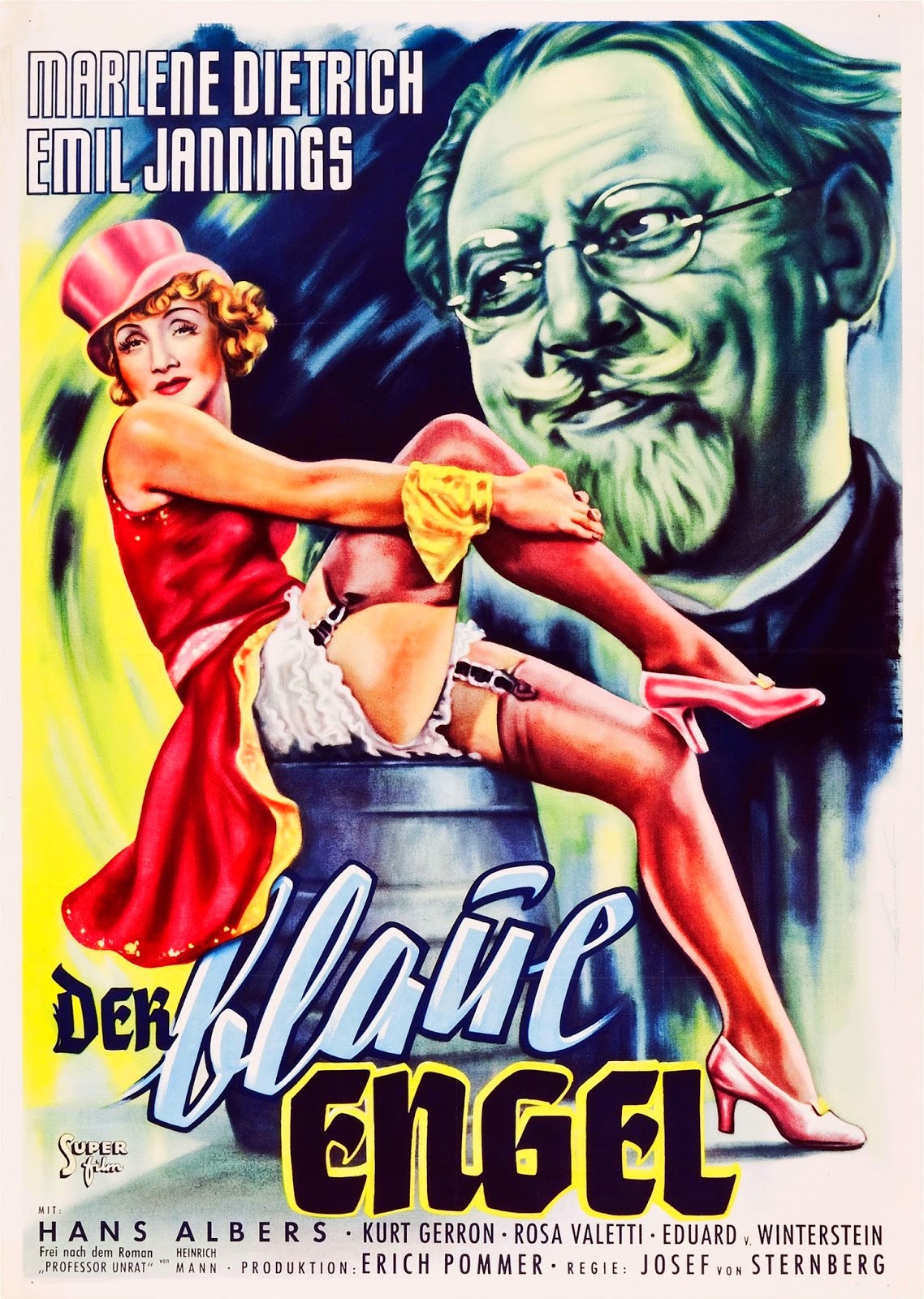
The Blue Angel (1930)

The Blue Angel was the first of the Josef von Sternberg-Marlene Dietrich films but it stands apart from the others. It was made in Germany at Ufa Studios (with both German and English language versions being shot in Germany) and it was on the strength of its success that von Sternberg and Dietrich ended up at Paramount.

Professor Immanuel Rath (Emil Jannings) teaches at the local gymnasium (the German equivalent of a high school). He is a pompous and faintly ridiculous figure but he has an orderly respectable life which suits him. He is alarmed to discover that his pupils have been sneaking into the notorious Blue Angel night-club, to watch the rather lascivious performances of the famous Lola Lola (Dietrich). The Professor sets off for the Blue Angel to put a stop to this, and there he encounters Lola Lola herself. She flirts with him outrageously, having decided that he’s rather sweet.

Rath becomes obsessed by Lola Lola, with ultimately disastrous consequences.

Emil Jannings was a huge star in Germany at the time and the movie was intended as a star vehicle for him. Marlene Dietrich had been making films for several years but was still unknown even in Germany. The Blue Angel would change all that. After this film she was a certified international star and Paramount was soon waving cheque books in front of her.

Jannings was a fine actor but was still fairly locked into the silent era style of acting. That doesn’t really matter since this is a Josef von Sternberg movie and Jannings’ performance simply gives it more of the stylised feel that was von Sternberg’s trademark. Dietrich was clearly much more comfortable with the sound film medium, and that’s an advantage as well. Her more relaxed, ironic performance offers the right contrast.

There are elements of melodrama here but to a large extent the story plays out as farce, and it actually is very funny at times.

The conventional way to approach The Blue Angel is to see Lola Lola as a femme fatale who lures poor Professor Rath to his doom. That conventional view can be defended but what makes it such an interesting film is that all the evidence in favour of the conventional view is open to quite different interpretations.

When you watch the film carefully however that conventional view doesn’t quite stand up. When they first meet Lola Lola does have some fun at his expense but it seems to be good-natured flirtatious fun. When she goes up the spiral staircase in her dressing room, undresses and then tosses her panties down at him you could see that as the first stage in her plan to degrade him. In fact it’s much more likely that in her world this is a perfectly normal thing to do - she is used to dealing with men who take such things in their stride because that’s how her world works. She can’t be expected to understand that poor Rath has probably never seen a pair of ladies’ panties before, much less had a pair dropped on him. She’s simply being herself.

When she tells him that she thinks he’s sweet, I think we can take that at face value. She flirts with him, but she’s not teasing him in a cruel way. She not only sleeps with him but gives the impression that she enjoyed it. She doesn’t mock him. She behaves the way you’d expect a woman to behave if she’s just spent the night with a man she’s fond of. She’s playful and affectionate. She really does feel a weird (even possibly perverse) attraction to him, but the attraction seems to be there.

When he proposes to her she bursts out laughing but then she realises that he actually means it and she accepts. I think it’s important to note that she in no way manipulates him into marriage and she has nothing to gain from the marriage. She’s not trying to gain respectability - she is from first to last indifferent to respectability. She doesn’t marry him for his money because he doesn’t have any.

The wedding night scene gives the impression that she not only intends to have normal marital sexual relations with him but that she’s looking forward to it. There is not the slightest suggestion that she feels any distaste for the idea of sleeping with him.

The notorious scene in which he puts her stockings on for her can be read as a sign of the degradation to which his obsession has reduced him, but Lola Lola does not really mock him. She accepts the act of physical intimacy the way one would expect a wife to accept such an act from her husband, and again there’s nothing to suggest that she is denying him other acts of intimacy.

She does of course end by destroying him, but I don’t think she ever had the slightest intention of doing so. What destroys the Professor is that he has tried to move from one world to another, to move from the world of order and respectability to the world of carefree fun and pleasure and he is simply not equipped to survive in that world. That’s not Lola Lola’s fault. It was a tragic error of judgment on Rath’s part, and if he’d been more worldly he could have had the best of both worlds - he could have secretly married Lola Lola or set her up as his mistress. But he’s not capable of doing that. It is he who insists on publicly marrying her and publicly proclaiming her as his wife. And when he starts to fall apart it’s because he cannot adapt to her world. Lola Lola has offered him what she has to give and it’s not her fault that it fails to make him happy. And remember, she never asked him to marry her and she was obviously happy to sleep with him without being married to him. She did not entice him into marriage by holding out the promise of sex to him.

I think it’s almost certain that Lola Lola has much more affection for Rath than von Sternberg does. It’s clear that von Sternberg sees him as a pompous authority figure who deserves to be taken down. It’s also just possible that much of the complexity of Lola Lola’s character comes from Dietrich’s extraordinarily sensitive performance.

If von Sternberg had wanted us to see Lola Lola as a cruel wanton destroyer of men you have to ask yourself why he passed up countless opportunities to indicate that Lola Lola despises Rath. In fact in scene after scene we see her treating him with kindness and love, and even being protective towards him. She actually appears to love him. Until the very end, when Rath’s self-destructiveness has reached epic proportions, there’s no clear indication that she has stopped loving him. Perhaps she has affairs, but for Lola Lola giving her body is not the same as giving her heart. And again one has to ask, if Lola Lola has been betraying Rath why does von Sternberg not include anything to indicate specifically that this is so?

Perhaps the best clue to the relationship is the line from her famous song from the movie (known in English of course as Falling In Love Again) - “Men swarm around me like moths to a flame/and if their wings get burnt, I can't be blamed.” Professor Rath should never have tried to leave his own world, but he freely chose to do so.

I think that seeing Lola Lola as a woman who destroys a man accidentally rather than deliberately makes the film a lot more interesting. And it makes her a much more fascinating and complex character. What makes it even more interesting is that while Lola Lola may not be a scheming femme fatale she is certainly a woman who lives uncompromisingly for pleasure. Adding another layer of complexity to the movie is that we’re not necessarily meant to condemn her for this, in fact we may be meant to admire her for it. My take on Lola Lola is that she’s a woman who wants to give love as well as receive it and that Rath is the first man who has actually wanted more from her than sex.

A lot of people will insist on seeing this movie as having some political message related to the rise of the Nazis. There’s really not the slightest reason to think that von Sternberg had any such intentions.

This movie has plenty of von Sternberg visual style (including some very definite Expressionist touches). An interesting point is that von Sternberg based Lola Lola’s kinky fetishistic look on the kinky fetishistic paintings of the Belgian Symbolist painter Félicien Rops.

The Eureka release includes both the German and English versions. It’s important to note that the English version is not a dubbed version. The entire film was shot twice, once in German and once in English. There are some differences between the two versions. It’s almost universally acknowledged that the German version is the superior version. The English version is slightly toned down. One of the many reasons for preferring the German version is that the German words to Falling In Love Again are Lola Lola telling us exactly what sort of woman she is, and this is completely lost in the English lyrics. The German lyrics to the song explain the whole movie.

The Blue Angel is a bona fide masterpiece that lives up to its reputation. Very highly recommended.

Thursday, February 4, 2021

Shanghai Express (1932)

Shanghai Express, released in 1932, was the fourth of the movies made by Josef von Sternberg starring Marlene Dietrich (and the third to be made at Paramount).

It is 1931 and the Shanghai Express is about to depart from Peking (as it was in those days) but whether it will reach Shanghai in three days without incident is another matter. The country is in the grip of civil war (the film was based on an actual incident that occurred in 1923, during the Warlord Era).

Among the passengers is the glamorous but notorious Shanghai Lily (Marlene Dietrich). She is described as a “coaster” - a woman who survives by her wits on the coastal fringes of China. She is of course a courtesan. She is sharing a compartment with the equally glamorous Hui Fei (Anna May Wong), a Chinese woman who is also, we assume, a prostitute (although making too many assumptions about characters can be dangerous in this film).

Also among the passengers is Captain Donald Harvey (Clive Brook), a British Army doctor. He knew Shanghai Lily several years before, when her name was Madeleine. She tells him she has changed her name. He asks if that means she is now married, to which she replies that no she isn’t - “It took more than one man to change my name to Shanghai Lily.” It’s been five years but Donald Harvey has not forgotten her. She is not the sort of woman a man forgets. She has also not forgotten him. Could it be that Shanghai Lily once had her own heart broken?

The other western passengers include a German coal merchant, an American gambler, a French officer, a half-Chinese man named Chang (played by Warner Oland, yes Charlie Chan) an elderly hyper-respectable American lady with her little dog and a missionary. The elderly American lady and the missionary are shocked by the presence of immoral women like Shanghai Lily and Hui Fei on the train. Most of the passengers have some secret which eventually they will be forced to reveal.

The train is hijacked by a man claiming to be a revolutionary general although he is probably little more than a petty warlord. He is looking for a hostage important enough to be exchanged for one of his key lieutenants who has been captured by the Government. There’s not much more to the plot than this.

It’s almost superfluous to say that Dietrich looks ravishing. Her movies with von Sternberg were very much celebrations of her beauty, and her exotic allure. Her performance is excellent but it’s her status as a visual icon that matters.

Clive Brook is OK although perhaps a bit too stiff for us to believe that Shanghai Lily could have once lost her heart to him. Anna May Wong is very good as the rather mysterious Hui Fei.

Warner Oland is extremely good, good enough to have stolen the picture except that nobody could steal this picture from Marlene Dietrich.

You have to be very wary of reading reviews of this movie. Von Sternberg’s approach was very extreme and it’s an approach that alienates a lot of people. I read one review that complained that Shanghai Express was a movie that emphasised form over content. But that’s exactly what von Sternberg was aiming for. That’s the entire point of all of the von Sternberg-Dietrich movies. The style is the message. The content is of little importance. You either approve of that approach or you don’t. If you’re not in sympathy with movies that privilege style over content then you’re probably not going to like any of the von Sternberg-Dietrich movies.

There is certainly a thriller plot here and had this movie been made by anyone else that would have been the core of the movie. But this is a von Sternberg movie and the thriller plot is merely incidental. It only matters insofar as it tells us something very important about Shanghai Lily. This is a love story. That is the only plot element that matters at all. The preacher at one stage remarks that love without faith is like religion without faith — worthless. That’s all you need to know to understand the movie.

Lee Garmes won the Best Cinematography Oscar for this film although Dietrich claimed that the movie’s look was entirely the work of von Sternberg. It’s a truly gorgeous film.

Universal’s DVD release offers an extremely good transfer without any extras.

I’ve also recently reviewed two more of the von Sternberg-Dietrich movies, The Devil is a Woman and The Scarlet Empress.

Shanghai Express was a major commercial success. Although both critics and audiences would later turn against von Sternberg his films became ever more extreme exercises in style at this stage the von Sternberg-Dietrich partnership was riding high. If you haven’t seen any of these movies Shanghai Express is probably the best place to start. It’s still very much a movie that is all about style but it has a slightly stronger plot than the others and it has some suspense and even some action. 

Do not however make the mistake of thinking this is another thriller-on-a-train movie. If you do you’ll be perplexed by the movie’s structure. That’s not what this movie is about. Don’t worry about the plot. It’s totally unimportant. It’s the visual brilliance of von Sternberg and the iconic presence of Marlene Dietrich that make this movie a masterpiece. Very highly recommended.

Thursday, September 3, 2020

The Scarlet Empress (1934)

The Scarlet Empress is the fifth of the six Josef von Sternberg-Marlene Dietrich movies made at Paramount. These movies were so heavily influenced by the personal relationship between director and star that without Dietrich they would probably never have been made, or if they had been made they would have been entirely different films, so it’s reasonable to refer to them as the von Sternberg-Dietrich movies.

The Scarlet Empress was a box office failure and while it’s a truly great movie it’s not hard to see why it failed commercially. This is a very extreme movie. Von Sternberg himself described it as “a relentless excursion into style” and he wasn’t kidding. It’s difficult to think of any Hollywood movie of that era that is so obsessively concerned with style rather than substance. The style is the substance. That’s the secret of its greatness but it’s taken to an extreme that undoubtedly alienated contemporary audiences.


Sophie Friederike Auguste, Prinzessin von Anhalt-Zerbst (Marlene Dietrich) is betrothed to the heir presumptive to the Russian throne, the Grand Duke Peter. In 1744 the young German princess arrives at the court of the Empress Elizabeth of Russia. The dashing Count Alexei (John Lodge), who had been sent to Prussia to fetch Sophie, had led her to believe that her prospective husband was a paragon of handsome masculinity so Sophie had been very enthusiastic about her marriage. She is appalled to discover that Peter is actually a misshapen half-wit who plays with toy soldiers.

Sophie, now renamed Catherine at the empress’s insistence, goes ahead with the marriage (the marriage ceremony giving von Sternberg the opportunity to indulge his taste for aesthetic excess). The marriage is hardly a success. Peter has his toy soldiers and his mistress and he hates Catherine. Catherine has her lovers and she disposes Peter. The big problem is what will happen when Elizabeth dies. Will Peter get rid of Catherine before she gets rid of him?


You could be forgiven for thinking that the plot merely exists in order to prove von Sternberg with the opportunity to give us one outrageous visual set-piece after another, and to some extent you’d be right. But those visuals are unbelievable. The sets are grotesque. At the Russian court the chairs are like gigantic gargoyles swallowing people up. The doors in the palace look like they were designed for giants and require half a dozen people to open them. Everything is surreal and wildly exaggerated. It’s like a fairy tale that has turned into a drug-induced nightmare. It’s impossible to list all the strange and wonderful and disturbing visual moments. It’s just one visual tour-de-force after another.

Everything is suffused with eroticism, mostly perverse eroticism. The Production Code started to be enforced in 1934 but The Scarlet Empress either got in just in time to avoid trouble or perhaps the Production Code Authority just missed the bizarre sexual imagery and incredibly risqué dialogue. Maybe the sadomasochism and perversity simply baffled them. There’s also a kind of dream sequence when the young Sophie is having stories read to her which contain quite bit of nudity. There’s even a nudie cuckoo clock.


Dietrich of course looks stunning. Her performance is strange and mesmerising but it would have seriously alienated viewers at the time. They would have been bewildered by the countless layers of irony and the emotional detachment. Catherine is not a heroine but she’s not a villainess. She’s not a monster, nor is she a victim. She is all of these things, and none. She may be an innocent with the soul of a libertine or a libertine with the soul of an innocent. She may be incapable of love or she may love too deeply. There’s nothing for an audience to get a handle on. And audiences do not react well to that. It’s all quite deliberate. She’s giving von Sternberg the performance he wants and she knows what she’s doing but it’s not going to sell at the box office.

Sam Jaffe as Peter and Louise Dresser as Elizabeth give outlandish over-the-top performances. John Lodge plays Count Alexei as the type of arrogant bad boy we could well believe has broken scores of female hearts.


There’s nothing even remotely conventional about this movie. By 1934 Hollywood standards it’s unique and bizarre. By today’s standards it’s unique and bizarre. This is von Sternberg being totally uncompromising. It wrecked his career but with this film and the following one, The Devil is a Woman, he got to make two final extraordinary masterpieces and perhaps after that there would have been nowhere left for his career to go.

The Criterion Collection DVD release is very disappointing and should be avoided. It’s incredibly grainy and it’s rather flat. The liner notes are also pompous and worthless. I believe there’s a far superior more recent UK DVD release.

The Scarlet Empress is an intoxicating blend of irony and delirious aestheticism. You might love it or hate it but you have to see it. I loved it. Very highly recommended.

Sunday, August 16, 2020

The Devil is a Woman (1935)

The Devil is a Woman is the last of the six Josef von Sternberg-Marlene Dietrich movies made at Paramount. It’s reasonable to refer to them as the von Sternberg-Dietrich movies. She was his collaborator, his muse and his lover. These movies would quite simply have been unthinkable without her and without her von Sternberg would certainly not have made them. Fittingly, The Devil is a Woman is a film about sexual obsession, and the price of such obsession.

It’s also of course, like the other five movies, an expression of von Sternberg’s particular aesthetic principles. He described the previous film, The Scarlet Empress, as “a relentless excursion into style” and that pretty accurately describes all the von Sternberg-Dietrich movies. While Dietrich was a fine actress she was not in these movies to act - she was there simply to be Marlene Dietrich, to be the centrepiece of a visual extragavanza.

The Devil is a Woman was based on the 1898 novel The Woman and the Puppet by Pierre Louÿs. Louÿs was a product of the fin de siècle Decadence and one of the great French writers of erotic literature. It’s certainly not difficult to see why von Sternberg would have been attracted to his work.

The movie takes place in southern Spain during Carnival. Young revolutionary Antonio (Cesar Romero) has met a fascinating woman. He then runs into his old friend Don Pasqual (Lionel Atwill), a middle-aged army officer. Don Pasqual knows this fascinating woman as well. She ruined his life. She really is a devil in the form of a woman. Don Pasqual warns Antonio to keep well clear of her but as we will see no man who falls under the spell of Concha Perez (for that is the lady’s name and she is of course played by Marlene Dietrich) can resist her. The more she hurts them, the more devoted they become.

Don Pasqual tells the story of his own involvement with her in a series of flashbacks. His masochistic longing for her is all the more tragic since he is a man of the world and he knows that she will play with him for a while and then cast him aside. But he keeps going back for more. He is not the first man to suffer at Concha’s hands, and as we will also see he will not be the last.

This story could have been approached as an outrageous sex comedy. While there is plenty of humour this is not quite a comedy. It’s not quite a tragedy either. Perhaps that’s the point. Sexual desire can make us clowns or tragic heroes, and sometimes it can make us both at the same time. It’s a farcical melodrama, or a melodramatic farce.

Concha is both pure evil and at the same time an adorable sex kitten. Dietrich plays the rôle superbly. She also looks absolutely stunning and her costumes are astounding. Lionel Atwill gives one of his finest performances (it may even be his best performance), managing to make Don Pasqual both dignified and ridiculous. Cesar Romero is also excellent. Edward Everett Horton plays the governor, another of Concha’s victims, and while he usually provided comic relief there is a serious edge to his performance here as well.

These are very flawed characters but it’s difficult to judge them too harshly. It’s even difficult to be too harsh on Concha. She is what she is. To disapprove of her would be to disapprove of sexual desire - it’s just in the nature of that desire that it brings joy and destruction. Her victims offer themselves willingly to be emotionally tortured.

Of course to a large extent it’s an opportunity for von Sternberg to indulge is aesthetic excess, which he does to extraordinary effect.

Not only do have characters wearing masks, we have whole scenes that take place behind visual barriers - lattice-work screens, iron grilles, fences, screens of trees and in some cases sheets of rain. This gives the movie a certain detachment which was clearly deliberate.

This movie was released on DVD as part of the Marlene Dietrich Glamour Collection five-movie set (and a great set it is) and it looks superb.

The Devil is a Woman was not a success at the box office. It was just too odd for audiences at the time, being neither a straightforward melodrama or romance or comedy but instead being all those things at the same time. Concha derives too much enjoyment from her cruelties, and her victims submit too willingly, for audiences at the time to approve of any of the characters. And it’s a movie that is just too wildly different from conventional Hollywood movies. It is however, in its own way, a masterpiece and is very highly recommended. 

Thursday, November 19, 2015

The Flame of New Orleans (1941)

The Flame of New Orleans is a stylish romantic comedy set in early 19th century New Orleans with Marlene Dietrich as an adventuress torn between money and love.

Claire Ledeux (Marlene Dietrich) is a phony countess out to snare herself a rich man. She puts on a good front. She has a nice house and beautiful clothes but she no actual money. Finding a rich husband is not just something to be desired - it’s a necessity. With her beauty and her glamour that should not be a difficult task and she has set her sights on wealthy middle-aged banker Charles Giraud (Roland Young). Success seems to be at hand, in fact he has already proposed, when fate steps in. She meets handsome sea captain Robert LaTour (Bruce Cabot). He would be a most unsuitable husband. He’s certainly not penniless but he’s a long long way from being rich. Most unsuitable indeed. On the other hand he is handsome and carefree and charming. What is a girl to do?

Claire has no doubts as to what she should do. She should marry her rich banker. There is however one major obstacle. Claire has had a colourful past and it has caught up to her. She has been recognised by an old flame who knew her in St Petersburg and the fellow has, most unfortunately, revealed Claire’s past to sundry acquaintances and word has got back to Giraud. Not only is Giraud understandably shocked. There is also the problem of his very respectable family. The woman he marries has to be of irreproachable character.

This is a tricky problem but Claire thinks she has the answer. If Giraud can be convinced that the adventuress with the shady past from St Petersburg was not Claire but her wicked cousin then all should be well. The fact that she has no wicked cousin is a minor obstacle. She will simply invent one. An identical cousin.

Of course it doesn’t work out as smoothly as she had hoped and that disturbingly attractive sea captain seems to keep turning up.

The plot is little more than a succession of very old clichés. It doesn’t matter. What does matter is that it’s executed with style, charm and wit.

René Clair made only a handful of movies in Hollywood but they included several gems, most notably And Then There Were None and the delightful supernatural comedy I Married a Witch. The lightness of touch he demonstrated in the latter film  is very much in evidence in The Flame of New Orleans. The screenplay provides the players enough to work with and they make the most of it.

Dietrich could play evil scheming spider women or tough cynical women but in this case she gets to play a scheming woman who might be somewhat amoral but is also charming and likeable and generally pretty sympathetic. She’s in superb form, and she’s breathtakingly glamorous as always. And naturally she gets to wear some stunning clothes.

Bruce Cabot and Roland Young are absolutely splendid as her rival suitors. Young plays Giraud as a somewhat ridiculous and pompous figure but one can’t help rather liking him. It’s the sort of part he relished and he’s terrific. Cabot is a handsome dashing leading man with a twinkle in his eye. Theresa Harris plays Claire’s black maid Clementine with style and panache. Mischa Auer provides additional fun as the cowardly but effervescent crazy Russian Zolotov. It’s a fine cast and they’re all at the top of their game.

This was a fairly ambitious and lavish A-picture by Universal’s standards and it looks extremely good, hardly surprising given that the cinematographer was Rudolph Maté. There are some nice visual touches, especially the river scenes.

The Flame of New Orleans is included in Universal’s superb Marlene Dietrich Glamor Collection DVD boxed set. Don’t be put off by the lack of extras or the fact that the five movies come on two double-sided discs. The transfers are gorgeous and all five movies are must-sees if you’re a Dietrich fan.

The Flame of New Orleans is a frothy very amusing and totally captivating romantic comedy. This is a very lightweight movie indeed but if you’re looking for pure entertainment this movie should be just what the doctor ordered. Highly recommended.

Sunday, January 18, 2015

No Highway in the Sky (1951)

No Highway in the Sky is one of the classic aviation adventure/disaster movies of the 1950s. This 20th Century-Fox production was made in England and it does have a very British feel to it.

The hero is Dr Theodore Honey (James Stewart), an eccentric American scientist working for the Royal Aircraft Establishment at Farnborough. Eccentric is perhaps not a strong enough word. Dr Honey is completely bonkers. He also happens to be a genius. He works in the metallurgy department and his current hobby horse is metal fatigue. Dr Honey has done some calculations and he has come to the conclusion that after 1440 hours the metal in the tail section of the new Rutland Reindeer passenger aircraft will become totally brittle and the entire tail section will fall off.

His superiors are inclined to be sceptical although his immediate boss Dennis Scott (Jack Hawkins) can’t help feeling somewhat worried. Although he shares the general view that Dr Honey is in most areas of life as mad as a hatter he respects Honey’s scientific abilities. He’s also come to regard the eccentric scientist with a certain amount of affection. He knows that when it comes to science Dr Honey deserves to be taken seriously.

The mild concern about Dr Honey’s theory becomes slightly more serious when it is pointed out that the prototype of the Reindeer crashed in Labrador in slightly mysterious circumstances. The two worrying things about the crash were the fact that the aircraft had in fact flown almost 1440 hours at the time of the accident, and the tail section was never found. There could be several reasons why the tail section was not located, but it could be because it had fallen off before the crash just as Dr Honey’s theory has predicted.

The people at the RAE have no wish to cause a panic or to lessen public confidence in British aviation but at the same time they are keenly aware of their responsibilities to the public. The matter has to be taken seriously. Dr Honey’s tests on a Reindeer tail section, intended to simulate the effects of 1440 hours flying time, are accelerated and Dr Honey is despatched to Labrador to try to find that missing tail section.

In one of life’s little ironies the aircraft on which Dr Honey is flying is a Reindeer. He’s never flown before and he’s pretty nervous but he’s not too worried since he’s been assured that none of the Reindeer aircraft in commercial service have flown anywhere near 1440 hours. Dr Honey, rather unexpectedly, strikes up two unlikely friendships on the flight. The first is with pretty young stewardess Marjorie Corder (Glynis Johns). The second is with glamorous movie star Monica Teasdale (Marlene Dietrich). Dr Honey is the sort of man who brings out the maternal instinct in women to a rather extreme degree.

With two women fussing over him the flight could have been quite pleasant if only the flight engineer had not revealed a very worrying piece of information - this particular Reindeer is actually the second prototype and it has amassed a considerable number of flying hours in test flights. In fact it has flown approximately 1440 hours already. Which means that if Dr Honey is right that tail section could fall off at any moment. Dr Honey is a man with few social skills but underneath his dithering and helpless exterior there is a surprising degree of steely determination. He is not going to sit back and allow the plane to crash without trying to do something about it. It’s not his own life he’s particularly concerned about. He just can’t bear the thought that if the aircraft crashes Monica Teasdale will be killed. And his admiration for the actress borders on worship. He also can’t bear the idea that the pretty young stewardess who has been so kind to him would be killed. He must do something. What he eventually does so is unconventional to say the least, and not the sort of thing that mild-mannered scientists from the Royal Aircraft Establishment generally do.

This movie rather neatly balances a scientific suspense story with human drama. That the human drama angle works so well is largely due to the splendid performances. James Stewart is in full-on nutty professor mode but being James Stewart he also manages to give Dr Honey a surprising dignity. It is at times a truly funny performance but our laughs are tempered with respect and affection for this odd but rather likeable man. Marlene Dietrich combines cynical amusement with genuine warmth in a way that only Dietrich could. Dietrich could have made Monica a stereotypical glamorous movie star but she doesn’t, and instead she makes Monica just as quirky and odd in her own way as Theodore Honey. Underneath the glamour she’s a rather kind-hearted soul although she’s smart enough to realise that as a movie star she’s well advised not to let that part of her character become too obvious.

Glynis Johns is equally good, wisely eschewing sentimentality. Jack Hawkins is good but under-utilised. Especially impressive is Janette Scott as Honey’s 12-year-old daughter Elspeth. Elspeth is very bit as odd and socially challenged as her father but their mutual devotion is touching without being sentimentalised.

The relationship between Honey and the two women is handled in an interesting manner. It’s not a conventional romantic triangle although there is a romantic angle to it. The interactions between the two women are particularly interesting, The temptation to add an element of cattiness must have been overwhelming but it’s resisted. Monica and Marjorie, despite being very different women, can’t help liking and respecting each other. There’s some tension but they’re both grown-ups and they deal with it.

The fact that there is no such aircraft as a Rutland Reindeer necessitated the use of special effects for the flying sequences. On the whole they work well, apart from the take-off and landing sequences which look very iffy.

The movie was based on the bestselling novel by Nevil Shute, an author now largely forgotten but immensely popular in 1951. Henry Koster directed, and very competently.

Fox’s made-on-demand DVD offers a very satisfactory transfer without any extras.

No Highway in the Sky is, along with Island in the Sky and The High and the Mighty, one of the three great aviation adventure movies of the 50s. It’s great entertainment and the offbeat but excellent acting performances add additional interest. Highly recommended.

Monday, November 12, 2012

Angel (1937)

Angel (1937)Angel, released by Paramount in 1937, brings together two of the great talents of 1930s Hollywood, director Ernst Lubitsch and star Marlene Dietrich. The coming together of these two outsiders, both having to adapt to living and working in a foreign country and both having done so with spectacular success in the early 30s, promises movie magic. Whether Angel delivers on this promise or not depends very much on what you’re expecting.

If you’re anticipating a typical Lubitsch light romantic comedy then you’re certainly going to be disappointed. This isn’t a comedy at all. Most of the negative reviews of this movie seem to assume that it is a failed romantic comedy but it’s actually quite obvious that it was not intended as such. Both Lubitsch and Dietrich could handle comedy (although Dietrich had not yet had an opportunity to display that talent) and both male leads, Herbert Marshall and Melvyn Douglas, were certainly adept at comedy. And yet the movie is undeniably lacking in laughs, which leads to the fairly obvious conclusion that comedy was not really what Lubitsch had in mind. That’s not to say that the movie is entirely humourless, but the humour is provided by the supporting players while the three leads play out the central plot in an entirely straight manner.

In fact it’s an attempt to apply the famous Lubitsch touch to a relatively straight romantic drama, to deal fairly seriously with adultery rather than treating it in the carefree amoral way in which the director had approached such subjects in the pre-code era, but to do so with the lightness of touch for which Lubitsch was renowned. There are situations in this movie that could have been played as comedy, but they’re played straight.

Angel (1937)

Lubitsch’s problem was how to adapt his style to the demands of the Production Code. Angel appears to be in the nature of an experiment, and it has to be admitted that it does not entirely succeed.

Diplomat Tony Halton (Melvyn Douglas) meets a woman in Paris. They have a harmless romantic adventure, an adventure that Tony takes rather more seriously. The woman refuses to tell him her name - he is simply to call her Angel. The adventure, however brief and harmless it may have been, leaves Tony obsessed by this woman. He is determined to meet her again. But how is he to find her? It will prove easier than he expects, but the results will be rather more complicated.

Angel (1937)

The scene then switches to the life of another diplomat, Sir Fredrick Barker (Herbert Marshall). He and his wife Maria (Marlene Dietrich) have what everybody assumes to be the perfect marriage. As Sir Frederick points out, their marriage is so perfect that they could not find anything to quarrel about even if they tried. The audience however knows that appearances can be deceptive, since Maria and Angel are in fact the same woman.

As luck would have it, Sir Frederick and Tony run into each other and start reminiscing about the war. Actually not so much the war itself as the leaves they both spent in Paris during the war, where they shared the affections of a woman. One assumes that these affections were the sort of affections for which a gentleman expects to pay in hard currency. In any case the two men strike up a friendship and Sir Frederick invites Tony to dine with him. And with his wife as well, of course. This is clearly going to be a slightly awkward situation.

Angel (1937)

We have here a classic romantic triangle that could lend itself to either comedy or drama and the movie elects to go for the drama rather than the comedy as Maria must choose between the two men. There will be many who will wish that Lubitsch had gone for the comedy instead but any movie has to be judged on its own terms and if you’re prepared to accept this one as a romantic drama rather than a romantic comedy you’ll find that it’s enjoyable enough.

Lubitsch and screenwriter Samson Raphaelson also faced the challenge of providing an ending that would satisfy the demands of the Production Code without seeming contrived or sentimental or moralistic, and in this endeavour they are entirely successful.

In the 1930s Marlene Dietrich was only truly comfortable when Josef von Sternberg was directing her, although she did give an impressive performance in the very underrated     1937 British film Knight Without Armour. In other movies not directed by von Sternberg she tends to appear rather uncertain. This was due not to a lack of talent but to the fact that her talent was an unusual one and most directors were unable to make the best use of it and she was frequently miscast. Lubitsch is more successful than most and her performance is generally successful. And of course she looks superb.

Angel (1937)

Melvyn Douglas is as charming as ever. Herbert Marshall approaches his role in a somewhat dour manner, his performance lacking the kind of zest that would explain why Maria married her, unless we assume (and it’s certainly a plausible interpretation) that she was attracted by his money and his social position. But that explanation won’t quite do - Maria is clearly in love with her husband and Marshall needed to play the role in a slightly more sympathetic manner. Edward Everett Horton provides the main comic relief as Sir Frederick’s opera-obsessed valet Graham.

Universal’s Region 2 and  4 DVD release is barebones but the transfer is a good one.

Visually the Lubitsch touch is certainly in fine form. This is not a movie that will please everyone but it’s worth giving it a chance. Perhaps it’s lesser Lubitsch, but it’s still Lubitsch, and Dietrich is always worth watching. Recommended.

Wednesday, July 18, 2012

Golden Earrings (1947)

Golden Earrings (1947)Golden Earrings, made by Paramount in 1947, is a decidedly odd little film. For one thing, given that the movie stars Ray Milland and Marlene Dietrich, you’d expect that the golden earrings of the title would be worn by Marlene Dietrich. In fact they’re worn  by Ray Milland. And thereby hangs a tale.

It is 1946 and Major-General Ralph Denistoun (Milland) is a distinguished retired soldier. He’s well-liked and well-respected but there are a couple of intriguing mysteries about him. It is said that he was involved in a hush-hush cloak-and-dagger operation in Nazi Germany just before the war and had been captured. He came back a changed man. Changed for the better. He had been very much a regular army officer, all spit-and-polish and very proper and somewhat cold. When he returned he seemed to be a much more friendly and open chap, strangely happier and much warmer.

And the other mystery is, why on Earth does a retired British army officer have pierced ears?

An American journalist who encounters him rather hesitantly asks him about the ear piercings. Denistoun smilingly tells him it never was a secret, it’s just that no-one else had ever dared to ask him for an explanation. Denistoun then tells him his story.

Golden Earrings (1947)

Just before the outbreak of war Lieutenant-Colonel Denistoun (as he then was) and a young officer named Byrd were sent to Germany to make contact with a German scientist who had been working on a new poison gas. It all went horribly wrong and both Denistoun and Byrd were quickly captured. They managed to escape and then split up, arranging to rendezvous at a certain crossroads in a few days’ time.

On the night of his escape the weary and hungry Denistoun encounters a gypsy woman, Lydia (Marlene Dietrich). Oddly enough this gypsy woman was expecting him. The river spirits had told her that that night she would meet her man. One look at Ralph Denistoun and she is convinced that this is in fact the man for her.

Golden Earrings (1947)

Denistoun thinks this is silly superstitious gypsy nonsense but at the same time he is very hungry and he’s glad of the company and pretty soon he realises he might in fact be a lot safer travelling with Lydia than on his own. She’s strange and wild and rather uncouth and deeply eccentric but she knows the country and no-one takes much notice of gypsies. So Lydia turns him into a gypsy, with gypsy clothes and with his skin stained and with a pair of golden earrings. What he doesn’t yet know is that the earrings are more than just gypsy fashion accessories. They mean that he is now Lydia’s man.

The setup might lead you to believe that this is going to be an exciting spy adventure yarn but there’s actually not very much spy adventure stuff in this movie. It is very much a love story, and a very unconventional one.

Golden Earrings (1947)

Denistoun soon finds that he’s grown rather fond of this gypsy woman, despite some of her more outré habits (such as cleaning fish in bed and smearing cod liver oil on her hair, and even more disturbingly on his hair as well). With Lydia’s help he is able to evade recapture and eventually make his contact with the German scientist. And of course he is able to return safely to England after his mission (which is not a spoiler since we have known right from the start that Denistoun made it back to England). Along the way he finds himself having to fight the chief of the gypsy band, a man named Zoltan, with the prize being Lydia. After the fight Denistoun and Zoltan find themselves the best of friends.

But what happens to Denistoun and Lydia at the end? You’ll have to watch the movie to find that out.

Golden Earrings (1947)

This very offbeat romance is really so strange that it has no right to succeed, but somehow Milland and Dietrich make it work. They’re both terrific and they have a perfect chemistry - not so much a sexual chemistry (although that’s certainly part of it) as a warm and affectionate chemistry. We really do believe that this mismatched couple could fall in love.

There’s also some gentle humour, something that both Milland and Dietrich prove themselves to be very good at.

Mitchell Leisen directed and while he’s not perhaps the most visually inspired of directors it’s difficult to fault the job he does here. The screenplay, by Abraham Polonsky, Helen Deutsch and Frank Butler, is warm-hearted and amusing.

Golden Earrings (1947)

This movie is available on DVD as part of Universal’s superb Marlene Dietrich Glamour Collection boxed set and the transfer is faultless.

Not a great movie perhaps but a thoroughly enjoyable and quirky love story that offers Dietrich the opportunity to have a wonderful time overacting outrageously but very entertainingly. Recommended.