Showing posts with label bette davis. Show all posts

Sunday, February 21, 2016

Another Man’s Poison (1951)

Another Man’s Poison is a deliciously overheated 1951 British crime melodrama with Bette Davis delivering one of the most outrageously over-the-top performances in a career studded with over-the-top performances.

Davis plays Janet Frobisher, a successful crime thriller writer who lives in a slightly gothic old house in Tarnmoor, a small village on the Yorkshire Moors. Her peaceful existence is interrupted by the arrival of George Bates (Gary Merrill). Bates wants to see Janet’s husband and he wants to see him urgently. Janet is estranged from her husband but Bates knows he has  been there recently. He knows this because he and her husband have just robbed a bank together. A policeman was shot during the robbery so Bates is a man in a great deal of trouble. He claims that Janet’s husband did the shooting but the police think Bates did it.

Janet explains that her husband can’t see him at the moment on account of being dead, Janet having killed him that morning.

They’re obviously both in difficult situations but Bates thinks he has an answer. If he poses as Janet’s husband he can hide out there indefinitely, and if Janet can produce a husband who is very much alive she’ll be off the hook for the murder of the husband who is now very much dead. The husband has been in Malaya for some years and no-one in the village has ever seen him so the plan should work.

There are a few complications. Janet doesn’t want a husband, alive or dead. She certainly doesn’t want George Bates as a husband. And George seems to be taking the posing-as-married thing a bit too seriously. He seems to be falling in love with her. That’s inconvenient since Janet is busy trying to carry on her affair with Larry Stevens (Anthony Steel). Larry is engages to Janet’s secretary Chris Dale (Barbara Murray),which is another complication.

There’s also the problem of the local vet, Dr Henderson (Emlyn Williams), who is a man with an insatiable curiosity. He’s Janet’s closest neighbour and he seems to be popping in all the time, asking some slightly worrying questions.

As you can see there’s plenty of potential for steamy melodrama here and that’s exactly what this movie delivers. The plot twists are sometimes a little predictable but in some ways that’s a plus - it adds to the fun when you can see each catastrophe coming. Catastrophes there are in plenty. George’s ingenious plan is the match that sets light to the powderkeg that has been building up as a result of Janet’s manipulativeness and possessiveness. 

Davis’s performance is deliriously over-ripe and superbly enjoyable. Val Guest’s screenplay offers her some choice bitchy dialogue which, as you would expect, she relishes. Just when you think Davis can’t get any more excessive there’s the horse episode and the excessiveness level goes right off into the stratosphere.

Gary Merrill and Emlyn Williams provide good support. Merrill holds his own surprisingly well even when Davis is in full flight.

While the story may not hold many surprises it’s the execution that matters and the execution is so manic that you don’t have time to notice the gaping plot holes. Gaping plot holes such as expecting us to believe that there’s not a single solitary soul who has ever set eyes on Janet’s real husband. Or that a bank robber can disappear from view merely by pretending to be someone’s husband even though his photograph has been plastered on the front page of every newspaper in the country. And my favourite - a major plot point is that the most incriminating piece of evidence against George is the fingerprints on the gun used in the robbery, even though George has the gun in his possession and could easily just rub the damned fingerprints off!
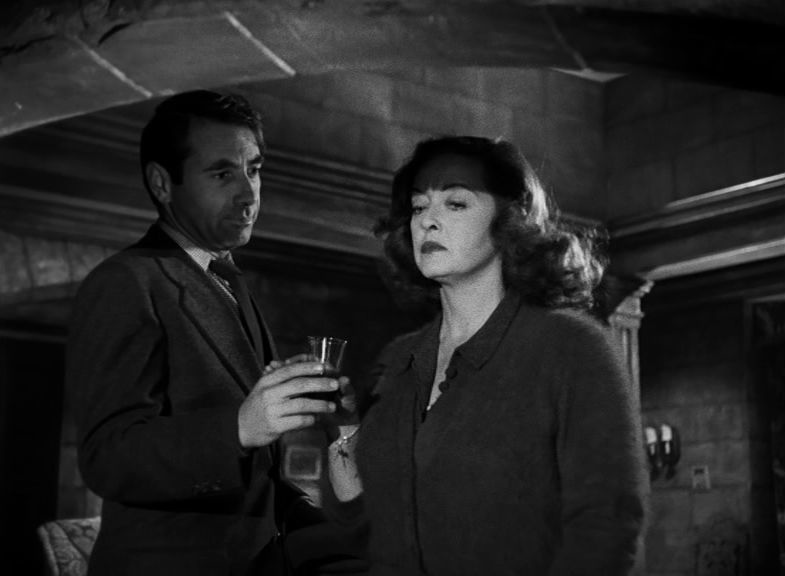
Irving Rapper directs with energy and style. He’s particularly fond of extreme high-angle shots which he uses very effectively.

Simply Media’s Region 2 DVD is barebones but the transfer is a very good one.

This is a movie that makes no sense at all but with Bette Davis in this sort of form that doesn’t matter in the slightest. Another Man’s Poison is a high camp extravaganza that will delight any Davis fan. Forget about logic and just sit back and enjoy the ride. Highly recommended.

Saturday, July 6, 2013

The Virgin Queen (1955)

Virgin Queen2

You might expect that The Virgin Queen will tell the story of Queen Elizabeth I of England. In fact it tells the story of Sir Walter Raleigh, but Raleigh’s story can hardly be told without making the queen a very central character indeed, and with Bette Davis playing Elizabeth it’s not surprising that it’s the queen who dominates the movie.

This is a lavish production by 20th Century-Fox but the focus is on the characters rather than the spectacle.

Walter Raleigh (Richard Todd) makes use of a chance encounter with Robert Dudley, Earl of Leicester (Herbert Marshall) to have himself presented at court. Raleigh is ambitious but his ambitions go beyond becoming a mere courtier. He wants to lead an expedition of three ships to the New World and to return with enough treasure not only to make his own fortune but also to win the queen’s undying gratitude. He hopes to ingratiate himself to a sufficient extent with Elizabeth that she will not only agree to approve his project but will also provide the ships.

VirginQueen1

Winning the queen’s favour turns out to be a daunting and complex task. It is complicated by the all-too-obvious circumstance that the queen’s affections for him are romantic in nature, and by the fact that he has fallen in love with one of her ladies-in-waiting, Beth Throgmorton (Joan Collins). Eventually he is given not three ships but only one. It’s a fine ship though and Raleigh is given permission to modify her to his own specifications. However, his difficulties with the queen are far from over. His glorious career may be ended prematurely by the headsman’s axe.

Queen Elizabeth as portrayed by Bette Davis in this film is a horror from Hell - capricious, cruel, spiteful, vain and selfish. She is a spider woman surrounded by courtiers who are as vicious as they are spineless. She is a foolish absurd old lady who expects groveling obedience. The suffocating and poisonous atmosphere of her court is the most memorable thing in the movie.

VirginQueen2

Whether any of this has the remotest connection with history is another matter, but this is after all a movie not a documentary. What can be said with certainty is that no other actress has ever had the courage to make herself so hideous for a role, or to portray Elizabeth I in such an unsympathetic manner. Considering that Elizabeth Tudor has generally been treated by historians with fawning admiration it’s interesting to see such a contrary point of view made so forcibly.

While the movie is highly unsympathetic to Elizabeth it lets Sir Walter Raleigh off rather lightly. Historically he seems to have been something of an opportunist but in this film he is a spirited and wholly admirable hero, a man prepared to stand up even to the queen. Richard Todd plays him as a swashbuckling romantic hero and it has to be said that he does it well.

VirginQueen3

Joan Collins is impressive as Raleigh’s secret wife Beth Throgmorton, a woman who rather unluckily finds herself the victim of the queen’s insane jealousy. Collins makes Beth an intelligent and very spirited character, which makes it wholly convincing that the dashing Raleigh would have fallen for her.

Herbert Marshall is as reliable as ever. Robert Douglas is entertaining as the slimily malevolent courtier Sir Christopher Hatton.

German-born director Henry Koster does an adequate if less than inspired job.

VirginQueen4

I picked up Fox’s Region 4 DVD in a bargain bin for a couple of dollars. My hopes were as a result not very high but in fact it’s quite a superb anamorphic transfer (the movie was shot in Cinemascope) and the colours are dazzling.

The Virgin Queen is not a complete success. It seems uncertain whether it wants to be a swashbuckling adventure or a romance. In some ways it’s a pity it didn’t go more for the adventure angle - Richard Todd could have been a rather successful swashbuckler. It is however a fascinatingly different and rather perverse portrait of a monarch corrupted by power. Forget history. This is a Hollywood movie. And an entertaining one. A must-see for Bette Davis fans.

Saturday, January 21, 2012

The Letter (1940)

The Letter, directed by William Wyler for Warner Brothers in 1940, contains what may well be Bette Davis’s finest performance. And it’s a great film.

It’s hard to go wrong when adapting a Somerset Maugham story for the screen. For some reason his stories just work perfectly as movies.

The setting is a rubber plantation in Malaya, some time during the 1930s (the war is never mentioned so it’s clearly some time before 1939).

The Letter (1940)

The famous opening sequence is one of the best you’re ever going to see, with Bette Davis emptying a revolver into a man. We have no idea who he is or why she shot him, or why she kept on shooting him after long after he was obviously dead.

The District Officer and her lawyer are sent for and Leslie Crosbie (Davis) tell her story. The man she shot was Peter Hammond, another planter. He had made unwanted advances to her, there had been a struggle, she had grabbed her husband’s revolver and being so upset she hadn’t realised that she had just kept on pulling the trigger. Everyone is very sympathetic. Her husband Robert (Herbert Marshall) arrives shortly afterwards and he is very sympathetic as well. Clearly she had had no choice.

The Letter (1940)

Of course the District Officer has no choice but to arrest her and she will have to stand trial for murder in Singapore but no-one has the slightest doubt she will be acquitted. Until her lawyer, Howard Joyce (James Stephenson), receives information that a letter exists. A Very compromising letter. A letter written by Leslie to the deceased, begging him to come to her while her husband was away. Apart from being very damaging in itself, suggesting n intimate relationship between her and Hammond and casting extreme doubt on her story of being suddenly attacked for no reason, its existence also flatly contradicts the statement she made that she had had no contact of any kind with Hammond for many weeks and that he was no more than a casual acquaintance.

The existence of the letter makes it more than likely that Leslie will be convicted and hanged. Howard Joyce is an honourable man but against his better judgment he is persuaded to try to buy the letter. At the very least this could end his career and he might well face criminal charges for attempting to pervert the course of justice.

The Letter (1940)

The letter is in the hands of Hammond’s widow, a Eurasian woman. She insists she will not sell the letter unless Leslie comes to her personally and at their meeting her hatred for Leslie is all too apparent. But she sells the letter.

It would seem that Leslie is now out of the woods but the killing has had consequences for everyone concerned, for Leslie, for her husband and for Howard Joyce. It may well end by destroying all their lives.

William Wyler was renowned for being a perfectionist who was capable of forcing an actor to do take after take after take and as a result many actors hated working for him. Bette Davis was one of the few who appreciated that Wyler’s methods worked and he got extraordinary performances from her. In a role which could easily have become histrionic and excessively mannered Davis turns in a subtle and controlled performance.

The Letter (1940)

Herbert Marshall and James Stephenson are also superb. While Leslie dominates the film both Robert and Howard Joyce are complex characters thrown into emotional turmoil and not always entirely certain of their own motivations. They are in fact more complex than the self-centred and selfish Leslie.

The visual style certainly has affinities with film noir, although film noir would not truly arrive on the scene for another year or two. The use of shadows and moonlight and in particular the use of light broken up by slatted blinds suggest that The Letter might well have been a major influence on the noir style.

The movie deals indirectly with the effects of colonialism, especially the effects on the representatives of the colonial power. Boredom, despair, alcoholism and adultery are obviously the major ingredients in life in colonial Malaya.

The Letter (1940)

The temptation to give this movie a feminist reading and to treat Leslie as some kind of victim is a temptation that should be strongly resisted. She is a complete monster, thoroughly evil and manipulative. One can’t help suspecting that the signs of remorse she displays have nothing to do with genuine remorse but are merely signs of self-pity and of her frustration that she has been found out and that her elaborate lacework of lies has come unravelled. Leslie’s favourite hobby is lacework and to me the symbolism is clear enough - she constructs intricate patterns of lies and manipulations rather like a spider spinning a web of deception.

Apart from the visual elements there are some thematic similarities to film noir. I suppose you could it tropical noir. It’s a superbly crafted film and fully justifies Wyler’s methodical and perfectionist approach. A great movie.

Monday, October 3, 2011

Jezebel (1938)

The popular legend regarding Jezebel is that Bette Davis got the part as a consolation prize for missing out on the role of Scarlett O’Hara in Gone With the Wind. As a result it’s usually dismissed as a poor man’s Gone With the Wind.

In fact Jezebel was released first, but that was because the production of Gone With the Wind dragged on for so long. Warner Brothers therefore managed to bear Selznick to the punch with their own southern epic. Jezebel earned Bette Davis her second Oscar, and was the beginning of a fruitful collaboration between the star and director William Wyler. So even if the popular legend is true the movie ended up being a major step forward in Davis’s career.

The superficial similarities between the two stories are best ignored. Although they both feature a strong-willed southern belle Jezebel is quite capable of standing on its own merits.

Jezebel (1938)

Davis is Julie Marsden, and to describe her as strong-willed would be woefully inadequate. She’s determined to have her own way, not only at the risk of destroying others but even at the risk of destroying herself. She simply can never back down. She is going to be married to be married to handsome young banker Preston “Pres” Dillard (Henry Fonda) but she is not satisfied that she has him sufficiently broken to the saddle yet. She intends to make sure the job is done properly before the marriage takes place. Early in the movie we see her dealing with a badly behaved colt and it’s clear that as far as Julie is concerned the only difference between training a horse and training a man is that men take just a little longer.

Unfortunately she makes one disastrous miscalculation in training Pres. She loses him, and losing something that she wants is something that has never happened to her. She doesn’t like it. She intends to do something about it. The price will be terrible, but that doesn’t make her hesitate for a moment. Her instrument will be a former beau of hers, Buck Cantrell (George Brent). The drama will be played out against the background of the disastrous yellow fever outbreak in New Orleans in 1853.

Jezebel (1938)

The problem with most of the writing on this movie is that it obsesses over Davis’s character and her performance and on trying to give a feminist interpretation of the movie’s treatment of Julie. While Julie is certainly central to the film this blinds many people to the possibility that there may be more going on in this film. In fact in some ways this is an even more interesting examination of the culture of the Old South than Gone With the Wind.

The real theme of the movie is the reckless violence that is the inevitable by-product of the southern obsession with honour, and the stiff-necked and unthinking pride that motivates this obsession. The men slaughter each other in duels with no more thought than they would put into the question of whether to go to the theatre tonight or not.

Jezebel (1938)

It’s surprising this theme has been overlooked, because it’s actually stated quite explicitly several times, especially just before the duel that will have such devastating repercussions. Julie’s mother remarks that it’s easy for southern women to start the southern men quarreling but it’s impossible to stop them. Julie also makes some bitingly ironic remarks about the realities of southern chivalry, and about the southern determination to cling to their customs.

In this movie we see that this fatal pride is not confined to the men. Julie displays the same insanely exaggerated pride, the same unwillingness to back down, the same terrifying recklessness. It’s this proud self-destructiveness that is the cause of every disaster in the story, even including the yellow fever epidemic (since the city authorities have been repeatedly warned of the vital necessity of draining the swamps near the city but have contemptuously rejected the warnings). And of course lurking in the background is the coming war, and again at several points in the film we see the stubborn refusal on the part of southerners to accept the possibility that a war might end with their own defeat. Just as Julie refuses to accept the idea of defeat.

Jezebel (1938)

Which is not to say that the movie is unsympathetic to its characters. Their excessive pride is intimately bound up with a deep and abiding love for the land that has nourished them. Julie tries to explain this to Pres after he returns from a period in the North filled with scorn for the ideals and the culture of his own land. There’s a tragic inevitability to events, as people do things that will lead them to disaster because they are simply unable to imagine any other way of behaving.

For Julie the crucial event is her humiliation at the ball, a humiliation which is entirely self-inflicted. This ballroom scene is Wyler’s masterstroke. Bette Davis of course was always inclined to take her performances to emotional extremes but Wyler keeps this tendency in check so that when the moments of emotional overload come they are all the more effective.

Jezebel (1938)

George Brent is the surprise packet in this movie - he’s very very good indeed. As for Henry Fonda, while I’m always of the opinion that any movie could only be improved by replacing him with another actor, any other actor, in this movie he is at least adequate.

While it’s true that it lacks the scope of Gone With the Wind, and while it’s equally true that Julie is a less complex character than Scarlett O’Hara it’s also true that if you can such comparisons aside there is much to ponder and much to enjoy in Jezebel.

Tuesday, May 24, 2011

A Stolen Life (1946)

A Stolen Life, released by Warner Brothers in 1946, is not just a Bette Davis melodrama, it’s also her first film as a producer so one assumes it was a personal project. And it’s certainly ideal Bette Davis material.

Davis is Kate, a rather shy woman who spends her leisure hours painting. We will shortly find out that she has a twin sister, a sister (Patricia) who has always gained whatever whatever she wanted, often at the expense of Kate. Kate has never had the confidence to fight for what she wants.

Quite by accident, Kate has tumbled upon something that she thinks she might be able to keep for herself. This something is a man. His name is Bill (Glenn Ford), and he’s a lighthouse keeper’s assistant. He understands loneliness, and he’s kind and sensitive and really he’s the man Kate has been waiting for her whole life. But of course Patricia finds out, and wants Bill for herself.


The plot from this point on becomes increasingly and outrageously melodramatic. Patricia seems to have won, but there are many plot twists still to come. Some of the twists are obvious (such is the nature of melodrama) but there’s a major one towards the end that is both unexpected and deliciously ironic. I won’t spoil any of the fun for you.

There’s a slightly inconsequential sub-plot involving Kate’s ambitions as a painter. She meets a real artist. We know he’s a real artist because he’s rude, selfish and boorish. But of course he sees things as they really are, and understands Kate’s problems in a way that she doesn’t. She lacks confidence and a willingness to take risks, especially sexual risks.


This is the kind of role that gives Bette Davis rein. And she makes the most of it. Davis understood melodrama and she understood the type of acting it demanded, and she was happy to oblige. And she eagerly accepts the challenge of playing two roles, the good sister and the bad sister. What makes things interesting is that the good sister is the more complex and demanding role and Davis recognises this. Davis is at her outrageous best.

Glenn Ford naturally gets overshadowed but he delivers a solid enough performance. Walter Brennan is amusing as the crusty lighthouse keeper. Dane Clark is suitable obnoxious as the artist Karnock.


Having one actress play two roles has been done many times but technically A Stolen Life manages the feat remarkably effectively.

The plot is of course ludicrous but that’s hardly a problem in the world of melodrama. Just forget logic and enjoy the ride. The whole thing is gloriously overdone and over-ripe.

I saw this one on cable TV but it is available on DVD, and it’s a must for any self-respecting Bette Davis fan.

Saturday, March 5, 2011

Beyond the Forest (1949)

If you’re a lover of camp and you haven’t yet seen Bette Davis’s 1949 film Beyond the Forest then all I can say is that you have missed out on one of the most awesomely camp extravaganzas in cinematic history. It’s often listed as a film noir although it’s perhaps better described as a noirish melodrama.

The plot is not just pure melodrama. It’s hyper-melodrama. Bette Davis is Rosa Moline. Rosa lives in Loyalton, a small town that is dominated by the local timber mill. She’s married to Dr Lewis Moline (Joseph Cotten), a dedicated small-town doctor who is love and admired by the townsfolk. The townsfolk do not love and admire Rosa. She disturbs them. Disturbs them deeply. She doesn’t like small-town life. She doesn’t like baking. Or children. Or square dancing. Or any of the normal activities of the good citizens of Loyalton. Most of all Rosa does not like the good citizens of Loyalton. Not like is perhaps not quite the correct expression. It would be more accurate to say that she loathes and despises them, and she makes no attempt to hide her contempt.

Rosa was always different. Her dreams were not dreams of domestic bliss in Loyalton. She dreamed of escape to Chicago. Escape to anywhere.

Living in Loyalton is bad enough, but Lewis Moline makes Rosa’s life intolerable. He’s a do-gooder. He doesn’t expect his patients to pay him if they can’t afford it. As a consequence he is not a rich man. More to the point, Rosa is not the wife of a rich man. And she very much wants to be.

She has a candidate in mind. Neil Latimer is a millionaire businessman who owns an enormous hunting lodge on the nearby lake, and Rosa has already managed to attract his interest. In fact she’s started an on-and-off affair with him. But what she wants is to marry him.

The movie starts with an inquest into a fatal shooting, with Rosa apparently the chief suspect. At this stage we have no idea of the identity of the victim. This will be revealed in an extended flashback sequence that occupies most of the movie’s running time.

Bette Davis gives one of the most outrageously over-the-top performances of her career. Given that her career includes so many outrageously over-the-top performances I realise that’s quite a claim, but it’s a claim I stand by. It’s not just her performance that is extraordinary. She was a decade too old for the role, and she has her hair dyed jet black. Her appearance is truly bizarre. Somehow though these things end up counting in her favour. It’s obvious that Rosa, despite her scheming and her breath-taking ruthlessness, has no hope whatever of realising her dreams, that any chance she might have had of doing so is long gone. As a result the viewer cannot help feeling sorry for her. She’s a tragedy waiting to happen.

King Vidor directed the movie, and he did so in an overwrought and wildly melodramatic style. Combined with the subject matter and Davis’s acting what you end up with is massive camp overkill. Davis and Vidor though are not afraid of being melodramatic, they are not afraid of going too far, and the results are splendidly entertaining. King Vidor had by this time been directing for three-and-a-half decades so he knew a thing or two about making movies. There’s no question that the excessiveness of this picture was a conscious choice, and with a story like this one it was arguably the only valid choice.

Joseph Cotten’s understated acting style proves a perfect foil for Davis. Ruth Roman provides additional fun as Rosa’s perpetually rebellious housemaid.

The final sequence involving the train is a tour-de-force of movie melodrama.

Sadly this movie is unavailable on DVD but being a Warner Brothers production it turns up on TCM in Australia from time to time and I assume it gets screened on TCM in the US at various times as well. It’s a movie not to be missed by fans of cinematic excess, and most certainly not to be missed by fans of Bette Davis. As the original poster for the film so aptly put it, nobody’s as good as Bette when she’s bad.

Tuesday, January 25, 2011

Marked Woman (1937)

Marked Woman is a 1937 Warner Brothers crime movie, and a surprisingly hardboiled one.

Warner Brothers of course were renowned for their gritty early 1930s gangster epics and their 1940s film noir but the late 30s was a fairly bland time for crime movies. The Production Code had killed the classic gangster film and the American film noir of the 40s had not yet emerged in all its shadowy hard-edged glory. Marked Woman owes quite a bit to the studio’s earlier gangster movies and anticipates the cynical doom-laden film noir style.

The plot is based very loosely on the real-life case of mobster Lucky Luciano but the focus in the movie is not on the gangster at all (which represents a shift from Warner’s earlier gangster films). In this case the focus is on the girls who work in a night-club. It was a fairly respectable night-club until it got take over by crime boss Johnny Vanning. He turns it into a high-class clip-joint.

The girls who work there aren’t overly thrilled about this, and they’re even less pleased that they are now “hostesses” but they don’t have much choice. Vanning control all the city’s night-clubs, and it’s better than working for starvation wages in a resectable job, assuming any of them could get respectable jobs.

One of the girls is Mary Dwight (Bette Davis) who’s been doing this kind of work to support her kid sister Betty through college. When Betty comes to the big city to visit her she tries to hide what she does for a living but unfortunately one of club’s clients has just been murdered by Vanning’s henchmen and the girls (including the innocent kid sister) find themselves arrested on suspicion by the young and zealous DA (Humphrey Bogart). Betty is soon drawn into this twilight world and Mary discovers there is a much higher price to be paid than she ever expected.

Bogart hadn’t yet quite perfected his screen persona and he’s actually rather dull. It’s the women who dominate the movie in any case. Mary and her friends are all complex three-dimensional characters an there are fine performances by all the actresses, especially Lola Lane as the cynical but likeable Gabby and Isabel Jewel as the ditzy but sympathetic Emmy Lou who unwittingly drags Betty into the word of big city vice.

And then there’s Bette Davis. This is Bette Davis in full flight, chewing scenery like there’s no tomorrow. At times she goes completely over-the-top but being Bette Davis she somehow gets away with a performance that no-one else could have pulled off.

Lloyd Bacon was a reliable and very competent director and his direction is tight, well-paced and stylish. In 1937 the Production Code was making this sort of subject matter difficult to deal with but Marked Woman manages to avoid being sentimental or too obviously moralistic. Even the ending is quite satisfying.

This is a classic of hardboiled film-making. Highly recommended.

Sunday, November 28, 2010

Satan Met a Lady (1936)

In 1936 someone at Warner Brothers got the bright idea of turning Dashiell Hammett’s novel The Maltese Falcon into a screwball comedy. The result was Satan Met a Lady. Now you might think be thinking that this sounds like one of the dumbest ideas ever. If you are thinking that, you’re dead right.

I have to be quite honest here and say that I’m not that much of a fan of the screwball comedy genre. There are some exceptions. Bringing Up Baby is one of my favourite films ever. But the screwball comedy really had to be done well, and done with a cast and crew who knew what they were doing. If you couldn’t afford people in the class of Cary Grant, Carole Lombard or William Powell then you were well advised to steer clear of the genre, because of the danger you’d end up with an annoying mess. Like Satan Met a Lady.

It’s not that the two leads lack talent. The female lead is after all an actress by the name of Bette Davis. You may have heard of her. Yes, a great actress, but she’s not the name that immediately springs to mind when you mention screwball comedies. The male lead is Warren William, one of the great actors of the pre-code era who after the code found himself reduced to doing puerile B-comedies. Like Satan Met a Lady.

There are some bizarre changes to Hammett’s story. There’s no Maltese falcon for starters. The crooks in this picture are seeking the legendary trumpet of the medieval hero Roland. It’s a silly unnecessary change that seems to have been made to allow for the opportunity of adding some painful trumpet gags to an already tedious script. The Sydney Greenstreet role is played by a woman.

The characters have all been renamed. Sam Spade has become Ted Shayne. The basic plot outline, with the trumpet substituted for the falcon, is still there. But it’s played for laughs. Combining a detective yarn with elements of screwball comedy wasn’t necessarily a disastrous idea. In fact, combining a Dashiell Hammett detective story with elements of screwball comedy wasn’t necessarily a bad idea. The Thin Man worked pretty well for MGM. But it had the right leads, and the right mix of crime and humour. It was done with the required lightness of touch. Satan Met a Lady just doesn’t have that. What it has is lots of broad humour, and an air of desperation. Bette Davis regarded it as one of the lowest points of her career.

The big problem though is Warren William. His success in the pre-code era was based on playing cads, but they were cads who were genuinely dangerous. The charm and the wisecracks were combined with a touch of real menace, a mixture that he was able to pull more successfully than anyone else. The Production Code meant that he found himself playing loveable rogues and having to rely on a broad style of comedy that didn’t suit his urbane manner. He ended up being merely irritating.

So is Satan Met a Lady worth bothering with at all? Well if you bought the three-disc DVD Special Edition of The Maltese Falcon you got this movie included anyway, and if you really enjoy this brand of humour you might like it. I loathed it.

Monday, May 31, 2010

Front Page Woman (1935)

Front Page Woman sees Bette Davis and George Brent as rival newspaper reporters who are also sweethearts.

Devlin (Brent) wants to marry Garfield (David) and naturally wants her to quit her job, since being a newspaper reporter is no job for a woman. They make a bet - if he can prove that women are no good as journalists, she’ll marry him. Which of course makes sense - why wouldn’t a woman want to marry a man who has publicly humiliated her and demeaned her and spends most of his time making snide remarks about how stupid women are?

This is 1935, the Production Code is in force, and it’s time for uppity women to be put in their place. And if you need an actor to portray an arrogant sexist pig, who better than George Brent? He made an entire career out of playing obnoxious pigs. Of course Garfield doesn’t really mind being treated like an idiot, because she doesn’t really want to be a reporter. She wants to get married.

If you can sit through 80 minutes of George Brent being insufferable and annoying, you do get to see Davis finally get the upper hand. Sort of. But of course, after he’s systematically sabotaged her career and engaged in every kind of underhanded trick to make her look like a fool, she realises how much she really loves him and how much she wants to marry him.

You also have to endure the unbelievably irritating Roscoe Karns as Devlin’s offsider.

Apart from His Girl Friday I’m not really a fan of newspaper movies, and Front Page Woman did nothing to make me alter my views on the genre. At this stage it’s clear that Warner Brothers still didn’t have any clear idea what to do with Bette Davis, and she’s wasted in this role.

This not a movie I’d particularly recommend. It’s a good example of the less obvious sort of damage done by the Production Code. And it's disappointing because Bette Davis as a feisty woman reporter could have been a real winner in the pre-code days.

Saturday, May 22, 2010

The Petrified Forest (1936)

The Petrified Forest was the movie that finally put Humphrey Bogart on the map as an actor. In 1936 his career was going nowhere fast until Leslie Howard persuaded Jack Warner to give him his chance in this movie, and the rest (as they say) is history.

Leslie Howard is penniless drifter Alan Squier, a failed writer and intellectual whose wealthy wife has finally tired of him and found herself a new pet, a promising young painter. Hitch-hiking through the Arizona desert he stumbles into a gas station and diner in the middle of nowhere. The daughter of the proprietor is Gabby Maple (Bette Davis) and her dreams are all of escape to France, to civilisation. She is immediately infatuated by Alan’s charm and his intellectual pretensions. She wants to go to France with him. Alan is suffering from a very severe case of world-weariness and self-pity and doesn’t want to inflict himself on a woman. He is humiliated enough when she has to pay for his meal, and decides to skulk off into the desert to continue his wallowings in self-hatred.

At roughly the halfway point of the movie the tome changes from philosophical musings and romance to suspense and suppressed violence, with the arrival of notorious gangster and killer Duke Mantee (Bogart). They’ve stolen a car from a rich couple who find themselves held hostage at the diner, along with their chauffeur, Alan, Gabby and Gabby’s her drunken old grandfather who is always boring everyone with his stories of his supposed youthful encounter with Billy the Kid. While Alan and Duke Mantee appear on the surface to have little in common, one being a passive over-sensitive intellectual and the other being a desperate and vicious man of action, Alan believe they are kindred spirits. Both are doomed, both are outsiders, both are in love with death. It appears that for both men this love affair is about to be consummated.

Seen today this movie seems incredibly stagey and outrageously talky. That it works is due almost entirely to the three leads. Leslie Howard makes Alan likeable and sympathetic when he so easily have been annoying and pompous. Bette Davis is touchingly naïve, high-spirited and amusing. Bogart, whose performance apparently owed a great deal to Leslie Howard’s advice on toning down his acting, gives us the first glimpse of the characterisation he would later perfect and which would make him a bona fide star.

The philosophising about the conflict between civilisation and nature, between the Old World and the New, between refection and action, life and death, etc, would have been little more than the 1930s equivalent of pop psychobabble if delivered by anyone other than Leslie Howard, It makes it sound almost profound. There’s a very 1930s atmosphere of impending chaos and social collapse, of civilisation at the end of its tether.

The extreme staginess, the obviously fake backgrounds to the outdoor scenes shot on a sound stage, the confining of the action to a single room, all these things could have counted against the film but in fact they enhance its impact, giving it a stifling and artificial feel that complements the theatrical performances.

And while there’s very little action, when it does come the sudden outburst of extreme violence has a tremendous impact.

This is in many ways a landmark movie, a link between the Hollywood movies of the 30s and those of the following decade, and to a certain extent an anticipation of the American style of film noir that emerged in the 40s. And the three central acting performances are more than sufficient reason to make this a must-watch movie.