Saturday, January 14, 2023

Anna Christie (German-language version, 1930)

Anna Christie was Greta Garbo’s first talkie and it was in fact shot twice simultaneously, once in English and once in German for the German market (where MGM quite reasonably expected it to do very well). Garbo is in both versions but the supporting casts are different and the two versions had different directors. Clarence Brown directed the English-language version while Jacques Feyder directed the German version. And different writers - Walter Hasenclever wrote the dialogue for the German version and Frank Reicher wrote the German screenplay.

The English-language version doesn’t get a lot of love, even from Garbo fans. It was based on Eugene O’Neill’s play and it’s very very stagey. It was a very odd choice on MGM's part for Garbo's debut in talkies. There are those who think that the German-language version is the better movie - more daring, slightly more dynamic and with a better performance from Garbo. It’s the German version we are concerned with in this review.

The movie begins with a lengthy opening sequence in which a broken-down old sailor, Chris Christopherson (Hans Junkermann) and his equally broken-down mistress Marthy (Salka Viertel) are getting quietly plastered in a waterfront bar. Chris has received a letter from his daughter Anna whom he hasn’t seen for fifteen years. She’s coming to see him. Marthy persuades Chris to go to the restaurant next door to get some food in his stomach to sober him up a bit, Chris departs, and Garbo makes her famous entrance.

Chris had abandoned his family years earlier. He has convinced himself that Anna has had an idyllic childhood on a farm. He has no idea that she is a prostitute.

Chris is captain of a barge and he lives aboard. Anna moves in with him. Chris has grown to hate the sea. He is haunted by the fear that Anna will marry a sailor. Anna falls in love with the sea.

A fierce storm blows up and Chris rescues a shipwrecked sailor, Matt Burke (Theo Shall). Matt takes a liking to Anna. Like Chris he is convinced that Anna is a good decent girl. Matt despises whores.

Anna for her part has always hated men. During that supposedly idyllic childhood on the farm she was raped by the farmer’s son. Matt is the first man she has ever liked. And she slowly realises that she has fallen in love with him. For his part matt has decided that Anna is the girl he will marry.

The problem of course is that Anna is tortured by the idea that she is deceiving Matt. She has allowed him to build up a fantasy about her, a fantasy in which she is a sweet innocent virgin. She would obviously be a fool to tell him that she’s a whore but if she doesn’t tell him and they get married she will always feel guilty.

The German version, like the English version, is very stagebound. This was of course the very early days of talkies when the initial technical problems involved with sound technology imposed serious limitations on directors. It wasn’t easy to introduce movement into shots. It was easier to stick to a few basic camera setups. In this case there is the added problem that almost all the action takes place on a handful of sets, and they’re not exactly visually impressive sets. It’s not easy to make a sleazy waterfront bar or the cabin of a coal barge visually stunning.

It’s all very claustrophobic. That suits the content but it doesn’t make for exciting viewing.

It’s also, being essentially a filmed play, a story told mostly through dialogue rather than by visual means. Anna Christie never really manages to feel cinematic.

Jacques Feyder was a sound choice as director. He had directed Garbo in her last silent film, the stylish and very underrated The Kiss, a year earlier.

You have to bear in mind that it wasn’t just MGM who were worried how audiences would respond to Garbo’s voice. Garbo herself had no idea whether audiences would go for her Swedish accent (in fact audiences decided that her voice was sexy and exotic). She was almost certainly a bit nervous shooting the English-language version. On the other hand she was extremely comfortable speaking in German so she could focus more on her acting than on her voice. She does seem generally more at ease here than in the English version.

There can be no complaints abut the casting of the German-language version. Hans Junkermann as Chris, Theo Shall as Matt and Salka Viertel as Marthy are all good. Theo Shall is particularly good.

Garbo is excellent. It’s not a glamorous role but she manages to look terrific anyway while still being totally convincing as a very unglamorous, confused rather embittered woman.

The sea is clearly meant to have some deep symbolic significance. I guess it’s supposed to represent fate.

As for pre-code content, it’s made absolutely explicit that Anna is a prostitute. There’s anything aspect to the movie that is very very pre-code but I can’t reveal what it is without revealing spoilers. But this German version is very very obviously a pre-code movie.

The German version (with English subtitles) is included as an extra on the Warner Home Video DVD that was included in their superb Garbo boxed set some years ago. The print was obviously not in very good shape but it’s quite watchable and sadly it seems unlikely that anyone is ever going to bother doing a proper restoration.

Anna Christie is a movie that never escapes from its stage origins and it’s much too stagey and static and dialogue-heavy. It’s rather stodgy. Worth seeing for the fact that the story is told in such an overtly pre-code way, and for Garbo.

Wednesday, January 11, 2023

Bend of the River (1952)

Bend of the River, released by Universal-International in 1952, was the second of the Anthony Mann westerns starring James Stewart, following the success of the superb Winchester ’73.

This time Stewart plays Glyn McLyntock. He’s acting as guide to a party of about a hundred settlers setting off into the wilderness in Oregon to establish farms. McLyntock figures he might take up farming itself.

Then comes a chance encounter. A man accused of horse stealing is about to be hanged by a Lynch mob. McLyntock saves him. The man tells McLyntock that he didn’t steal the horse. McLyntock says he doesn’t care. He just doesn’t like to see a man get hanged.

The man is Emerson Cole (Arthur Kennedy). Cole decides to ride along with the settlers for a while. He might eventually decide to head for California. McLyntock and Cole strike up a friendship which is solidified after Cole saves McLyntock’s life in a clash with a Shoshone raiding party.

When these two men meet we get our first inkling that McLyntock may have a colourful past. Cole has heard of him, and is surprised that the legendary Glyn McLyntock would want to take up farming. When Cole tells McLyntock his name there’s an interesting flicker of recognition in Glyn McLyntock’s eyes.

The leader of the settlers is Jeremy Baile (Jay C. Flippen). He has two beautiful daughters, Laura (Julia Adams) and Marjie (Lori Nelson). Cole senses that there’s something between McLyntock and Laura and asks McLyntock outright if Laura is his girl. McLyntock says that no, she isn’t.

The settlers have bought food supplies and cattle from Tom Hendricks (Howard Petrie), a trader in Portland, and they’re rather worried when the supplies don’t arrive. McLyntock and Cole ride into Portland and discover why. Portland is in the grip of gold fever. Hendricks has resold the shipment of supplies to gold miners, for ten times its value. McLyntock and Cole take steps to get those supplies back, which leads to a series of wild action scenes. In Portland they pick up another mysterious stranger, the smooth gambler Trey Wilson (Rock Hudson).

They also pick up half a dozen men to help with the loading and unloading and with the wagons. These men seem like a bunch of cut-throats but there’s no alternative to hiring them.

McLyntock and co set off down the river in a steamer but they can only go as far as he rapids and they can be sure that Hendricks will be waiting for them with a bunch of gunmen. Setting off cross-country seems like a better option. But Hendricks in is hot pursuit.

There’s plenty of action in store, and plenty of opportunities for betrayal.

Mann handled spectacle particularly well and this is a visually very impressive movie. The action scenes (of which there are many) are expertly staged.

James Stewart gives the sort of performance he was starting to become known for - there’s an edge to it and there are hints of inner darkness. Arthur Kennedy is splendid. Rock Hudson’s rôle is strictly a supporting one but he’s fine. Julia Adams makes a spirited heroine. I like Chubby Johnson as the riverboat captain, Mello. He just knows he should never have left the Mississippi.

There are critics who like to see the Anthony Mann-James Stewart westerns as noir westerns. I see this as representing a kind of condescending attitude towards the western genre. It’s as if a western can only be treated seriously if you can see it as a film noir with six-guns and horses. By the late 40s westerns were starting to become more ambitious and more thematically complex but the thematic complexity came from exploring the potential of the western genre itself. The westerns of the 1950s can stand on their own merits. They’re best understood on their own terms. I don’t see any film noir elements in this movie. Approaching Anthony Mann’s westerns as noir westerns sets up misleading expectations.

Major themes which recur during the golden age of the western (from the late 40s to the early 60s) are revenge and redemption. There’s a bit of both in Bend of the River.

We have three central male characters in this film, and all three are nicely ambiguous. McLyntock is clearly a good and honourable man but we have reason to believe that maybe there are things in his past that he’d really like to forget. Possibly things that aren’t so good and honourable.

We have no idea for most of the movie what makes Emerson Cole tick. He obviously has a very shady past but he seems like he’s a reformed character. Jeremy Baile doesn’t believe that a man can change. He thinks Cole is still a wrong ’un. McLyntock wants to believe that Jeremy is wrong. He has to believe that Jeremy is wrong. He has to believe that a man can change.

This is clearly the core of the movie. Can a man really escape his past?

McLyntock needs to believe that Cole can achieve redemption because if he can’t then McLyntock might start doubting whether his own redemption is possible.

Trey Wilson seems like the kind of character who will turn out to be a ruthless crooked gambler and a generally bad type but his behaviour doesn’t seem consistent with superficial appearances.

The plot is fairly straightforward. The suspense in this movie lies not in wondering what will happen next but rather in wondering how the major characters will react. It’s suspense that is character-driven.

Bend of the River was shot in Technicolor in the Academy ratio and it looks terrific.

Bend of the River is not a noir western but it is a grown-up serious western and an intelligent one. It’s also very exciting. Highly recommended.

Umbrella Entertainment in Australia have released this movie on DVD in their remarkably good-value Six Shooter Classics range. The transfer is extremely good.

Monday, January 9, 2023

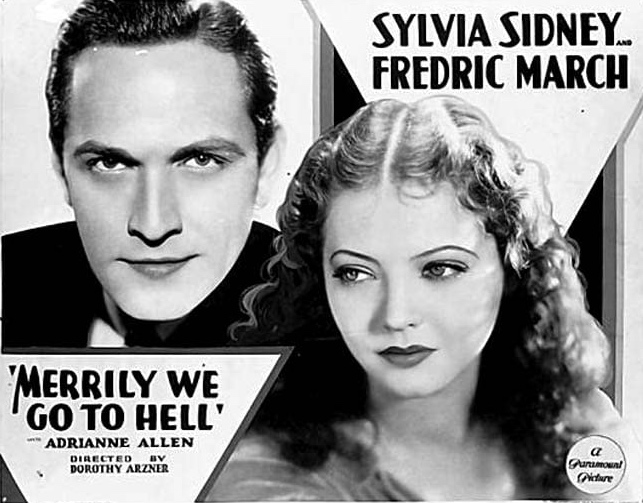
Merrily We Go to Hell (1932)

Merrily We Go to Hell is a 1932 Paramount pre-code movie directed by Dorothy Arzner. It’s a romantic melodrama with some humour and while it does address a serious issue (alcoholism) it does so in a characteristically pre-code way.

Jerry Corbett (Fredric March) is a newspaper columnist. He’s fairly successful despite his prodigious intake of liquor. He dreams of being a real writer. He wants to write plays. What with writing his columns and drinking he has trouble finding the time to settle down to serious writing.

One night at a party Joan Prentice (Sylvia Sidney) catches his eye. He takes a liking to her. She likes him as well. He’s amusing and charming, even though he’s very drunk.

They meet again and things start getting fairly serious between them. They decide that getting married would be a fine thing to do.

Joan is the heiress to a vast food-canning fortune. Her father doesn’t approve of the match. He assumes that Jerry is just after Joan’s money. He figures that if he offers Jerry a lot of money to call the wedding off Jerry will jump at the offer. Jerry refuses the money. Mr Prentice decides that maybe Jerry really does love his daughter. He’s still not happy about the marriage but he gives them his blessing.

After the marriage Jerry seems to be a reformed character. He stops drinking. He finishes his play.

Instead of the acclaim that he hoped for all the play gets him is a pile of rejection notices. And then finally it gets accepted. It’s going to be produced. Jerry looks like being a success, and his marriage looks like being a success as well.

There’s one fly in the ointment. The star of the play will be Claire Hempstead (Adrianne Allen). Claire is the woman who broke Jerry’s heart a couple of years earlier. In fact she’s one of the main reasons he took refuge in the bottle.

Maybe it will be OK. Maybe Jerry is over Claire. But as soon as he meets her again he knows that he isn’t over her.

Jerry knows what the answer to his problem is. He crawls back inside the bottle.

Jerry’s instinctive response to any kind of setback or any kind of pressure is to get drunk. The idea of facing up to problems or trying to solve them doesn’t seem to occur to him. He’s a nice enough and he can be very charming and he means well but he’s never met a problem he hasn’t wanted to run away from.

Jerry is clearly obsessed with Claire all over again. Joan comes up with a solution, and it’s a very pre-code solution - an open marriage. Jerry can fool around with Claire as long as Joan gets to fool around with other men. Their lives become one long round of parties, night-clubs, booze and sex. Joan is a modern girl. She can handle an arrangement like this. At least she thinks she can. Of course there are some melodramatic twists still to come.

I’ve never been much of a fan of Fredric March but he’s pretty good in this film. He resists the temptation to overact and he captures both Jerry’s charm and his weakness extremely well.

Sylvia Sidney is excellent. She also resists any temptation to overact. She’s likeable and charming and convincing as a young woman facing the realisation that her marriage is about to crash and burn.

I liked Skeets Gallagher as Jerry’s loyal pal Buck. He could have been made a mere comic relief character but fortunately that temptation is avoided.

Look out for Cary Grant in a bit part.

There are those who assume that Dorothy Arzner was the first successful woman director in Hollywood but in fact that honour belongs to Lois Weber who had a notable career as a director between 1911 and 1934.

The self-appointed moral policemen at the time who were outraged by pre-code movies and who eventually forced rigid censorship upon the movies had no doubts in their minds that these movies were a deliberate attempt to undermine traditional morality. In fact that was never really true. Most pre-code movies come down on the side of traditional morality. Mostly they come down on the side of marriage. If they were advocating anything it was a more flexible and forgiving and humane version of traditional morality. Maybe people who break the social rules don’t have to suffer savage punishments. But that in itself horrified the moral policemen who had no interest in a more flexible, forgiving, humane version of traditional morality. Moral policemen enjoy punishing people.

When you actually watch a movie like Merrily We Go to Hell you have to wonder how on earth anyone could interpret it as undermining marriage and the family.

This movie is one of the six included in the Universal Backlot Pre-Code Collection DVD boxed set, a set that is well worth purchasing.

Merrily We Go to Hell has lots of pre-code naughtiness but like a lot of pre-code movies it mixes licentiousness with a grown-up awareness that sex and fun have emotional implications. It also mixes pre-code flexible morality with traditional melodrama. It’s a pretty good little movie and it’s recommended.

Friday, January 6, 2023

Manslaughter (1922)

Manslaughter is a 1922 silent melodrama directed by Cecil B. DeMille. It is uncompromisingly a melodrama. I personally think that in order to understand DeMille as a director you have to watch at least a few of his silent movies. You need to watch a couple of his melodramas and a couple of his silent comedies. When you’ve done that you start to look at his later movies in a different light. You understand that far from being the bad director that many critics he was in fact a great director but he wasn’t the kind of director of whom most critics approve.

DeMille’s silent comedies in particular are a revelation. There’s no slapstick here. These are sophisticated comedies of manners. They also demonstrate DeMille’s fondness for outrageous fantasy sequences.

His melodramas are pure melodrama.

Most mainstream critics and most mainstream audiences tend to consider realism to be all-important. Movies should reflect life as it is. The only exceptions are movies that are overtly fantasy or science fiction and most mainstream critics and audiences get uncomfortable when fantasy or science fictional elements intrude in an otherwise realistic story.

I don’t think DeMille ever made a consciously realist movie in his life. When you watch a DeMille movie you enter a parallel universe. It’s the world of movie magic, which is essentially a fantasy world. You enter the world of melodrama, and melodrama is not a realist genre. Things that would be totally unacceptable in a realist movie, things like amazing coincidences, are perfectly acceptable in the world of melodrama. Melodrama is not trying to show us reality but rather a kind of heightened exaggerated version of reality. Melodrama obeys different conventions. Real life doesn’t have endings in which people get what they deserve (whether good or bad) but it’s a convention of melodrama that melodramas do end that way. If you can’t accept that then you won’t enjoy melodrama.


When you’ve seen DeMille’s earlier movies it’s much easier to appreciate later DeMille movies such as The Sign of the Cross, Samson and Delilah and The Greatest Show On Earth. Especially The Greatest Show On Earth, a much misunderstood movie. It’s vulgar, grandiose and overblown because it’s supposed to be. DeMille wasn’t trying to make a gritty social realist movie about the actual lives of circus performers (which is what a lot of critics would have liked). He was taking us into the totally unreal world of the circus, a world of make-believe and unreality and glamour in which everything is a show. DeMille totally loved that world. He revelled in it.

Which brings us to Manslaughter. Lydia Thorne (Leatrice Joy) is a wild girl. Basically she’s a flapper. She lives for pleasure. She spends her time in speakeasies and at wild parties. And she lives for speed. She has a sports car and she drives it fast and recklessly. When motorcycle cop Jim Drummond (Jack Mower) pulls her over for speeding she bribes him with a diamond bracelet. This will have consequences (this is melodrama after all).


Humourless moralising District Attorney Daniel O’Bannon (Thomas Meighan) is in love with Lydia but he disapproves of her. He disapproves of all these crazy kids today. He thinks that America in 1922 is just like ancient Rome - a world of decadence and debauchery. It must end badly. Pleasure is bad and if you pursue pleasure you will eventually pay a price. His musings on this subject trigger the movie’s first fantasy sequence, as Lydia in the guise of a wicked Roman empress presides over an orgy.

Lydia’s maid Evans (Lois Wilson), desperate for money to send her ailing son to a healthier climate, steals a diamond ring from her mistress. Lydia is initially outraged and wants Evans sent to prison but then changes her mind and decides to ask the judge for clemency. But Lydia is too drunk to turn up at court and Evans goes to prison. This subplot is important because it establishes that Lydia is irresponsible and spoilt but she isn’t cruel or malicious. She really did intend to save Evans from prison. This subplot will also have important later consequences (again remember that this is melodrama).

Lydia’s love of speed gets her into big trouble. She causes a traffic accident in which a traffic cop is killed. And yes, you guessed it, it’s the very same traffic cop she bribed earlier.

O’Bannon intends to send her to prison for a long stretch. He does this because he loves her and he thinks that a savage punishment will save her and turn her into the good girl he always believed her to be deep down.

These events will change the lives of all these characters (including Evans the maid), by means of lots more coincidences.

We’ll also get another ancient Rome fantasy sequence in which the barbarians invade and punish the Romans for their debauchery by killing the lot of them. O’Bannon likes this fantasy. Pleasure must be paid for.

The acting isn’t really in the excessively extravagant style that many people associate with silent films. It’s reasonably naturalistic. Which is a net positive since there’s enough melodrama in the story itself. Leatrice Joy is very good as Lydia. Thomas Meighan is OK as O’Bannon although O’Bannon is not an easy character to like.

DeMille came up with a very successful formula early on. He discovered that he could get away with all sorts of sex and sin in a movie if he added in the message that people who indulge in such things must pay for their pleasures. It was a formula that was later to be used countless times by exploitation film-makers. The kicker is, he always made the sex and sin seem like enormous fun and he always made the people who indulge in such things attractive and sexy. And he always made those who enforce the punishment seem humourless and boring. It’s almost as if the audience was supposed to come down on the side of sex and sin. Whether that was really DeMille’s intention can be debated but he certainly understood that it was the sex and sin that would have people lining up to buy tickets for his movies.

Manslaughter is typical DeMille outrageousness, with both the debauchery and the moralising melodrama being equally outrageous. And I haven’t yet mentioned the boxing match between two women and the all-female pogo stick race. Manslaughter is highly recommended because nobody made movies quite the way Cecil B. DeMille made them.

Manslaughter was released on DVD by Kino Video as a double feature paired with DeMille’s 1915 movie The Cheat.

Tuesday, January 3, 2023

I’m No Angel (1933)

I’m No Angel, released by Paramount in 1933, was Mae West’s third feature film. One thing that has to be made clear is that if you’ve never seen a Mae West pre-code movie then you’ve never seen a Mae West movie. Her three pre-code movies, Night After Night, She Done Him Wrong and I’m No Angel are the only Mae West movies that count and they’re the only ones worth seeing if you want to know what Mae West was all about.

Mae West wasn’t just a star. She wrote or co-wrote her movies and she was responsible for much of the dazzlingly wicked dialogue.

In this movie she plays Tira. Tira works at a smalltime carnival. She’s the star attraction of the girlie show. She’s also a part-time lion tamer. She has the same effect on lions that she has on men - she has them eating out of her hand.

She has a boyfriend, Slick Wiley (Ralf Harolde). At least he thinks of himself as her boyfriend. Tira is on the lookout for something more promising. Her horoscope has told her that she’s about to meet the kind of man she wants.

Slick is no good and inevitably he gets himself into a jam. He’s trying to shake down a guy and slugs him. He slugs him a bit too hard. The guy doesn’t die but he’s badly hurt and that’s going to mean a stretch in the Big House. Tira is kind of mixed up in the incident but she certainly had no intention of seeing anyone get hurt. Now she needs to borrow money from the carny boss. He’ll lend it to her, on the condition that she jazzes up her lion-taming act a bit. It needs a gimmick. What could be a better gimmick than having Tira stick her head in a lion’s mouth?

Tira isn’t overly keen but she allows herself to be persuaded. The lion in question is Big Boy and he’s just a big old gentle pussycat. He would never hurt Tira. So Tira agrees.

The new act is a sensation and pretty soon Tira has hit the big time. She’s the star attraction in a major circus and she’s making real money.

But she’s still on the lookout for that special man. She figures she’s found him when Kirk Lawrence (Kent Taylor) goes backstage to meet her after one of her shows. Kirk is a nice guy, he’s rich and he’s crazy about her. Kirk already has a fiancée, Alicia Hatton (Gertrude Michael), but for Tira winning Kirk away from Alicia is child’s play. Soon Tira is set up in a luxury apartment with all the furs and jewels a girl could want.

Kirk’s family is determined not to let a gold digger circus performer get her hand on Kirk and his money. Kirk’s cousin Jack Clayton (Cary Grant) shows up to try to persuade Tira to let Kirk go. Jack is even richer than Kirk, he’s even better-looking and he’s even nicer. Tira is happy to drop Kirk. She has Jack now. He’s totally crazy about her and he wants to marry her.

For Tira there’s an added bonus. She has actually fallen in love with Jack. But of course there are complications that threaten to wreck her dreams of wedded bliss.

It ends with what is surely the most entertaining courtroom scene in movie history. Tira isn’t on trial. It’s a civil case and she’s the plaintiff. The case is going badly. Until Tira takes over the cross-examining of the witnesses herself. This is Mae West at her best. The whole movie is fun but the courtroom scenes are simply brilliant and dazzling.

Mae West was forty when she made this movie. She was getting a bit old to play a sex kitten. And while Miss West’s figure is impressive it’s the sort of figure that had been fashionable in the Edwardian age and was totally out of fashion in 1933. None of that matters. Mae West believed in herself and she carries off her rôle with ease and with style.

Cary Grant was not yet a huge star but he was definitely a rising one. The two films he made with Mae West (the other being She Done Him Wrong) were massive hits and boosted his career at just the right time. Grant and West make a great team.

There’s plenty of per-code naughtiness here. Absolutely everything in this movie would be forbidden once the Production Code came into effect. It’s not just the sexual innuendos. It’s the fact that Tira is a woman who clearly has sex frequently and with great enjoyment but she isn’t shown as a depraved monster and she doesn’t pay any price for breaking the sexual rules. Even worse (from the point of view of society’s self-appointed moral guardians) is that the movie is totally on her side and she’s shown as being perfectly capable of falling genuinely in love in spite of her wicked past.

This is actually very much a feelgood movie, which of course is something else the Production Code would have taken exception to. Dealing with sex in an open and honest way is shocking enough but to do it in a lighthearted and good-natured way rather than demonstrating that sexual pleasure leads to misery and degradation would have been way too much.

I’m No Angel is just terrific wicked fun. Highly recommended.

Sunday, January 1, 2023

movie highlights of 2022

These are some of the more interesting movies I saw and reviewed in 2022. Not necessarily the best, but the ones that really grabbed me.

I Start Counting (1969). Offbeat British fairy tale thriller. Stunning performance from Jenny Agutter.

The Collector (1965). A young man collects butterflies, and girls. Not what you expect from William Wyler.

La Piscine (1969). Euro-decadence with Alian Delon, Romy Schneider and Jane Birkin.

Pasquale Festa Campanile's The Slave (AKA Scacco alla regina AKA Check to the Queen, 1969). More euro-decadence. A tale of dominance and submission, but not necessarily sexual.

Basic Instinct (1992). Paul Verhoeven riffs on Vertigo. The greatest of all neo-noirs.

Blonde Venus (1932). Josef von Sternberg directs Marlene Dietrich. Hot Voodoo!

Overall a pretty good year for movie watching for me.

Thursday, December 29, 2022

Repeat Performance (1947)

Repeat Performance is a 1947 Hollywood adaptation of William O’Farrell’s quirky 1942 novel of the same name, which as it happens I read just recently. It’s an extremely interesting book but when I read it I remember thinking that there were so many ways in which Hollywood could make an unholy mess of a film adaptation.

It turns out my fears were well grounded. They really did make a mess of it. Everything that made the book so intriguing is lacking in the movie.

The basic idea is exactly the same in both book and movie. In the book a man’s life has ended in disaster and he’s facing a murder charge. But, by means which are never explicitly explained, he gets the chance to live the previous year all over again. He gets the chance to avoid the mistakes which led him to disaster. For some wholly unexplained reason the decision was made to make the protagonist of the movie rather than a man. Which in itself is no problem.

The movie opens with Sheila Page (Joan Leslie) shooting her husband Barney (Louis Hayward). Sheila is in a mess but she is given a chance to escape from the mess. By some mysterious means she is transported back in time for one year. She knows what it was that led to that shooting so it should be easy to make sure that this time it doesn’t happen. This time she will do things differently.

Sheila is a very successful actress and a major star on Broadway. Barney was at one time a successful playwright. Now he’s a self-pitying drunk.

Since Sheila is living the past year of her life all over again she knows what is going to happen. Barney will meet English playwright Paula Costello (Virginia Field). He will have an affair. That affair will lead to catastrophe. All Sheila has to do is to keep Barney and Paula apart.

That turns out to be less easy than it sounds. Sheila does do things differently, but somehow Barney and Paula meet anyway. And sure enough Barney and Paula start drifting into an affair. Sheila knows that she has to find a way to put a stop to this affair but she has no idea how to do it.

What makes the book interesting is that the protagonist isn’t entirely a bad guy but he’s very far from perfect. He’s human. He has plenty of human weaknesses. He finds it difficult to avoid temptations. He is impulsive and selfish. The question is, what is it that leads him to ruin? Is it just sheer bad luck? Is it fate? Is it poor judgment? Self-indulgence? Or is it his own personality flaws? We neither entirely despise him nor admire him but he’s human enough that we do care what happens to him. He’s a classic noir protagonist.

Unfortunately the decision was made to make the protagonist of the movie, Sheila, squeaky clean. She’s a regular Little Miss Goody Two Shoes. Which makes her totally uninteresting and makes it difficult to care about her fate. It also means that she doesn’t have the chance, reliving that fateful year, to learn anything about herself, to understand why she made bad decisions. Sheila in the movie is such a good girl that she never does anything wrong. It’s a fatal weakness in the movie. The movie entirely misses the point of the book, and as a result the movie ends up drifting aimlessly.

All the subtlety and cleverness and irony and ambiguity that was in the novel is missing from the movie. It’s been sanitised and dumbed down and made bland and innocuous. The feeling of impending doom in the novel, as the protagonist tries to avoid making the same mistakes and makes new ones instead, is gone. And the movie just doesn’t make any worthwhile use of its promising central idea.

It’s hard to judge Joan Leslie’s performance since Sheila is such a nothing character. Louis Hayward overacts but there’s not much he can do to distract us from the fact that Barney is a more simplistic character than any of the characters in the book.

Richard Basehart as Sheila’s poet friend William fares much better than the other cast members. Tom Conway gives his standard performance as theatrical producer John Friday, another character who has been made less interesting than his counterpart in the novel.

While the book is definitely noir fiction, the movie is not by any stretch of the imagination a film noir. The decision to make Sheila into Little Miss Perfect effectively removes all the noirness from the story.

The script apparently went through many changes and as so often happens in such cases the focus was lost. What we’re left with is a routine crime/romantic melodrama with a clumsy gimmick. As a crime/romantic melodrama Repeat Performance is not a truly bad movie, it’s just very disappointing. It’s a story with so much potential, which makes the disappointment all the more bitter.

Repeat Performance is a moderately entertaining movie that could have been something special. Recommended, with reservations.

I've reviewed William O’Farrell’s novel on Vintage Pop Fictions.