Tuesday, January 17, 2012

The Challenge (1960)

The Challenge (released in the US as It Takes a Thief) is a Jayne Mansfield film noir. That might seem a pretty unlikely concept so you’re probably sceptical at this stage. It does co-star Anthony Quayle and it does have a pretty good director in John Gilling and those two facts were enough to persuade me to give it a chance.

Gilling was responsible for some of Hammer’s best horror movies of the 60s (such as The Reptile and Plague of the Zombies) so there’s no question about his ability to create a sinister atmosphere.

Mansfield plays Billie, leader of a criminal gang in London. She has a plan to pull off a daring bullion robbery and she involves Jim (Anthony Quayle) in the venture. Her exact intentions towards Jim remain ambiguous. They’re lovers but whether she really loves him is uncertain and whether she intends to double-cross him remains equally obscure.

The problem is that Billie’s control over her gang is far from complete. Kristy (Carl Möhner) takes orders from her reluctantly, partly because he resents Jim (he wants Billie for himself) and partly because he simply wants to run the gang himself.

Jim is the chump. He’s a nice guy battling to raise a 6-year-old son after his wife’s death. He doesn’t want anything to do with crime but he’s under Billie’s spell and she promised him it would be just one job and then they’d buy a farm together. His job is not to take part in the actual robbery but to take the loot and hide it after the robbery. Kristy clearly intends that Jim should be the fall-guy.

Whether Billie intends this or not is uncertain but either ay he does become the fall-guy and serves five years in prison. Wen he’s released he’s determined to go straight but the money is still hidden somewhere and the gang wants it. The police have him under surveillance, hoping he’ll lead them to the money or to his accomplices.

Billie meanwhile has been doing very well. After pulling off a series of successful robberies she’s now running a strip club. Her control over her gang has however become even less sure. They’re determined to get the money from the bullion robbery no matter how they have to do it while Billie wants the money but she doesn’t want any harm to come to Jim. She’s a criminal but she hates violence and she clearly has some feelings towards Jim even if she herself is probably not really aware how strong those feelings might be.

Kristy is untroubled by any such scruples and without telling BiIlie he has Jim’s son kidnapped to put pressure on him to reveal the whereabouts of the loot. Jim has to find a way to get his son back which is not going to be easy with the police watching him. The power struggle between Billie and Kristy meanwhile comes to a head.

The classic B noir was pretty much dead in Hollywood by 1960 but the British were still making moody atmospheric low-budget crime films, and doing a very good job of it. The Challenge is a fine example. The plot is nothing special but Gilling’s stylish and energetic directing propels it along in a very entertaining manner. In the early stages in particular there’s plenty of very noirish black-and-white cinematography.

There are also some very decent action sequences, especially the scene with Billie (who was the driver for the gang as well as being the mastermind behind their plans) leading the police on a fairly spectacular (by the standards of 1960) car chase. There’s plenty of tension as well as Jim races to save his son from the psychopathic Buddy.
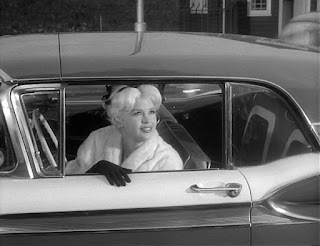
Whether it’s a true film noir is debatable but it certainly has a femme fatale and it has an ordinary man caught drawn into murky and dangerous waters but he’s not a true noir protagonist because he’s never in danger of being corrupted by the noir underworld. It’s more a Hitchcock-style thriller with noir overtones and a dash of sleaze.

Anthony Quayle is very good, as always. The key character though is Billie and that’s where the movie potentially has a problem. It’s the sort of role that would have been tailor-made for Diana Dors who would have pulled it off effortlessly but Jayne Mansfield (who was a fine comic actress) isn’t in the Diana Dors class as a serious actress and doesn’t really have the acting chops for such a complex role. But she gives it her best shot and she’s a lot better than one might have expected.

This is very much a B-movie but it’s consistently entertaining and well worth a look for fans of gritty crime movies. Renown Productions’ UK region-free PAL DVD release lacks extras but it’s a very nice transfer of a little-known and underrated movie.

You also get to see Jayne Mansfield wearing one of the most bizarre dresses ever worn by an actress. She looks little Little Bo Peep, if Little Bo Peep had decided to forget the sheep (which keep getting lost anyway) and head to the big city to take up a career as an exotic dancer. If I’d been her I’d have asked for extra money for wearing that dress.

The Challenge isn't perfect but it's worth seeing. Highly recommended.

Saturday, January 14, 2012

Beau Geste (1939)

I have a real soft spot for Gary Cooper. I know he’s not everyone’s favourite, that many people consider him wooden, but I’m finding that I like him more and more. In particular I think he’s very underrated as a comic actor. Beau Geste gives him some opportunities to display this side of his talent but mostly it’s an old-fashioned adventure film. And a very very good one.

The three Geste brothers are orphans who’ve been raised by the kindly Lady Patricia Brandon, along with the mildly obnoxious heir to the Brandon fortune, Augustus Brandon. The eldest of the Geste boys is Michael, known as Beau (Gary Cooper). The youngest, John Geste (Ray Miland), is in love with Lady Patricia’s daughter (played by a very young Susan Hayward).

Beau Geste (1939)

Unfortunately much of this fortune has been gambled away by Lady Patricia’s dissolute husband, Sir Hector Brandon. In fact only one real treasure remains to the estate is the fabulous sapphire, the Blue Water. Until the days comes when that too must be sold. Except that it is mysteriously stolen, and Beau just as mysteriously disappears. His brother Digby (Robert Preston) soon departs as well, followed by John.

Needless to say the general assumption is that on of the Geste boys has stolen the sapphire. And where have the three brothers gone? They’ve gone to join the Foreign Legion.

Beau Geste (1939)

There they find themselves exposed to the none-too-tender mercies of the brutal Sergeant Markoff (Brian Donlevy). He’s as avaricious as he is brutal and he soon gets and of the fact that one of the Geste brothers almost certainly has the Blue water sapphire. And he wants it.

He also wants command. The actual commander of Fort Zinderneuf is Lieutenant Martin but when he falls ill of fever Markoff sees his chance. If Martin dies, which seem certain, he will assume temporary command, but if he can do something incredibly heroic and impressive he would have an excellent chance of getting a commission. Something like putting down a mutiny would do just fine. If there’s no mutiny in the offing, he can always manufacture one. All he has to do is push the men hard enough.

Beau Geste (1939)

After their experience of Markoff’s sadistic command style most of the soldiers are ready to give him the mutiny he wants. Except for the Geste brothers, Beau and John (Digby has been posted elsewhere), and a handful of others. At this moment a horde of Tuaregs arrives on the scene and mutiny has to take a back seat to survival. For Markoff it’s another opportunity - a heroic defence of the fort will do just as well to earn him his commission. And whatever his failings, Markoff is an able soldier.

The epic defence of the fort provides some spectacular action scenes, ably handled by director Wiliam A. Wellman. We already know the final result since the opening scene of the movie showed us the arrival of the relief column and the shocking discovery they made when they entered the fort. The rest of the movie is essentially one long flashback which will provide the explanation of their discovery.

Beau Geste (1939)

The cast is uniformly superb. Brian Donlevy goes close to sealing the picture but really everyone plays their parts to perfection.

This is a thrilling combination of action, romance, adventure, old-fashioned heroism and high drama, the sort of things movies were all about back in the days when Hollywood made great movies.

Wednesday, January 11, 2012

Where Danger Lives (1950)

Australian director John Farrow made only a handful of movies that could be described as film noir but the ones he did make are exceptionally interesting, and the best of them may well be his 1950 production for RKO, Where Danger Lives.

This is a somewhat underrated entry in the noir cycle and it’s rather odd that it hasn’t received more attention. It was an A-picture with some big name stars (Robert Mitchum and Claude Rains) made by a well-respected director and it not only ticks most of the noir boxes it also has some interesting features of its own.

Mitchum plays a dedicated young doctor named Jeff Cameron. He loves his work, he’s highly thought of and he’s engaged to be married to an equally dedicated nurse (Julie, played by Maureen O’Sullivan). Life is good and it promises to get better. Then fate steps in. Just as he’s about to leave the hospital to go on a date with Julie he’s called back to attend an emergency, an attempted suicide.

The attempted suicide is Margo (Faith Domergue). She’s not in any real danger but she seem a little evasive, and the guy who brought her in seems even more evasive. The following morning when Jeff goes to check on her he discovers she’s given a false address and has discharged herself. Then he gets a cable from her, asking him to meet her at a night-club.

He’s instantly smitten by her. She’s sexy and glamorous and (given the fact that she’s just tried to kill herself) she’s obviously emotionally disturbed. He’s a sensitive man who’s devoted his life to helping people (we discover as the movie progresses that he really is a man who chose medicine as a career for the highest motives and is relatively indifferent to money). A man like that really doesn’t stand a chance - here’s a chance to save somebody who also happens to be sex on legs. Pretty soon they’re dating.

She tells him her sad story. She lives with her father, an elderly man with not long to live who is something of a control freak. He could, and would, cut her off without a penny (and he’s a wealthy man) if she wanted to mary a man he didn’t approve of. And it sounds like he’s a man who’s unlikely to approve of a penniless young doctor who doesn’t even have a practice of his own. Of course she loves Jeff and wants to marry him but she tells him it’s going to be tricky handling her father. Jeff doesn’t care about her father’s money. He just wants to marry her. After having a few too many drinks he turns up at her house with the intention of trying to talk the old boy around and he quickly discovers that nothing that Margo told him was true. Most importantly, Mr Lannington (Claude Rains) is not her father.

Things get out of control rapidly, there’s a struggle and Mr Lannington attacks him with a poker. Jeff punches him and Lannington is knocked out cold. Jeff had received a very nasty blow on the head and he’s extremely groggy but everything is OK, he’ll just get some water and bring Lannington around and then he can leave and go back to his decent ordinary everyday life. He just needs to put his head under some cold water to clear it a bit. When he returns from the bathroom he finds that everything is not OK and he’s not ever going to be able to go back to the daylight world. He’s trapped in the noir nightmare world and there’s no escape. Margo announces that Lannington is dead.

Jeff still thinks everything is not lost. After all it was a clear case of self-defence. But he’s very groggy and he just can’t think straight and Margo tells him nobody will believe him but it’s OK because she has two plane tickets booked for Nassau and they should just head for the airport. Jeff isn’t sure that’s a good idea, they should just call the police and explain everything, but his head is swimming and maybe Margo is right. The airport turns out to be a bad idea and pretty soon they’re in her car heading for the Mexican border and the noir nightmare world has claimed them well and truly.

Jeff is not your typical noir protagonist. He’s not a chump. He’s not the kind of guy who would normally be caught in this kind of nightmare. He’s not a Walter Neff, with the seeds of corruption already inside him just waiting to blossom. It’s the blow on the head that dooms him. All the evidence he needs to work out what is really going on is there before him and normally he’d work it out in quick time but his head just keeps spinning and he can’t put his thoughts together.

Mitchum is terrific, as always. Faith Domergue is the big surprise. She’s not particularly well thought of as an actress (she got her contract with Howard Hughes for the usual reasons) but she’s perfectly cast and does a fine job in a difficult role. Margo isn’t quite the typical femme fatale -she’s clearly not playing with a full deck and we’re never quite sure just how conscious she is of what she is doing and the effects it has on others. The ambiguity is never fully resolved, one of the features that make this movie slightly unusual as 40s Hollywood movies go.

John Farrow shows himself to be a master craftsman. His framing of the scenes involving Mr Lannington, Jeff and Margo is constantly shifting reflecting the unstable dynamics between the three of them, with Jeff and Margo seeming to be drawn together at one moment only to be split apart the next. At times Lannington recedes into the background and seems insignificant only to be suddenly brought into the foreground as the power shifts. The scenes between Margo and Jeff show the instability and ambiguity of their relationship. One moment they seem to be synchronised and then we realise they’re not in tune at all. It’s all done with subtle manipulation of the framing.

Farrow makes extensive use of long takes. One vital scene is done in a single shot, seven minutes without a single cut. Farrow was apparently a prickly character and even more than most directors he detested having his work interfered with. Perhaps long takes were his way of preventing studio interference. When you do your most crucial scenes in very long takes there’s not much the studio can do - they can’t eliminate the scene or shorten it or recut it. Either way it’s a technique that requires not only great skill and self-confidence from a director but also enormous confidence in his actors, and Mitchum and Domergue are equal to the challenge.

Farrow has the advantage in this film of having the great Nick Musuraca as his cinematographer. That, combined with an intelligent and literate script by Charles Bennett, superior acting performances and a director who is in complete command of his craft, makes Where Danger Lives an object lesson in just how good classical Hollywood film-making could be. Highly recommended.

Sunday, January 8, 2012

A Scandal in Paris (1946)

A Scandal in Paris (1946)

Douglas Sirk’s 1946 film A Scandal in Paris (Thieves' Holiday) is a fictionalised account of the extraordinary career of François Eugène Vidocq, a famous criminal who became an even more famous policeman.

Vidocq’s misspent youth was very misspent indeed. He allegedly killed a fencing instructor at the age of 14, joined the army several times and was cashiered just as many times, fought many duels, was a professional gambler, a thief, a forger and a pirate. After which he became a police spy and went on to found the French criminal investigation department of the Paris police, the Sûreté. He was one of the pioneers of modern police methods, especially the use of undercover operations and was renowned as a master of disguise

A Scandal in Paris (1946)

When I say the film fictionalises his life it should be noted that most of what is known about Vidocq comes from his own accounts of his life and is most likely highly unreliable. Either way he was obviously perfect material for a movie, and who better to play a charming rogue than George Sanders?

In the movie version Vidocq is as notorious for his pursuit of the ladies as for his pursuit of dishonest money, and ideally prefers to combine both. Stealing the ruby-studded garter of the girlfriend of the chief of the Paris police is one of his more colourful exploits, although it’s one that will come back to haunt him.

A Scandal in Paris (1946)

Vidocq actually starts the movie in prison. He escapes along with his cell-mate, Emile Vernet (Akim Tamiroff). He gets a job, posing as a model for an equestrian painting of St George and the dragon, and promptly steals both horse and costume. A chance encounter in a graveyard brings him into contact with the family of the Minister of Police. He naturally takes the opportunity to rob their house. And then an idea occurs to him. The Minister has fired his Chief of Police for being unable to solve the crime - if Vidocq could present him with the solution, and the stolen jewels, the Minister might be persuaded to appoint him as Chief of Police. Just imagine the possibilities that might open up for criminal activities on a scale he has not previously even been able to contemplate.

There is a complication however. The beautiful daughter of the Minister, Therese (Signe Hasso), has fallen in love with the man in the painting of St George, who is of course Vidocq. When she meets the actual Vidocq she discovers he really is the man she wants, but she’s a virtuous young woman and could never marry a thief. In fact she wants to save him from his life of wickedness. Will he choose love or crime?

A Scandal in Paris (1946)

This movie is a delight from start to finish. It’s a complete romp, and makes no concessions to anything as boring as realism. Vidocq’s biography is outrageous and fanciful and the movie takes its cue from that. The dialogue sparkles. The sets and costumes are extravagant. The tone is light-hearted, sophisticated and good-natured. The scene on the Chinese carousel is a nice touch.

George Sanders is of course superb in a role that allows him full scope for his talents. He gets fine support from Gene Lockhart as Richet, the former Chief of Police, and Carole Landis as Richet’s wife.

A Scandal in Paris (1946)

This movie is total entertainment and I can’t recommend it too highly. Absolute joy.

Odeon’s all-region UK DVD release boasts no extras but sound and picture quality are generally good.

Wednesday, January 4, 2012

The Sign of Four (1932)

It’s almost impossible to count the number of actors who have played Sherlock Holmes on either the big screen or the small screen. One of the more successful, although now largely forgotten, was Arthur Wontner.

Wontner played the great detective in five British films between 1931 and 1937 (one of which is sadly now lost). The third of the Wontner Sherlock Holmes movies was The Sign of Four, in 1932. It’s a reasonably faithful adaptation of Sir Arthur Conan Doyle’s novel of the same name.

The Sign of Four (1932)

The most interesting change is that whereas in the novel the mystery is revealed at the end (as you’d expect in a mystery novel) in the film it’s revealed at the beginning. The movie is therefore not so much concerned with the mystery as such, as with the way in which Sherlock Holmes solves it. It’s a perfectly valid technique and one that has been used with success by some very notable mystery writers. I’ll try to reveal as little as few plot details as possible in this review.

The mystery in this case revolves around a fabulous Indian treasure and an assortment of people who believe they have some claim on it although they’re all in fact thieves.

The Sign of Four (1932)

The mystery begins with the daughter of a British Indian Army officer who inexplicably starts to receive gifts of extremely valuable pearls. She receives a letter explaining merely that the gifts are to right a wrong that has been done to her, and she suspects it has something to do with the mysterious death of her father. He had been stationed in the penal colony in the Andaman Islands. A plan of a fortress with four names on it (the sign of four of the title) will provide another clue.

Wontner makes a pretty good Holmes. There are even those who have claimed that he is the definitive Holmes. I don’t agree (I regard Basil Rathbone and Jeremy Brett as the two greatest interpreters of the role) but Wontner is perfectly acceptable. Ian Hunter is an adequate Watson.

The Sign of Four (1932)

Director Graham Cutts was a major player in the early days of the British film industry, being a co-founder of Gainsborough Studios. He was apparently somewhat difficult to get along with and his career declined after the introduction of sound. His subsequent reputation has suffered due to the fact many of his movies have either not survived or are difficult to see. On the evidence of this film he was a talented director. For a 1930s British movie it features some rather bold stylistic flourishes, it’s well-paced and it’s exciting with a surprising number of action sequences (and includes an impressive speedboat chase).

If you’re a Sherlock Holmes fan this one is well worth watching.

The Sign of Four (1932)

One of the chief obstacles to the enjoyment of this movie is the very poor quality of the public domain prints that are available. Both sound and picture are terrible. It’s a pity because it’s by no means a bad movie.

Monday, January 2, 2012

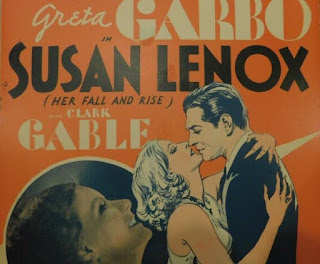
Susan Lenox (Her Fall and Rise)

Susan Lenox (Her Fall and Rise) is a movie that does not seem to be highly regarded today either by Greta Garbo’s fans or by Clark Gable’s. In fact this 1931 MGM movie doesn’t seem to be highly regarded by anyone which is a pity. Perhaps the problem is that it’s pure melodrama and we live in an age that finds melodrama unsettling without a hefty dose of irony. The opening sequences are an object lesson in succinct story-telling.

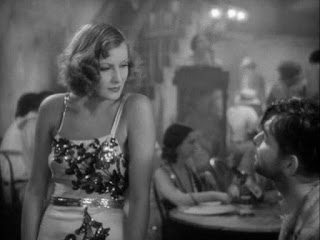
A woman in a very conservative Swedish immigrant community in the US dies giving birth to a illegitimate child. The child, Helga (Greta Garbo), is raised by her brother-in-law. He does his duty by her but cannot show her any love, being ashamed of the circumstances of her birth. He arranges a marriage for her but, repelled by the drunken advances of a man she does not love, she runs away before the marriage.

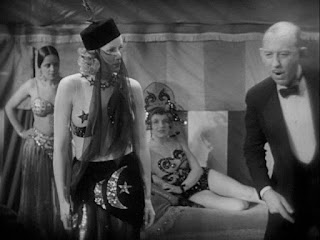
She ends up hiding out in the barn of a neighbour in the middle of a rainstorm. He’s an engineer named Rodney Spencer (Clark Gable) and he’s like no-one she has met before. He’s cheerful, good-natured and kind and it’s obvious they’re going to fall madly in love. But fate steps in. Rodney has to go to Chicago and while he’s away her brother-in-law and he intended husband turn up. She flees, and ends up joining a travelling carnival (I warned you this was pure melodrama).

Rodney sets off in search of her but unfortunately she’s spent the night with the manager of the carnival. She didn’t really have a choice as her husband-to-be turned up again and it was the only way to persuade the manager to hide her but Rodney isn’t very understanding and their relationship seems to have encountered an insurmountable obstacle.

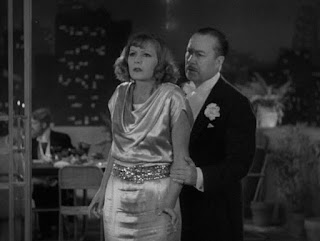
Helga decides that if Rodney thinks she’s a whore then she’ll be a whore. A very successful one. She re-invents herself as Susan Lenox and becomes a wealthy and sought-after courtesan. She is destined to cross paths with Rodney again however and it’s obvious that their love is a strong as ever even if it’s turned to hate. They realise too late that the strength of their hate is simply a measure of the strength of their love. Rodney embarks on a course of self-destruction, but Helga/Susan cannot forget him. Somehow she will find him again, even if she has to scour every low waterfront dive in the country. You cannot fight a love like this.

Garbo and Gable, unexpectedly, generate a very real if unconventional chemistry. They’re both stubborn but sympathetic characters. Gable has plenty of boyish charm and although it’s a little odd to see Gable as a champion of the old-fashioned virtues of fidelity his performance is quite successful.

Garbo plays a typical Garbo heroine, a woman for whom nothing matters except love. Even while selling herself to other men she never forgets Rodney. 

Robert Z. Leonard isn’t renowned as the most stylish of directors but he and cinematographer William H. Daniels (who photographed most of Garbo’s movies) do a fine job with the use of light and shadow especially in the early stages of the film. Telling the story of Helga’s childhood entirely as a kind of shadowplay is a nice touch, reinforcing the idea that she has never had her own life.

You have to accept that this movie obeys the rules of melodrama, so criticising the use of coincidence and the fact that a travelling carnival just happens to come along right when the heroine needs one is missing the point. It’s all gloriously romantic, a product of an age that still understood such things.

Highly recommended. The Warner Archive DVD-R is a rather nice transfer.

Sunday, January 1, 2012

The Man Who Would Be King (1975)

It took John Huston a quarter of a century to bring Rudyard Kipling’s The Man Who Would Be King to the big screen, but the wait was worth it.

Like almost everybody who has read Kipling’s original short story Huston had fallen in love with, and being a fikm-maker he recognised that not only would it make a great movie, it would it make a great John Huston movie. His first idea was to cast Clark Gable and Humphrey Bogart in the lead roles, but every time he thought the film was going to happen something went wrong. He had almost given up hope, and then in 1975, courtesy of producer John Foreman, he finally got his chance.

In some ways Huston was fortunate he had to wait until 1975 to make this move. While Gable and Bogart could certainly have played the leads there’s no question that Sean Connery and Michael Caine were much more suited to the roles.

The Man Who Would Be King (1975)

The story opens in India in the late 19th century with an encounter on a train between a newspaper reporter named Rudyard Kipling (Christopher Plummer) and a very disreputable character named Peachy Carnehan (Michael Caine). Peachy has just stolen Kipling’s watch, but he then looks at the medallion attached to the watch chain discovers to his horror that he has robbed a fellow Freemason. Peachy is a rogue, a cheat, a blackmailer and a thief but he does have a moral code of his own and stealing from a a brother Mason is something he could never do.

As a result of this chance meeting Kipling gets to meet both Peachy and Peachy’s partner-in-crime, Daniel Dravot (Sean Connery). And Kipling comes to learn of their plan. Peachy and Daniel have decided that India is too small for men such as them. They are planning to journey to Kafiristan to become kings. To reach Kafiristan they must pass through Afghanistan and Kipling assures them they will never make it alive.

The Man Who Would Be King (1975)

Peachy and Daniel are not deterred. They have spent every penny of their ill-gotten gains on the purchase of twenty Martini rifles. Being ex-British Army NCO’s they know how to train men to fight and they are confident they will soon carve out a kingdom. Kipling expects that he will never hear from them again but three years later he hears their tale. They achieved their goals, they won their kingdom, but at a terrible price.

Since the source material was a short story a considerable amount of expansion was necessary to make a feature film (the screenplay was co-written by Huston and Gladys Hill).The extra material is a perfect fit with Kipling’s original tale and adds to the power of the story. In particular the movie stresses the extent to which Daniel comes to believe in his destiny. He had always believed in his destiny of course of course but he had thought his destiny was to become fabulously rich by plundering a kingdom. Now he realises there was more to it. He has been hailed as the son of the legendary Sikander (Alexander the Great who conquered northern India in 328BC). Daniel starts to believe he really is the successor to Sikander.

The Man Who Would Be King (1975)

Freemasonry played a role in Kipling’s story but it’s even more important in the film, providing the key to the recognition of Daniel as a god as well as a king and leading him on to a dangerous self-delusion.

Connery and Caine are magnificent. These are larger-than-life characters and they pull out all the stops. The support cast includes Michael Caine’s wife Shakira in one of her rare acting appearances.

The Man Who Would Be King (1975)

The location shooting (done mostly in Morocco) is spectacular, the action sequences are impressive, the movie looks absolutely glorious. It has all the themes that were bound to appeal to John Huston - it’s a story of friendship, of aspirations that are insanely excessive and bound to have tragic results, of greed and ambition, of loveable rogues who are dishonest but brave, and it’s a story of obsession. It was perfect material for the man who’d made movies such as The African Queen, Beat the Devil and Moby Dick. It’s a story that is at times very moving but with a sense of fun mixed with tragedy, and with tragedy mixed with irony.

Of course such a movie could never get made today. It would be accused of cultural insensitivity and countless other sins against political correctness.

The Man Who Would Be King (1975)

The UK Blu-Ray release looks superb and includes a contemporary making-of featurette that shows John Huston clearly having a great time.

This has always been one of my favourite movies of all time and it still stands up as well as ever. Very highly recommended.