Monday, January 27, 2020

Guns, Girls and Gangsters (1959)

Kino Lorber have released a three-movie set of crime potboilers featuring legendary blonde bombshell Mamie van Doren. So far I’ve only watched Guns, Girls and Gangsters but already I’m a confirmed Mamie van Doren fan.

Chuck Wheeler (Gerald Mohr) has just been released from San Quentin and he has big plans - to rob an armoured car carrying the take from Las Vegas casinos to LA. The haul should be at least two million dollars (an astronomical amount of money in 1959). The only thing is, he needs Joe Darren (Grant Richards) because Darren is the one guy who knows how to launder the money. To get to Darren he intends to use his old cellmate Mike Bennett’s wife Vi Victor (Mamie van Doren). Vi is a canary working at one of Darren’s night clubs and Daren’s been making time with her. As well as the two million Chuck intends to get Vi as well. Considering that her husband Mike (Lee van Cleff) is insanely jealous and psychotically violent and is being released in three months’ crime any man thinking of putting the moves on Vi seriously needs his head examined. But of course the whole point of the movie is that any man who sets eyes on Vi is not exactly going to be thinking sensible thoughts.

Chuck’s plan is a good one but Chuck is thinking more about Vi than anything else. His judgment is not as sound as it might be (I must say I can’t blame him).

The plan might have worked except that Mike has found out that his wife has been sleeping around while he was inside so he busts out and proceeds to create havoc for everybody, leaving an ever-lengthening trail of corpses behind him. Vi makes every man crazy but crazy doesn’t even begin to describe what she does to Mike.

The movie relies a lot on voiceover narration which is usually a bad idea but there’s a lot of plot to be packed into the 70-minute running time so it’s perhaps excusable. And it’s important to get the background to the crime sketched in as quickly as possible so we can get to what’s really important - Mamie van Doren. That’s what the audience for this film wants to see, and there has to be time to let her do a couple of musical numbers so we can see just how sexy she is. And she’s plenty sexy.

Vi is hardboiled and not very moral but she’s also rather sentimental. There’s a sweet kid underneath the bad girl exterior. Life hasn’t offered her much and she’s had to take what she can get, which she’s done without hesitation, but while she’s unscrupulous she’s not in the least evil. Miss van Doren does a pretty reasonable job here. She makes Vi believable and she makes her interesting.

As a singer and dancer she wouldn’t set the world on fire (although she’s OK) if it wasn’t for that body, but she has that body and she’s read the instruction manual that came with it. Her night club performances are what you’d expect in the old Vegas of the late 50s. This was the Vegas of the Rat Pack and the movie captures the atmosphere of money and seedy glamour.

Cult movie fans will naturally be waiting to see Lee van Cleef make his entrance. He doesn’t disappoint. He’s bad and mad and dangerous and he’s totally out of control. He’s a killing machine. Gerald Mohr is pretty good too as Chuck. Chuck is a bit like Vi. His problem is that he’s not quite as bad as he thinks he is.

The heist scenes are done fairly well. This was a pretty low budget film but while it might lack sophistication director Edward L. Cahn keeps things moving along at a cracking pace. It’s also moderately violent by 1959 standards. Of course there’s no gore or anything remotely approaching it but there are a couple of killings that are chilling in their cold-bloodedness. This is a movie that tries to be hardboiled and mostly it succeeds.

The anamorphic transfer is very good. There are no extras. The movie is in black-and-white and looks all the better for it.

This is a B-movie and it makes no apologies for this. It glories in it. It’s a celebration of tackiness and trash culture. It wants to be lurid, and it is.

This would be an entertaining little B-movie even without Mamie van Doren. With her it’s loads of fun. And she sure does fill a dress very nicely.

Guns, Girls and Gangsters is highly recommended.

Sunday, January 19, 2020

Robbery (1967)

Robbery is a 1967 British crime thriller directed by Peter Yates and based on the Great Train Robbery of 1963. Steve McQueen saw this film and was so impressed, especially by the car chase, he hired Yates to direct his next film. That film would be Bullitt.

Robbery was produced by Stanley Baker who is also the star. In 1967 Baker was one of the most significant figures in the British film industry. He was a huge star in Britain and after Zulu in 1964 he was a pretty big star internationally. Baker wanted to be more than just a star and he was already establishing himself as a major force behind the scenes. Baker was the first major British film star to be unequivocally and unapologetically working class and as such he not only helped to change the whole character of he industry in Britain, he also paved the way for a new wave of working class stars like Sean Connery and Michael Caine.

Robbery starts in the middle of what is obviously a heist but we don’t really know what’s going on. It’s a meticulously planned and timed operation, the sort of robbery that could only have been planned by someone who believes in obsessive attention to detail. It culminates in a car chase but it’s not until the heist is over that we discover it was a diamond robbery. But this movie is not about that diamond robbery. The diamond job was  merely a way of raising capital for a much bigger much more ambitious job. In fact the biggest robbery ever carried out in Britain up to that time.

The diamond robbery went without a hitch. Well, almost. There was one tiny mistake which lands one of the gang in prison. Not so much a mistake, more a case of one of those little things that goes wrong that cannot possibly be anticipated. This sets the tone for the rest of the movie. The mastermind behind the robberies is Paul Clifton (Stanley Baker). He plans his crimes like military operations. Every single detail is planned and rehearsed and then rehearsed again.

This is very much one of those heist movies in which the emphasis is on the buildup and then on the detailed unfolding of a complex plan. That’s not to say that it’s lacking in action, but the action is always balanced by slower scenes in which the tension builds remorselessly. Clifton’s robberies are so well planned that nothing can go wrong but of course we know that something will go wrong, we just don’t know what it is that is going to bring disaster, and we don’t know how bad the disaster will be since Clifton is the sort of guy who believes in having a contingency plan for everything. He doesn’t have a driver for every vehicle, he has two.

This movie also represents something of a major departure for heist movies in its emphasis on realism. The criminals behave like real criminals. The cops behave like real cops. The police investigation is obsessively realistic police procedural stuff. The cop leading the investigation, Detective Inspector George Langdon, might not be a man of brilliant insights but he overlooks nothing.

Even the car chase is grittily realistic. We really believe we’re watching a real police pursuit through real streets. It’s exciting but unglamorous - the excitement comes from the sense of realism.

The focus is on the nuts and bolts of both crime and police work. The characters are cogs in a machine, with no real personality. We have no idea what motivates Paul Clifton. He’s a criminal because that’s what he does for a living. He wouldn’t know how to do anything else. Inspector Langdon is a cop because he wouldn’t know how to do anything else. The one exception is Clifton’s wife Kate (Joanna Pettet), torn between her obviously genuine love for Clifton and her weariness of life as the wife of a career criminal. She is tired of waiting for him to get out of prison, tired of being a wife cut off from love (and very obviously tired of years without sex).

Yates was a fairly inexperienced director but the similarities in tone and approach between this film and Bullitt are so strong that he was clearly already starting to find his style. Having Douglas Slocombe, one of the greatest of all British cinematographers, on board would certainly have helped. Robbery has an overwhelming grinding sense of emptiness and futility. These are criminals who know they’ll eventually be caught, if not for this crime then for the next one. Their lives are interludes between prison terms. Escaping from the cycle is something that just doesn’t occur to them.

This is clearly a movie that had serious money spent on it, not surprising given Stanley Baker’s box office clout at the time.

The DVD from Kino Lorber offers a very nice anamorphic transfer. The main extra is an audio commentary that is unfortunately very disappointing, focussing mainly on trivial details that we could easily look up for ourselves.

It’s interesting to compare this movie with the excellent 1969 British TV series The Gold Robbers, also dealing with an intricately planned heist that slowly unravels due to the accumulation of small unanticipated factors that didn’t seem to be mistakes at the time but turn out to be fatal errors.

Robbery is gripping stuff. Very highly recommended.

Sunday, January 12, 2020

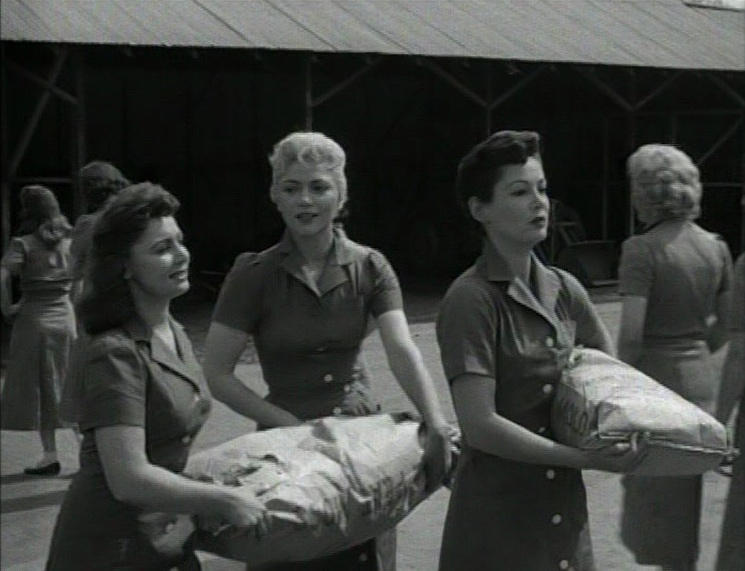
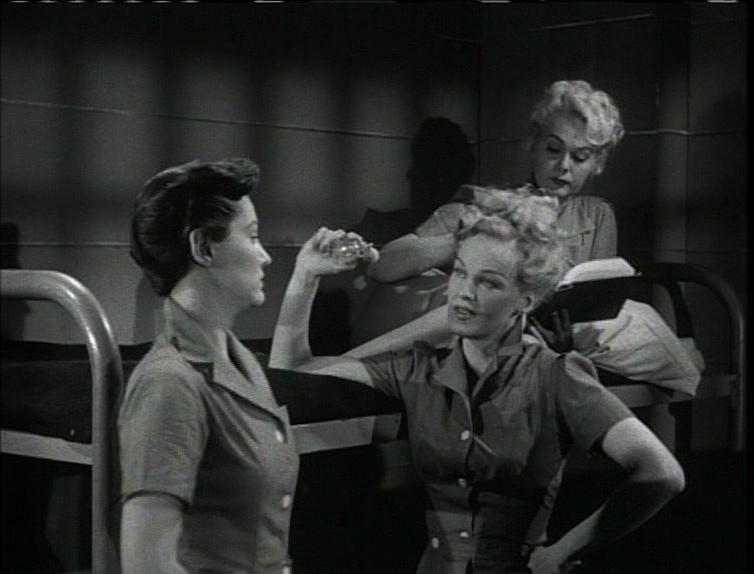
Girls in Prison (1956)

When a movie has a title like Girls in Prison you could be forgiven for thinking it’s going to be one of those hair-raisingly sleazy women-in-prison (WiP) movies of the 70s and early 80s. But this particular movie was made in 1956 so you know you’re not going to get graphic torture and lots of bare female flesh. So what exactly are you going to get?

There were relatively respectable mainstream movies dealing with women in prison, movies like Caged (made by Warner Brothers in 1950). Of course there’s no getting away from the fact that the subject matter is going to have at least a slightly lurid tinge but these movies at least tried to deal with the subject without too much sensationalism.

Girls in Prison seems to be a bit of a hybrid. It’s a low-budget B-movie which is not quite an exploitation movie but it veers pretty close to the line.

The movie’s pedigree may provide some hints as to the intentions behind it. Producer Alex Gordon made lots of movies for American International Pictures. Director Edward L. Cahn and writer Lou Rusoff had much the same sort of background. Executive producer Samuel Z. Arkoff was the man behind countless very cheesy although often very entertaining very low-budget flicks. This all suggests that this movie is not going to be an actual exploitation movie but it is going to be very much drive-in fodder. The film’s tagline - What happens to girls without men? - certainly has nicely lurid overtones.

Ann Carson (Joan Taylor) has earned herself a nice long stretch in the women’s penitentiary for her involvement in a bank robbery. Naturally she claims that she had no idea those men she was with actually intended to rob the bank. The court didn’t buy her story and the prison governor doesn’t either. But Rev Fulton (Richard Denning), the youngish very handsome do-gooder prison chaplain, swallows it hook, line and sinker. He just can’t believe that such a sweet innocent young girl (she’s supposed to be just twenty although Joan Taylor was twenty-seven and looks it) could have been mixed up in anything illegal.

While this is very definitely a women-in-prison movie and almost all the action takes place in the prison or in the fields where the women are put to work it’s also a crime thriller. A lot of money was stolen in that bank robbery. Everybody believes that Ann has the proceeds of the robbery stashed somewhere. And everybody wants it. Rather cleverly the movie keeps things a bit ambiguous. We figure out right from the start that the story Ann told in court was probably not strictly true in every detail but we’re still not sure of the precise nature of her involvement in the robbery. It is possible that she was an innocent dupe, or perhaps mostly innocent, or perhaps manipulated. Or she might even be totally guilty. It’s not just that her story is not absolutely convincing. Her behaviour is just a little odd.

Some of those who want that money are prepared to take drastic steps to get it. Ann shares a cell with Jennie, the tough-as-nails queen bee among the prisoners, and Melanee, a southern belle who’s probably never been within five hundred miles of the South. Jennie and Melanee are not exactly pals but they’re willing to work together to find a way to separate Ann from the money. There’s also a hoodlum on the outside who thinks he can get the money through Ann’s dear old dad (who is actually a conniving old ex-con). Given the pressure Ann is under you’d think she’d be delighted that Rev Fulton is trying to get an appeal ring on her behalf but she seems strangely hostile to the idea. Which doesn’t bother Fulton - he’s found someone to save and he’s going to save her whether she likes it or not.

It all leads up to a fairly outrageous climax.

There is a certain theme that plays a major rĂ´le in every women-in-prison movie made from the late 60s onwards. There’s going to be at least one female prisoner who is perhaps just a little too fond of other girls, if if you catch my drift. This theme is introduced in Girls in Prison very early on. Poor Ann finds herself being fondled and she’s not too happy about it. She doesn’t really like Melanee (Helen Gilbert) at all, and she certainly doesn’t like her in that way.

Joan Taylor’s performance as Ann is quite effective. She makes her just ever so slightly hardboiled but vulnerable as well and mostly she makes her ambiguous which is why the film requires. Adele Jergens is terrific as the totally amoral Jennie, as is Helen Gilbert as the frustrated lesbian Melanee. Phyllis Coates adds a disturbing touch as Ann’s other cellmate Dorothy, a completely insane murderess who thinks that every new prisoner is Lois, the woman she blames for the murders of her husband and son (of course Dorothy actually killed them in an insane rage after her husband ran off with this Lois woman).

The weak link is the reverend. He’s way too good to be true and he’s irritating. It’s a credit to Richard Denning’s natural charm that he doesn’t come across as so irritating that he spoils the movie.

Girls in Prison ticks most of the women-in-prison boxes. There’s lesbianism, there’s a catfight, Ann gets a beating. Of course this being 1956 it’s all very much toned down and very tame compared to later WiP films. The one thing missing is the sadistic prison warder. All members of the prison staff are paragons of virtue and overflowing with kindness. On the other hand the women prisoners are an appalling bunch so we can still understand why Ann isn’t having a good time. As a crime thriller this movie isn’t too bad.

Girls in Prison is not just a B-movie it’s on the cheap end of the B-movie spectrum but it’s fairly entertaining in a mildly disreputable and slightly trashy way. Recommended.

Saturday, January 4, 2020

Twenty Plus Two (1961)

Twenty Plus Two (AKA It Started in Tokyo) is a 1961 American private eye movie. It’s more in the straightforward mystery rather than the hard-boiled mould but there are some definite hints of film noir.

David Janssen stars. He was already a fairy well-known star on television thanks to the Richard Diamond Private Detective series. In Twenty Plus Two he’s Tom Alder, a private detective of a very specialised type. He finds people. That doesn't mean he takes ordinary missing persons cases. He finds missing heirs. If someone dies leaving a large estate and there are no known heirs he goes looking for heirs who may have been overlooked. Distant forgotten relatives. He then gets a percentage of the estate. It’s a good arrangement. These people have no idea that they are in line for inheritances from relatives of whose existence they may only have been dimly aware so they’re more than happy to pay him a generous percentage. He’s happy because he makes a very comfortable living indeed for doing a job for which he was a peculiar talent - for him it’s easy work.

Alder would not normally have any interest in the murder of Julia Joliet, a middle-aged woman who makes a living running a fan club for Hollywood star Leroy Dane, but some newspaper clippings relating to the Delaney case were found in Miss Joliet’s apartment. Twelve years earlier sixteen-year-old schoolgirl Doris Delaney disappeared. Her parents were very wealthy and influential people and the case attracted a lot of attention, and it remained a fascinating unsolved mystery. The Delaneys spent a fortune on private detectives to find their vanished daughter. If neither the police nor an army of private eyes could find Doris Delaney you might think that one man picking up such a cold trail twelve years later would have no chance. But Tom Alder is very very good at finding people. And he may have found a link that no-one else had spotted.

Alder is also finding that the past is hard to escape. He has run into Linda again. Linda Foster (Jeanne Crain) was his first love. Ten years ago she dumped him. It hurt. It hurt a lot. He had learnt to handle it but now she’s back and she wants him back and he has a feeling that he may be once again heading for a whole world of hurt.

There are numerous plot strands that don’t seem to be connected but of course they are connected and they’re resolved pretty well. While the plot is not really all that dazzling there are some very interesting and unusual elements to this film. The hero is most emphatically not an action hero. He doesn’t carry a gun (he’s not really a PI as such) and he doesn’t get into any fistfights. More unusually he doesn’t get beaten up. He doesn’t even threaten anyone. There’s only one scene with a gun and he’s not the one holding it. In fact he doesn’t do a single heroic thing. It’s not that he’s a wimp. He’s just not a tough guy hero. He’s an investigator and what he does is investigate.

Also unusual is the fact that he doesn’t go around interviewing witnesses and trying to pump people for information. He uses other people (real private detectives and contacts he has in useful places) to gather information. His talent is for putting the pieces of the jigsaw together, not for collecting the pieces. He just happens to be very good at putting those pieces together. He sees connections that others don’t see (such as a very minor but very significant difference between two photographs of the same person). Mostly Alder makes phone calls, patiently utilising his courses to assemble his clues (and the audience gets the same clues that Alder gets).

This is 1961, very much a transitional period in American movies. The Production Code was crumbling. This film deals much more openly with sexual subject matter than would have been the case even a couple of years earlier but it does so without ever getting sleazy or exploitative. It’s sex that drives the plot but sex is never used for titillation. There’s a flashback sequence in Tokyo in 1951 in which the young Alder meets a woman named Lilly in a bar. She’s obviously a whore but again the situation is handled subtly and without sensationalism.

Frank Gruber wrote and produced the film from his own novel. Joseph M. Newman directed, and quite effectively in a very low-key manner.

Janssen plays Alder with a certain quiet charm with perhaps just a touch of neuroticism lurking beneath the surface. It’s a fine performance. Jeanne Crain seems destined to be the femme fatale and she does it well. But then there’s Nicki (Dina Merrill) and she might turn out to be the femme fatale. And there’s also Lilly and she could qualify as well. One of the many interesting things about this movie is that the story arcs of the characters don’t develop as you expect they’re going to. Agnes Moorehead is in splendid form as the proud and rather shrewd mother of the long-lost schoolgirl.

The Warner Archive DVD offers a very good anamorphic transfer.

Overall Twenty Plus Two is a low-key slightly offbeat slightly noirish mystery and it’s really quite appealing. I highly recommend this one.

Tuesday, December 24, 2019

Calamity Jane (1953)

Having become quite a fan of Doris Day in other movie genres I thought it was about time for me to bite the bullet and attempt one of her musicals. Calamity Jane, made at Warner Brothers in 1953, seemed like as good a place as any to start.

Calamity Jane was an actual historical figure but don’t panic - this movie is not going to bother with anything as tiresome as historical accuracy. And in any case it appears that the real Calamity Jane was not exactly a sticker for accuracy when it came to recounting her adventures.

As the movie opens Calamity is saving a stage coach under attack from a Sioux war party. The stage coach is on its way to Deadwood in the Dakota Territory. Calamity’s account of the attack is embellished a little in the telling but it seems that the people of Deadwood are used to this. Wild Bill Hickok is particularly sceptical, which doesn’t prevent him from being a close and devoted friend to Calamity.

There is trouble brewing in Deadwood. The manager of the town’s only theatre has announced, with much ballyhoo, that he was importing a famous (and glamorous) actress from New York City. Unfortunately there was some confusion on the subject of gender and the actress who arrives is in fact an actor. The townsfolk (almost all of them men and exceptionally starved of female company) are most displeased and are about to trash the theatre when Calamity steps in. She will go to Chicago and bring back a real actress, a major star, the famous Adelaid Adams.

Calamity is not the most feminine of women and she’s a bit of a rough diamond. And her knowledge of the theatre is non-existent. She mistakes the great actress’s maid for the actress herself. The maid, Katie Brown, has always nourished the dream of a career on the stage and now sees her opportunity. She neglects to tell Calamity that she isn’t the great star.

As you might expect, her theatrical debut in Deadwood is somewhat eventful. The audience is initially pleased, Katie being an actual female and a fairly attractive one. When she tries to sing in the style of Adelaid Adams it becomes evident that she is an impostor. Once again Calamity comes to the rescue and when Kate is persuaded to simply be herself she becomes a surprise hit.

Katie and Calamity set up housekeeping together but there are complications. Both women are madly in love with a handsome young lieutenant. Of course you know that somehow or other true love is going to triumph.

Allyn McLerie, an actress I’d never heard of, is extremely good as Katie. Howard Keel is Wild Bill Hickok, and I’m afraid I’m not a fan of either his singing or his acting.

Doris Day on the other hand is a delight. She’s funny, she’s feisty, she’s convincingly butch  as the tomboy Calamity.

The movie has a very very artificial feel to it, which I like. It looks like it was filmed entirely on a sound stage and that gives it a very appealing unreal feeling. You don’t want anything as tedious as realism in a musical. It’s amusing, the sings are a bit uneven but they have their moments, it’s outrageously romantic and it’s just generally fun.

I wouldn’t go so far as to say that I’m a convert to 50s Hollywood musicals but I’ve now come across a couple that I’ve liked a good deal. Calamity Jane is recommended.

Monday, December 16, 2019

Viva Las Vegas (1964)

Viva Las Vegas is a pretty lightweight movie. Which is OK. It’s an Elvis Presley movie so you’e not going to be expecting Citizen Kane. The important thing is that it’s a great deal of fun. And unlike some of Elvis’s movies, it’s well-made stylish fun.

The plot is thin, and that’s putting it mildly. Lucky Jackson (Elvis) is an up-and-coming race-car river who heads off to Las Vegas to win enough money to buy a new engine for his race car so he can enter the Las Vegas Grand Prix. He wins the money at the gaming tables, and loses it in bizarre circumstances (well maybe not so bizarre since he was pursuing a young lady at the time). Now he’s forced to work as a waiter but the upside is that he’s met Rusty Martin (Ann-Margret) and he’s pretty sure that she’s the girl he’s been looking for all his life.

He has a rival both romantically and on the race-track, a suave Italian count Elmo Mancini (Cesare Danova). The count is actually a pretty nice guy but you might think twice about  trusting him with your car or your girl.

Rusty falls for Lucky just as hard as he falls for her but there’s a snag. She’s worried about his driving. She doesn’t want to be the widow of a race-car driver. Lucky is equally determined not to give up his dream of success on the race-track.

Lucky’s immediate problem is how to find the money for that engine he needs but at the same time he’s not going to give up on Rusty. That’s pretty much it for the plot, and for the type of movie this is it’s perfectly adequate. There’s the right mix of humour and romance. The humour isn’t overdone. The temptation to resort to overly broad comedy or slapstick is resisted, and quite rightly.

However slight it might be plot-wise and thematically this movie has several very big things in its favour. Firstly there’s Elvis. It’s not a demanding rĂ´le (he was a decent actor and could handle more ambitious parts) and mostly what he has to do is to be charming, likeable, sexy and charismatic. All of which he manages with ease.

Secondly there’s Ann-Margret. She’s the perfect leading lady for him. She can match him charisma for charisma and star quality for star quality and she seems like exactly the sort of gal that a character played by Elvis would fall in love with. She gets to do several songs including a showstopper Las Vegas-style big production number. Her acting is more than adequate, she makes Rusty feisty but cute and she looks stunning. And she gets a memorable entrance that lets us know we’re in the presence of a star.

Thirdly there’s the fact that MGM spent some serious money here and they hired some very competent people. Screenwriter Sally Benson had written Shadow of a Doubt for Hitchcock and she wrote the screenplay for Anna and the King of Siam. Director George Sidney had helmed a string of classic musicals such as Anchors Aweigh, The Harvey Girls, Annie Get Your Gun, Show Boat. Viva Las Vegas is a slick, polished well-crafted musical and Elvis’s performance of the title tune in the talent contest is a highlight.

And lastly there’s the other major star of the movie - Las Vegas itself. There’s quite a bit of location shooting, in places like the Flamingo Hotel and the car race through the city. This was the old Vegas - brash, vulgar and pulsating with life and excitement.

This is also a very good-natured movie. There’s no villain. Count Elmo will try his darnedest to win Rusty but he won’t cheat to do it and he won’t cheat to win the Grand Prix either. He’s a sportsman. His rivalry with Lucky is a friendly rivalry.

Then there are the songs and on the whole they’re pretty good.

The Deluxe Edition DVD offers a very good 16:9 enhanced transfer, an audio commentary and an excellent documentary on Elvis in Vegas.

Viva Las Vegas is immense fun. Very highly recommended.

You might also be interested in my review of Jailhouse Rock.

Sunday, December 8, 2019

The Third Man (1949)

The Third Man, directed by Carol Reed and released in 1949, is generally recognised as not just one of the greats of film noir but as one of the greatest movies of all time. I’ve seen it a couple of times and it would make my top ten list. Now I’m about to revisit it. Will I be as impressed this time as I was last time? We will see.

Despite the international cast The Third Man was a British production. The location shooting (of which there’s a great deal by the standards of 1949) was done in Vienna. Although there was not only a second unit but a third as well Reed in fact directed almost everything himself.

Holly Martins (Joseph Cotten), a popular American writer of westerns, arrives in Vienna shortly after the end of the Second World War. The city is occupied by the armies of the British, the Americans, the French and the Russians. Holly is broke but his old friend Harry Lime has tempted him to Vienna with the promise of work. Unfortunately by the time Holly arrives Harry Lime is dead, run over by a truck.

There were several witnesses to the accident but they all tell slightly different stories. Harry was killed instantly. He lived for just a short time. He lived long enough to pass on an important message. Holly has a bit of an over-active imagination and this combined with the odd discrepancies in accounts of the incident arouses his suspicion. British military policeman Major Calloway (Trevor Howard) advises him to leave Vienna but Holly is now determined to find out what really happened. Two men carried Harry’s body to the side of the road after the accident, but some accounts mention a mysterious third man. Holly is particularly keen to find this third man.

Holly tracks down Harry’s girlfriend Anna Schmidt (Alida Valli), Harry’s doctor and several of the witnesses, none of whom are very coöperative. He begins to suspect that Harry was actually murdered. Holly is right about the accident not being what it seemed to be but his theory as to what happened is quite wrong. Holly will find out the truth, but do we always want to know the truth? Does it actually help us?

When Greene was hired to write the screenplay he first wrote the story out as a novella which was later published (and the novella differs from the movie in several key points). This was one of the three collaborations between Greene and Carol Reed (the others being The Fallen Idol and Our Man in Havana) and those three movies are close to being Reed’s best work. Greene was quite lucky when it came to move adaptations of his stories. Apart from the lamentable 1958 version of The Quiet American most have been pretty good and several have been superb (not just the three films with Reed but also Brighton Rock and This Gun For Hire). Greene was a naturally cinematic writer, possibly the first great novelist to have a natural affinity for movies.

The Third Man has three huge claims to cinematic greatness. Firstly there’s the story. The screenplay was written by Graham Greene from one of his own stories. With Greene as the writer you know you’re going to get a tale that is literate and intelligent with a dash of black humour, deliciously twisted, and highly entertaining. There are plenty of typical Graham Greene obsessions in this tale. Betrayal of course. Not just betrayal of love, but betrayal of illusions. The idea that knowing the truth doesn’t necessarily make a person better off.

Its second claim to greatness is the cast. There’s Orson Welles, at the peak of his powers and in the rĂ´le of his career. But he’s not directing so his performance is more disciplined that usual. Then there’s Joseph Cotten, a good actor who is well cast and gives his career-best performance. And then there’s Trevor Howard, again perfectly cast and in top form. Alida Valli is excellent as Harry’s girlfriend. The supporting cast is equally impressive, with Bernard Lee especially good as Calloway’s sergeant. And there’s an aded bonus - the always delightful Wilfred Hyde-White.

Its third claim to greatness is its stylistic brilliance. It’s so stylish that there have been rumours that Welles took a hand in the directing. No-one familiar with Carol Reed’s career as a director would believe this for a moment. Style was Carol Reed’s middle name. And if you compare it to other notable Reed films such as Fallen Idol and Our Man in Havana you will see exactly the same visual flourishes that you see in The Third Man. Carol Reed didn’t need anyone’s help to direct a masterpiece. And in The Third Man he’s on fire. Reed used visual tricks when they were needed. This was a movie that lent itself to a bravura approach. This is the world of Harry Lime and nothing is straightforward.

Apart from the absurd claim that Welles had a hand in the directing there’s the equally nonsensical claim that he contributed in a major way to the script. In fact he contributed one line. These silly claims seem to have originated with Welles. Welles’ career as a director ended up amounting to virtually nothing and his one really memorable acting performance, in The Third Man, was a supporting rĂ´le in someone else’s movie. This must have rankled with him and may have led him to make these ridiculous wildly exaggerated claims.

Every single shot in this movie is exquisitely composed and photographed. There’s not a single moment that hasn’t had care and attention lavished on it. Cinematographer Robert Krasker won an Oscar for his work on this film. If it’s film noir visual style you’re after then this movie has it in abundance. In fact it’s hard to think of any movie that is more visually film noir than this one.

Mention must also be made of the famous zither soundtrack. l disliked it the first time I saw the movie but now I realise Reed was quite right in his judgment. It adds to the unique flavour of war-torn Vienna.

The StudioCanal Blu-Ray offers an excellent transfer and a host of extras. There have been many DVD releases of the film, some good and some terrible. This is one instance where, if you’re a fan of the movie, it probably is worthwhile upgrading to the Blu-Ray.

The Third Man may not be a perfect film but it’s about as close to perfection as you’re ever going to get. There’s not a single false note, not a single weakness. I said at the beginning that it would make my list of the ten greatest movies of all time and I’m now more convinced than ever of this. A truly great movie. Very very highly recommended.

You can find my review of Greene's novella The Third Man here.