Saturday, October 2, 2021

The Web (1947)

The Web is a 1947 film noir with a fine cast who have quite a list of noir credits between them.

Edmond O’Brien is Bob Regan, a struggling lawyer who is hired by wealthy industrialist Andrew Colby (Vincent Price). Why would a rich man like Colby want to hire a cheap lawyer, and more to the point why would he want to hire a lawyer as a bodyguard?

He claims to need a bodyguard because a former business associate, an old guy named Kroner, is just out of prison and nursing a grudge against him. Kroner was convicted of selling counterfeit bonds.

It soon turns out that Colby really did need that bodyguard, and it’s lucky that Regan is handy with a gun.

Regan’s buddy, Lieutenant Damico (William Bendix) isn’t happy about the shooting. Regan wasn’t worried about it, but now he is.

Regan still finds time to romance Colby’s private secretary, Noel Faraday (Ella Raine). Noel is beautiful, self-assured and very very classy. She’s about a million miles out of Bob Regan’s league. She is also very obviously Colby’s mistress. So it’s strange that Colby isn’t bothered by Regan’s attempt to romance her. Which is odd, since Colby is not the sort of man who would tolerate his woman playing around. He paid good money for her and she’s his property. Regan isn’t the sharpest knife in the drawer and he has no idea of exactly what he’s getting himself into.

He does realise that he’s gotten himself into, potentially, real trouble. So he decides to play amateur detective. One can only hope he’s better at being a lawyer than a detective. Even worse he decides to lay a trap, not realising that maybe he’s the one walking into a trap.

Edmond O’Brien was ideal as the kind of noir protagonist who is basically a nice guy who’s gotten seriously out of his depth. In other words, a good-natured chump. This was a breakthrough role for him, proving he had what it takes to be a leading man.

William Bendix is of course quite competent at playing a cop.

This was several years before Vincent Price made his first horror movie. At this stage of his career Price was mostly getting second lead roles, but second lead roles in very good movies. He seemed to be very much a rising star. He made a perfect smooth noir villain. He’s in fine form here, playing a man who is as charming as he is ruthless.

Ella Raines often played the good girl in noirs but this is more of a femme fatale role and she seems to relish it (as most actresses do). She’s smooth and silky and sexy and you get the idea that she’s probably dangerous to handle. Whether she’s really a femme fatale in this case is something you’ll have to watch the movie to find out. It’s a nicely ambiguous performance.

Michael Gordon had a reasonably successful career but he’s one of those directors who just doesn’t seem to attract any attention.

Kino Lorber’s DVD offers an excellent transfer and an audio commentary track (they’ve also released this title on Blu-Ray).

Whether The Web is a true film noir or not is another thing you’ll have to watch the movie to find out. It certainly has plenty of classic noir elements and touches of noir visual style.

The Web is a rather nifty little movie, part film noir and part melodrama. Highly recommended.

Saturday, September 25, 2021

The Macomber Affair (1947)

British-Hungarian director Zoltan Korda’s The Macomber Affair is based on Ernest Hemingway’s short story The Short Happy Life of Francis Macomber. It’s interesting that the most successful Hemingway adaptations (The Killers, To Have and Have Not) aren’t true adaptations - they merely take a Hemingway novel or story as the starting point. The more faithful adaptations don’t seem to work quite as well. Hemingway seemed on the surface to be ideal material for Hollywood but this wasn’t really the case. The raw existentialism of Hemingway could never be made palatable to Hollywood’s audience and without that raw existentialism Hemingway’s work loses its soul.

There’s the added problem that so much of the impact of Hemingway came from his prose style. Those. Very. Short. Sentences. Trying to reproduce the effect of the sparseness of Hemingway’s style was an almost insurmountable hurdle for film-makers. The opening scenes of Robert Siodmak’s 1946 version of The Killers is as close as anyone got.

Wilson (Gregory Peck) is a big-game hunter and he’s just returned from a hunting trip with the body of Francis Macomber. He had taken Macomber and his wife on a hunt and Macomber was accidentally shot.

We get the full story in a lengthy flashback. Macomber (Robert Preston) is a rich cocky American who claims to be an experienced hunter and he’s keen to demonstrate his hunting prowess in Africa. His wife Margo (Joan Bennett) is coming along as well. She doesn’t seem overly excited about this. The flirting between Wilson and Margo Macomber begins even before they set out on the hunt. We quickly figure out that while Wilson can face a charging elephant or lion without flinching he’s a lot less comfortable with women. Especially women who are beautiful, bored, unhappily married and obviously sexually frustrated. He’s never hunted that sort of game before. The obvious danger is that in this hunt it’s the woman who is going to be the hunter while Wilson is the prey.

There’s a nice scene early on, in fact on the first night out in the bush. Mr and Mrs Macomber have retired for the night in their separate bunk beds, each bunk bed fully enclosed in its own zip-up mosquito net. You get the feeling that that sums up their marriage - two people in separate totally enclosed worlds. It’s not just the obvious lack of sexual intimacy (although that is very obvious) but the lack of any kind of intimacy or communication at all. And even before this it has become clear that they don’t have conversations. They speak to each other quite a lot but both husband and wife are in fact having entirely separate conversations. It’s also clear that Macomber honestly has no idea what has happened to his marriage although he certainly knows that something is wrong with it.

Perhaps Macomber has come to Africa to prove his manhood and regain his wife’s love. Unfortunately what he proves, almost immediately, is that he is a coward. And he proves it in full view of his wife. Her indifference to him instantly becomes contempt. It’s also reasonable to assume that she feels humiliated, having her husband display his cowardice in front of another man.

She clearly considers that her husband is not a real man. But she is pretty sure that Wilson is a real man. In a situation in which her husband displayed his cowardice Wilson displayed coolness and quiet courage. That does something for a woman.

Macomber’s problem now is to find a way to overcome his cowardice. Maybe killing a buffalo, an animal considered even more dangerous than a lion, will help. If he can do it.

This seems to be a classic romantic triangle but in fact Wilson is just an observer.

This movie really is a total trainwreck. It has some fine moments but it doesn’t hold together. The characters are the problem. Wilson is a nonentity. Francis Macomber is a repulsive human being. Whether he’s a physical coward or not, whether he faces his fears or not, he’s a repulsive human being. It’s hard to care what happens to him. That leaves Margo as the only interesting character but her motivations are obscure to say the least. Much of this may have been due to the infantile restrictions of the Production Code. The script seems to aim for moral ambiguity and to make Margo a complex woman, but as far as the Production Code is concerned Good Girls get married at the end of the picture and Bad Girls find redemption by dying nobly. The writers clearly didn’t want to have such a clear-cut ending. They wanted ambiguity. They tried to get it, but at the cost of making Margo’s motivations incomprehensible rather than ambiguous.

It’s not the fault of the cast. Gregory Peck does what he can but Wilson is a badly underwritten character. Robert Preston tries hard. Joan Bennett is generally excellent and has some terrific moments but her big moments at the end are hampered by the confused script.

Assuming that Hemingway’s main interest was in the whole facing up to death and embracing it thing, that’s there but it wouldn’t have made an entire feature film and audiences wouldn’t have liked it and the studio wouldn’t have liked it and the Production Code Authority wouldn’t have liked it. So we get a romantic triangle as the focus instead. But it’s a romantic triangle that doesn’t really engage our interest since the only character we have the slightest interest in is Margo. And while Joan Bennett does what she can to inject some sexual tension into proceedings there is once again the Production Code, which ensures that it all remains much too tame.

If you want to see this movie on DVD your only choice seems to be the Spanish DVD release. It includes the English soundtrack with removable Spanish subtitles. Picture quality isn’t stunning but it’s quite OK. Sound quality is fine.

There’s an excellent review of this movie at Riding the High Country. Colin liked the movie much more than I did. Overall The Macomber Affair just didn’t really engage my interest.

Monday, September 20, 2021

Murder at 3am (1953)

Murder at 3am is a low-budget British crime thriller from 1953. It begins with a murder which happens at 3am. A woman who had left a night-club shortly before was attacked and robbed on her doorstep. This is the fourth such robbery but the first to end in murder.

The attacks have all taken place at around the same time, which Inspector Peter Lawton (Dennis Price) thinks is significant. All the victims have been women and all have been attacked after leaving night-clubs. There’s obviously a pattern, but at this stage not enough of a pattern to allow Lawton to solve the case.

Lawton’s sister has just become engaged to an up-and-coming writer of detective novels, Teddy King (Philip Saville). Teddy proposes an outlandish theory - that the first letters of the names of the night-clubs concerned might provide a vital clue. Lawton is sceptical. This is the sort of thing you’d expect in a detective story, not real life. Lawton is however prepared to consider any theory and he knows that criminals are often superstitious and do follow set patterns. In this case Teddy’s theory leads him astray.

Lawton has come up with a theory of his own - that the killer makes his escape via the river and that he uses a boat which is hidden on the river and that it can only be hidden at high tide. The attacks (by now there has been a fifth attack and a second murder) do seem to coincide with nights on which high tide is around 3am.

A new piece of evidence causes the investigation to take a very different turn.

The solution to the puzzle is perhaps a little contrived but then murder mysteries do often have slightly contrived solutions.

There’s some reasonable suspense at the end as the police net starts to close around the killer but will it close quickly enough to prevent another murder?

The use of the Thames as a hiding place and as a setting for the final manhunt is done quite effectively.

Dennis Price was very good at playing cads and sinister characters but he could play heroes with equal facility as he does here. Inspector Lawton is a rather languid although likeable sort of fellow but he’s a more methodical policeman than he initially seems to be.

The supporting cast is generally solid with Peggy Evans being quite good as Lawton’s sister (who plays an important rôle in the story).

Director Francis Searle spent his career churning out these kinds of low-budget movies and doing so quite successfully.

This is a solid enough police procedural.

Murder at 3am is obviously a low-budget effort and can be considered to be a representative of the “quota quickie” - cheap movies made to take advantage of a British government policy of imposing on cinemas a quota of British-made films. Quota quickies were and often still are often despised but many were quite decent if unambitious little movies. On the whole the quota system worked quite well - the quota quickies offered opportunities for actors who would otherwise have spent their careers in supporting rôles to get to play lead rôles and they offered opportunities for promising directors to hone their skills making feature films.

This movie is included in the Renown Pictures Crime Collection Volume 1 boxed set (a fine value-for-money set which includes nine feature films plus a short film). The transfer is pretty good. The set also includes the slightly odd but interesting Death Goes to School.

Murder at 3am is an unassuming B-feature that offers an hour of reasonably enjoyable entertainment and it’s worth a look.

Monday, September 13, 2021

The Belles of St Trinian’s (1954)

The Belles of St Trinian’s is a 1954 British comedy (starring the great Alastair Sim in a dual rôle) which was a huge box office hit and inspired no less than four sequels. It was based on the cartoons of Ronald Searle.

St Trinian’s is a school for young ladies in Barchester in England. Only the pupils are not exactly young ladies. To describe them as juvenile delinquents would scarcely be adequate. They’re more like a swarm of wild beasts, youthful gangsters, racketeers, con artists, terrorists and hardened criminals. They have been responsible for a county-wide reign of terror.

The school, run by Millicent Fritton (Alastair Sim), is teetering on the edge of bankruptcy but salvation may be at hand in the person the Princess Fatima (Lorna Henderson). Fatima is one of the seventeen daughters of a wealthy Arab oil sheikh. Miss Fritton hopes that young Fatima will be a goldmine.

The Ministry of Education has sent two inspectors to find out what is happening at the school. Neither man has been heard from since. Now in desperation Mr Bassett (Richard Wattis) and Superintendent Bird have decided that they will try to infiltrate a policewoman into the school, posing as a games mistress. Superintendent Bird has persuaded his very reluctant girlfriend Sergeant Ruby Gates (Joyce Grenfell) to undertake this hazardous mission behind enemy lines.

She is alarmed by what she finds at St Trinian’s. The girls are operating a very lucrative business - they have a distillery set up in the chemistry lab. They’re heavily involved in gambling. She’s also concerned by the presence of Flash Harry (George Cole) who appears to be the frontman for the girls’ gambling and bootlegging operations.

Millicent Fritton’s ne’er-do-well brother Clarence (Alastair Sim again), a bookie, persuades Miss Fritton to allow his daughter Arabella (Vivienne Martin), a young lady so terrifying that she was actually expelled from St Trinian’s, to return to the school. Clarence has a horse entered in a big race and Fatima’s father has a horse in that race as well. Clarence needs to know if the sheikh’s entrant, Arab Boy, is likely to be a threat to his own horse.

The plot revolves arounds the attempts by Clarence and the Sixth Form to nobble Arab Boy and the equally determined efforts of Miss Fritton and the Fourth Form to foil their schemes.

There’s also a hockey match. As Sergeant Gates observes, for the girls of St Trinian’s it’s more like jungle warfare than hockey with most of the opposing team ending up unconscious in the first aid tent.

Alastair Sim is wonderful as always and there’s a galaxy of fine British comic talent all in top form with Joyce Grenfell and George Cole really shining but there’s Eric Pohlmann, Joan Sims, Beryl Reid and Sid James as well, and even Shirley Eaton and a very young Barbara Windsor in bit parts.

Frank Launder directed and co-wrote the screenplay with Sidney Gilliat. They had worked together as screenwriters on The Lady Vanishes and plenty of other notable films. Gilliat was also responsible for the screenplay of the bizarre but fascinating 1934 British musical Chu Chin Chow.

The comedy in The Belles of St Trinian’s is a mixture of slapstick and farce with flashes of verbal sophistication. What matters is that it’s consistently funny. It’s also a good-natured movie (despite the girls’ propensity for violence no-one gets seriously hurt). This is an example of anarchic British comedy at its best.

It’s available on DVD in a Region 2 boxed set which includes the first four St Trinian’s movies.

The Belles of St Trinian’s is enormous fun. Highly recommended.

Tuesday, September 7, 2021

Calcutta (1946)

Calcutta is a Paramount crime drama directed by John Farrow and starring Alan Ladd. It belongs that interesting 1940s/1950s sub-genre of mystery thrillers (with hints of both film noir and adventure) in exotic settings.

The story takes place in Calcutta which is an interesting time for a movie in such a setting - a year before the independence of India and with China in turmoil as well (The Chinese Civil War would end in 1949). The movie was shot in 1945 (but not released until two years later) so it still has that wartime feel to it although the war is never mentioned directly.

Neale Gordon (Alan Ladd) and Pedro Blake (William Bendix) fly DC-3s for a Chinese airline. Their buddy Bill Cunningham flies for the same airline, until he gets murdered. He was strangled, with a Thuggee strangling cord. These three Americans have been close friends for years so there’s no way that Neale and Pedro are going to leave things to the police. They’re going to do some digging into this case on their own.

Bill Cunningham was about to be married, to a girl named Virginia Moore (Gail Russell). Which was a surprise, since none of these three Americans were guys you’d think of as the marrying kind. Neale is the kind of man who has a pretty sceptical view of women, especially women who have marriage on their minds, so he was both surprised and disturbed at the idea that some dame had managed to snare Bill (the idea that Bill and Virginia might simply have fallen in love doesn’t occur to his rather cynical mind).

Neale is also rather curious about the $8,000 diamond necklace that Bill had given Virginia. Bill never had that much money in his life. Neale is inclined to be suspicious of gambling club owner Eric Lasser (Lowell Gilmore) and an Indian businessman named Malik (Paul Singh), but then Neale is a suspicious kind of guy. He’s also inclined to be very suspicious of Virginia. His attitude towards Virginia oscillates back and forth.

Of course in the process of trying to find out what Virginia knows Neale gets to see quite a bit of her. He might be cynical about women but he’s not immune to their feminine charms. This isn’t very pleasing to chanteuse Marina (June Duprez) who is crazy in love with Neale.

Neale discovers part of what’s going on, which involves smuggling, but he doesn’t know the crucial things and he doesn’t know if he can trust Virginia. And that could be dangerous.

Seton I. Miller’s screenplay has more than just hints of film noir. This is pretty close to full-blown noir but with a few interesting twists. Neale Gordon is a good man but his weakness is his excessive cynicism. He and his friends are leading reckless aimless lives and seem to be deliberately flirting with death (there’s a definite similarity here to the Howard Hawks aviation classic Only Angels Have Wings). If he could learn to trust women he might find happiness, but the difficulty is finding a woman who really can be trusted (this is film noir world and it does contain women who should be approached with extreme caution).

Alan Ladd is in fine form, in fact he’s at the top of his game. His performance here has all the qualities that allowed him to take Hollywood by storm in the 40s.

Gail Russell is perhaps an odd choice for a femme fatale rôle but the most dangerous femmes fatales are the ones who seem sweet and innocent, and of course she may not actually be a femme fatale. Neale Gordon isn’t sure if she’s a black widow or if she really is a sweet innocent girl and the viewer is kept guessing as well. Most people seem to dislike Russell’s performance but I think it works rather well.

June Duprez almost steals the picture as Marina. She might turn out to be the woman who saves Neale, or she might be a victim of his cynicism and of the dangerous world she inhabits. Duprez has a genuinely interesting screen presence.

William Bendix is solid, as are all the supporting players.

This is not Calcutta in India, it’s Calcutta on the Paramount backlot, but while the setting might not be authentically Indian it is authentically exotic. This is the Calcutta that exists in film noir world.

John Farrow was an exceptionally interesting director who deserves more recognition. He made some classic film noir including The Big Clock and Where Danger Lives, the Cornell Woolrich adaptation Night Has a Thousand Eyes (1948) and also the rather overheated but highly diverting Diana Dors vehicle The Unholy Wife (1957). He was particularly enamoured of very long takes which he always utilised effectively. Farrow is both underrated and slightly controversial - a pious Catholic convert with a reputation for womanising and a man described by many of those who worked for him as a sadist.

Kino Lorber’s DVD offers a very good transfer and some extras including an audio commentary. It’s also available on Blu-Ray in the The Dark Side of Cinema IV boxed set.

Calcutta, which was reasonably successful at the box office, isn’t a great movie but I’m inclined to think that it’s been seriously underrated. It’s fine entertainment. Highly recommended.

Wednesday, September 1, 2021

Dragnet (1954)

The Dragnet TV series (which ran from 1951 to 1959) having been such a huge success that Warner Brothers decided to fund a spin-off movie in 1954. This was not just episodes from the TV series strung together but an original movie, with the same stars (Jack Webb as Joe Friday and Ben Alexander as Frank Smith) and directed by Jack Webb. And done very much in the laconic police procedural style of the TV series. This was the first attempt at a movie spin-off from a TV series so nobody knew whether the pubic would accept the idea or not.

Minor gangland figure Miller Starkie gets cut in half by no less than four shotgun blasts. He was a collector for gangster Max Troy. Troy and his hoodlums are the obvious suspects but gathering the evidence to bring a case against them will require patient methodical work. Which just happens to be what Sergeant Joe Friday and his partner Frank Smith are very good at.

This is an inverted mystery. We know the identities of the guilty right from the start (which was not generally the case in the TV series). The cops are also practically certain of the identities of the guilty parties. What they don’t have is any evidence that would allow them to hold those parties, much less get indictments. Lots of interrogations follow. Leads have to be followed up. There’s a witness who saw something important but he’s a witness the police cannot depend on. Miller Starkie’s widow knows something but getting her to talk will be a challenge (and the questioning of Mrs Starkie provides the movie with a very effective emotional gut-punch).

The trigger man has to be found. He will be found but these things take time.

Max Troy is subjected to bumper-to-bumper trailing. Friday and Smith sit right on his tail so he knows he’s being tailed. When he leaves his house they pull him over and they frisk him and make him empty his pockets. When he reaches his destination they pull him over and they frisk him and make him empty his pockets. Everywhere he goes the treatment is repeated. Troy is tough but no-one can stand that kind of relentless pressure indefinitely.

The cops in Dragnet don’t bother with imaginative theories and they don’t rely on sudden flashes of insight. There are procedures that have been proven to work. If you follow those procedures you’ll get a result. It doesn’t require brilliance or imagination. It just takes hard work and it uses up a lot of shoe leather but it’s a method that works a lot more reliably than imaginative theories and sudden flashes of insight. And it’s a method that works even if you’re just an ordinary reasonably competent cop. And the whole point of Dragnet is that Joe Friday is just an ordinary reasonably competent cop.

Friday is also a team player. He has no inclination to be a lone wolf or a maverick cop or to buck authority. He likes working as part of a team, because he knows that that is what works.

Jack Webb was a good director with an idiosyncratic style (which he invented) which worked perfectly for the TV series. He retains that style for the movie and it works here as well, and it gives the movie the same feel clipped hyper-realistic style.

There is a bit more action than was offered in the TV series. There’s one fairly impressive extended fight scene (shot rather cleverly).

The Dragnet movie was shot quickly and for very little money (from his TV experience Webb knew how to shoot quickly and efficiently) and it was a major box-office hit. In fact it was insanely profitable.

Jack Webb’s style as an actor was idiosyncratic as well but it works for me. And, as in the TV series, there are occasional moments of offbeat humour between Friday and Smith (which usually involved Smith’s odd ideas about health). The rest of the cast mostly comprises people that Webb worked with regularly and knew he could rely on and they’re generally extremely good. And they understood Webb’s approach.

There’s a moment (which lasts about fifteen seconds) involving an undercover policewoman when there’s the tiniest hint that Friday might be capable of having romantic feelings. It does at least establish that he really does have normal human emotions. 

The transfer on the Kino Lorber Blu-Ray is somewhat disappointing. It’s very uneven in quality, and at times the image is no better than VHS quality. Given Kino Lorber’s very good track record I assume that there were major problems with the source material which even a restoration couldn’t fix. At other times the image is excellent. The movie was shot in colour.

There’s an audio commentary from Toby Roan. Both 1.75:1 and 1.37:1 versions are included on the Blu-Ray but the movie was always intended to be screened widescreen.

If you love the TV series there’s no way you’re not going to love the movie. If you’re not familiar with the series it might just convert you into a fan. Highly recommended.

My review of the Dragnet TV series can be found here.

Wednesday, August 25, 2021

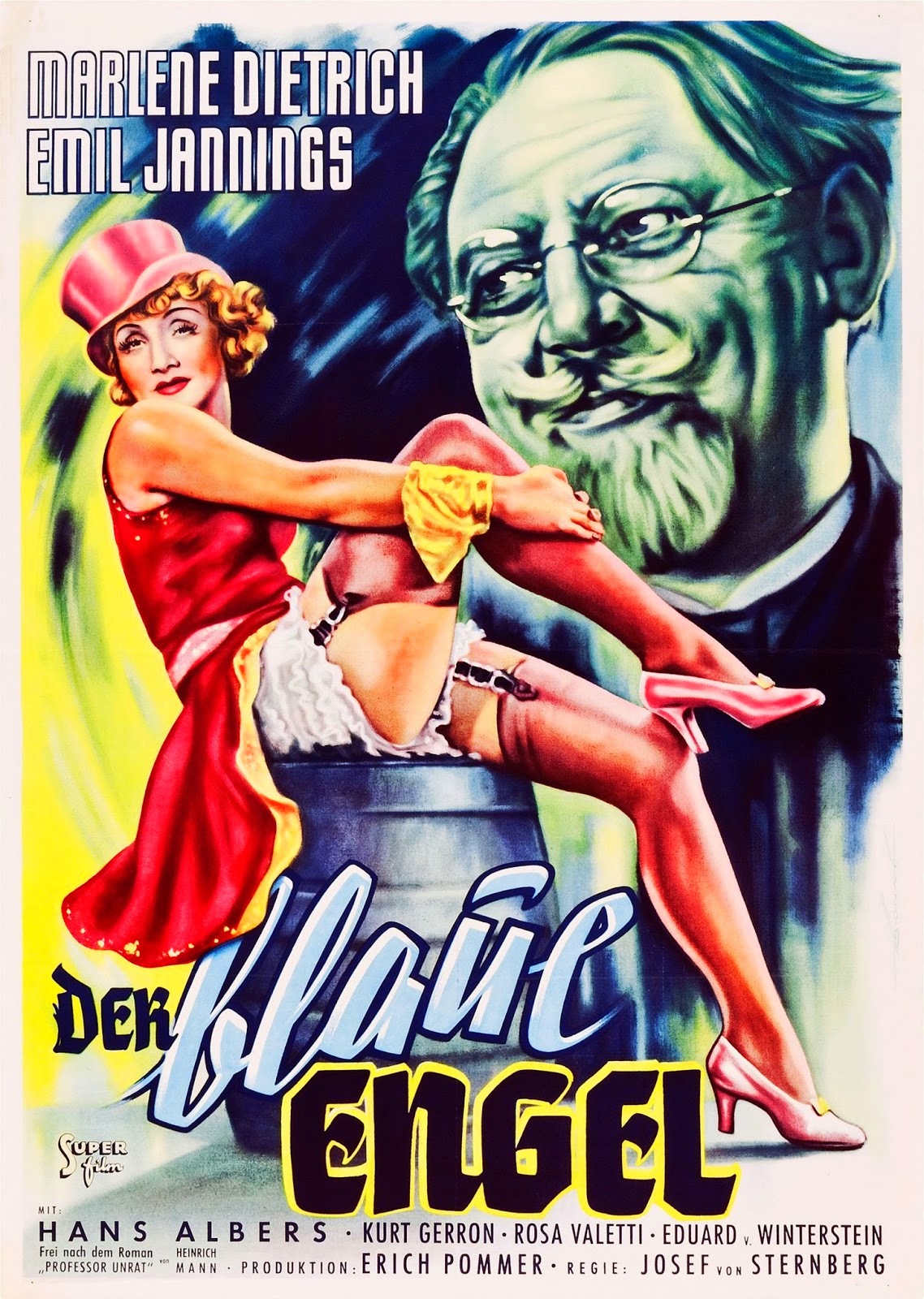
The Blue Angel (1930)

The Blue Angel was the first of the Josef von Sternberg-Marlene Dietrich films but it stands apart from the others. It was made in Germany at Ufa Studios (with both German and English language versions being shot in Germany) and it was on the strength of its success that von Sternberg and Dietrich ended up at Paramount.

Professor Immanuel Rath (Emil Jannings) teaches at the local gymnasium (the German equivalent of a high school). He is a pompous and faintly ridiculous figure but he has an orderly respectable life which suits him. He is alarmed to discover that his pupils have been sneaking into the notorious Blue Angel night-club, to watch the rather lascivious performances of the famous Lola Lola (Dietrich). The Professor sets off for the Blue Angel to put a stop to this, and there he encounters Lola Lola herself. She flirts with him outrageously, having decided that he’s rather sweet.

Rath becomes obsessed by Lola Lola, with ultimately disastrous consequences.

Emil Jannings was a huge star in Germany at the time and the movie was intended as a star vehicle for him. Marlene Dietrich had been making films for several years but was still unknown even in Germany. The Blue Angel would change all that. After this film she was a certified international star and Paramount was soon waving cheque books in front of her.

Jannings was a fine actor but was still fairly locked into the silent era style of acting. That doesn’t really matter since this is a Josef von Sternberg movie and Jannings’ performance simply gives it more of the stylised feel that was von Sternberg’s trademark. Dietrich was clearly much more comfortable with the sound film medium, and that’s an advantage as well. Her more relaxed, ironic performance offers the right contrast.

There are elements of melodrama here but to a large extent the story plays out as farce, and it actually is very funny at times.

The conventional way to approach The Blue Angel is to see Lola Lola as a femme fatale who lures poor Professor Rath to his doom. That conventional view can be defended but what makes it such an interesting film is that all the evidence in favour of the conventional view is open to quite different interpretations.

When you watch the film carefully however that conventional view doesn’t quite stand up. When they first meet Lola Lola does have some fun at his expense but it seems to be good-natured flirtatious fun. When she goes up the spiral staircase in her dressing room, undresses and then tosses her panties down at him you could see that as the first stage in her plan to degrade him. In fact it’s much more likely that in her world this is a perfectly normal thing to do - she is used to dealing with men who take such things in their stride because that’s how her world works. She can’t be expected to understand that poor Rath has probably never seen a pair of ladies’ panties before, much less had a pair dropped on him. She’s simply being herself.

When she tells him that she thinks he’s sweet, I think we can take that at face value. She flirts with him, but she’s not teasing him in a cruel way. She not only sleeps with him but gives the impression that she enjoyed it. She doesn’t mock him. She behaves the way you’d expect a woman to behave if she’s just spent the night with a man she’s fond of. She’s playful and affectionate. She really does feel a weird (even possibly perverse) attraction to him, but the attraction seems to be there.

When he proposes to her she bursts out laughing but then she realises that he actually means it and she accepts. I think it’s important to note that she in no way manipulates him into marriage and she has nothing to gain from the marriage. She’s not trying to gain respectability - she is from first to last indifferent to respectability. She doesn’t marry him for his money because he doesn’t have any.

The wedding night scene gives the impression that she not only intends to have normal marital sexual relations with him but that she’s looking forward to it. There is not the slightest suggestion that she feels any distaste for the idea of sleeping with him.

The notorious scene in which he puts her stockings on for her can be read as a sign of the degradation to which his obsession has reduced him, but Lola Lola does not really mock him. She accepts the act of physical intimacy the way one would expect a wife to accept such an act from her husband, and again there’s nothing to suggest that she is denying him other acts of intimacy.

She does of course end by destroying him, but I don’t think she ever had the slightest intention of doing so. What destroys the Professor is that he has tried to move from one world to another, to move from the world of order and respectability to the world of carefree fun and pleasure and he is simply not equipped to survive in that world. That’s not Lola Lola’s fault. It was a tragic error of judgment on Rath’s part, and if he’d been more worldly he could have had the best of both worlds - he could have secretly married Lola Lola or set her up as his mistress. But he’s not capable of doing that. It is he who insists on publicly marrying her and publicly proclaiming her as his wife. And when he starts to fall apart it’s because he cannot adapt to her world. Lola Lola has offered him what she has to give and it’s not her fault that it fails to make him happy. And remember, she never asked him to marry her and she was obviously happy to sleep with him without being married to him. She did not entice him into marriage by holding out the promise of sex to him.

I think it’s almost certain that Lola Lola has much more affection for Rath than von Sternberg does. It’s clear that von Sternberg sees him as a pompous authority figure who deserves to be taken down. It’s also just possible that much of the complexity of Lola Lola’s character comes from Dietrich’s extraordinarily sensitive performance.

If von Sternberg had wanted us to see Lola Lola as a cruel wanton destroyer of men you have to ask yourself why he passed up countless opportunities to indicate that Lola Lola despises Rath. In fact in scene after scene we see her treating him with kindness and love, and even being protective towards him. She actually appears to love him. Until the very end, when Rath’s self-destructiveness has reached epic proportions, there’s no clear indication that she has stopped loving him. Perhaps she has affairs, but for Lola Lola giving her body is not the same as giving her heart. And again one has to ask, if Lola Lola has been betraying Rath why does von Sternberg not include anything to indicate specifically that this is so?

Perhaps the best clue to the relationship is the line from her famous song from the movie (known in English of course as Falling In Love Again) - “Men swarm around me like moths to a flame/and if their wings get burnt, I can't be blamed.” Professor Rath should never have tried to leave his own world, but he freely chose to do so.

I think that seeing Lola Lola as a woman who destroys a man accidentally rather than deliberately makes the film a lot more interesting. And it makes her a much more fascinating and complex character. What makes it even more interesting is that while Lola Lola may not be a scheming femme fatale she is certainly a woman who lives uncompromisingly for pleasure. Adding another layer of complexity to the movie is that we’re not necessarily meant to condemn her for this, in fact we may be meant to admire her for it. My take on Lola Lola is that she’s a woman who wants to give love as well as receive it and that Rath is the first man who has actually wanted more from her than sex.

A lot of people will insist on seeing this movie as having some political message related to the rise of the Nazis. There’s really not the slightest reason to think that von Sternberg had any such intentions.

This movie has plenty of von Sternberg visual style (including some very definite Expressionist touches). An interesting point is that von Sternberg based Lola Lola’s kinky fetishistic look on the kinky fetishistic paintings of the Belgian Symbolist painter Félicien Rops.

The Eureka release includes both the German and English versions. It’s important to note that the English version is not a dubbed version. The entire film was shot twice, once in German and once in English. There are some differences between the two versions. It’s almost universally acknowledged that the German version is the superior version. The English version is slightly toned down. One of the many reasons for preferring the German version is that the German words to Falling In Love Again are Lola Lola telling us exactly what sort of woman she is, and this is completely lost in the English lyrics. The German lyrics to the song explain the whole movie.

The Blue Angel is a bona fide masterpiece that lives up to its reputation. Very highly recommended.