Monday, January 10, 2022

The Casino Murder Case (1935)

The Casino Murder Case, released by MGM in 1935, was the ninth of the Philo Vance movie adaptations. Of the Philo Vance movies I’ve seen so far this is by far the worst.

Numerous actors tried their hand at playing Philo Vance. Only one ever succeeded in getting it right and that was William Powell. In this case MGM, in a moment of complete insanity, decided to cast Paul Lukas as Vance. Lukas is wrong in almost every way but mostly he’s wrong because of his thick Hungarian accent. Philo Vance has to have an upper-class American accent. He’s an American blue-blood. That’s absolutely the core of the character. In one of the earlier movies, The Bishop Murder Case, MGM tried casting Basil Rathbone as Vance. That was an interesting experiment but it didn’t work because Rathbone was not convincing as an American. But it wasn’t as disastrous as the casting of Lukas. Had the movie been about an aristocratic central European detective he might have been OK but Philo Vance has to be thoroughly upper-crust American in order for the character to work at all.

It gets worse because Lukas is wrong in other ways as well. Philo Vance has to have an arrogant self-assurance but he also has to have a rather languid manner, both qualities which Lukas fails to convey. As a result the character he plays in this movie has absolutely zero connection to Philo Vance. This movie was doomed from the first moment Paul Lukas appeared on the scene. It’s not that Lukas is a bad actor. It’s just that this is one of the worst pieces of miscasting in movie history.

As for the plot, it begins with an anonymous letter claiming that if Lynn Llewellyn gambles tonight at his uncle’s casino tragedy will ensue. District Attorney Markham does not take the letter seriously. Philo Vance takes it very seriously and decides that he needs to take a closer look at the Llewellyn household.

There’s the unstable and eccentric old Mrs Llewellyn (Alison Skipworth), her son Lynn (Donald Cook) and his wife Virginia (Louise Henry). Much to the horror of the whole family Virginia intends to go back on the stage. There’s Lynn’s sister Amelia (Isabel Jewell), who’s rather fond of the bottle. There’s Amelia’s fiancé, Dr Kane (Leslie Fenton). There’s old Mrs Llewellyn’s brother Dick Kincaid (Arthur Byron) and there’s old Mrs Llewellyn’s secretary/companion Doris (Rosalind Russell). There’s plenty of tension between all these people.

Then the poisonings begin.

Plotwise the movie is passable. It tries to mix mystery and humour. The humour isn’t very successful but the Hollywood studios in the 30s were obsessed by the idea that mysteries and thrillers had to have comic relief.

There are some reasonably effective red herrings. The resolution is moderately effective.

Apart from the disastrous performance by Paul Lukas the rest of the cast is OK with Rosalind Russell and Isabel Jewell standing out. Eric Blore is mildly musing as Vance’s valet. Look out for Leo G. Carroll, entirely wasted as the butler.

Edward L. Marin (who directed the excellent George Raft film noir Nocturne in 1946) at least keeps things moving along.

The movie was based on S.S. Van Dine’s 1934 novel of the same name.

This movie is one of six included in the Warner Archive Philo Vance Murder Case Collection. The transfer is a bit rough with quite a bit of print damage and at times a slightly washed-out look. This boxed set is very uneven with some fine movies and some duds but it is at least interesting for the chance of seeing no less than six different actors playing (or attempting to play) Vance. What it does demonstrate beyond any question is that nobody part from William Powell should ever have been allowed to play Philo Vance.

If you’re going to buy the set anyway then by all means give this one a spin but really it’s a very average mystery offering at best passable entertainment.

Thursday, January 6, 2022

Duel in the Sun (1946)

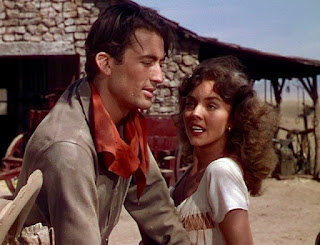
Duel in the Sun was David O. Selznick’s 1946 attempt to do a western in the Gone With the Wind style, an epic western. Selznick also saw it as a vehicle that would make his girlfriend Jennifer Jones into the biggest star in Hollywood. The problem, predictably, was that Selznick did what he always did. He interfered constantly in the production, driving away several directors and turning the production into a shambles. The script was rewritten countless times. Selznick took a hand in the writing. Only David O. Selznick could take a basically sound idea and turn it into a bombastic over-produced mess. In spite of all this Duel in the Sun (derisively known as Lust in the Dust) has its good points and manages to be entertaining in an eccentric sort of way.

It starts with a musical prelude. These musical preludes were the worst idea Hollywood ever came up with, this one one goes on and on and on and makes an already bloated movie even more bloated. At 146 minutes this movie is about an hour too long.

The story begins with the execution of Pearl Chavez’s father for murder. Pearl is half-Indian which explains the makeup job on Jennifer Jones who plays Pearl.

Her father’s dying wish was for Pearl to be sent to live with his second cousin Laura Belle McCanles (Lillian Gish). Laura Belle had been the movie of Pearl’s father’s life but she married a Yankee senator instead, Jackson McCanles (Lionel Barrymore). Laura Belle and the senator have two sons. Jesse (Joseph Cotten) is the good son. Lewton (known as Lewt) is the bad son. He’s a wild one.

Both sons take an interest in Pearl. Jesse’s interest is, naturally, noble and honourable. Of course it might have helped if he’d actually told her he loved her. Naturally Lewt’s interest in her is not the least bit honourable.

Give the choice between the decent honourable Jesse and bad boy Lewt Pearl naturally ends up with the bad boy. The trouble is that Pearl thinks Lewt will marry her. Lewt, having already had her, has no interest in marriage and in any case a McCanles is not going to marry a half-Indian girl.

There’s plenty of material for melodrama in all this and it’s melodrama we get, in a gloriously overheated style.

In 1946 it was very unusual for a western to be shot in colour. Duel in the Sun isn’t just in colour, it’s in amazingly lurid Technicolor. In keeping with the chaotic nature of the production three cinematographers worked on the film. And visually it really is extraordinary. It looks totally artificial and that turns out to be one of the movie’s biggest strengths. This is melodrama. The more artificial the setting the better.

There are some staggeringly brilliant visual moments. There are also some cringe-inducing moments.

The acting is all over the map. Lionel Barrymore is, as always, hammy but hamminess works in melodrama. Jennifer Jones gives a histrionic but entertaining performance. I suspect that the main problem with her performance was the constant script changes ordered by Selznick which had the result of making Pearl’s behaviour wildly inconsistent.

Joseph Cotten gives his standard Joseph Cotten performance. Which is OK, there’s nothing terribly wrong with a standard Joseph Cotten performance.

The big surprise is Gregory Peck. On paper he was miscast as the bad boy Lewt but in fact he’s terrific. If only he’d been given more rôles like this one, rôles that actually required him to act, instead of being cast endlessly as dull worthy priggish bores.

Characters in this movie do illogical things that are out of character simply because the messed-up script requires them to do so, even though those things don’t make a lick of sense.

Jesse is a problem. He’s supposed to be the honourable brother but I disliked him intensely. He could have saved Pearl from a whole lot of suffering if he’d just grabbed her, kissed her passionately and told her she was going to marry him. But he didn’t, because he’s an uptight self-righteous prig and I couldn’t help feeling that his attitude towards her is no better than Lewt’s, he’s just less honest about it. He might be excited by a woman like Pearl, but he’s not willing to marry her.

There was plenty in Duel in the Sun to shock the moral watchdogs of the time. Pearl obviously sleeps nude, at a time when Hollywood had married couples wearing pyjamas and sleeping in separate beds. She goes skinny-dipping. She goes skinny-dipping with a man watching her. It’s made quite explicit that Pearl and Lewt have sex. Whether Lewt forced her or not is open to debate. When Lewt treats her rough Pearl gets really excited. At a time when women in Hollywood movies were not supposed to experience lust Pearl’s lust for Lewt is very obvious. Bad boys get her really hot.

There are moments that are genuinely affecting and there are other moments that are supposed to be deeply affecting but end up being laugh-out-loud funny.

Duel in the Sun
is not a western. Selznick had no interest in making a western. It has a western setting, it has cowboys and it has some typical western plot elements but it does not have the feel of a western. It’s pure melodrama aimed (like all Selznick’s movies) at a female audience. It’s Gone With the Wind with cowboys. The struggle between a doomed aristocratic society and the new world of industry and democratic mass culture which drove Gone With the Wind is paralleled by the struggle between Jackson McCanles (who is essentially a feudal lord) and progress as represented by the railroad men.

Duel in the Sun is a sex melodrama. Every single significant action by the three central characters is driven by sex - sexual lust or sexual jealousy. And all the events of the past involving Pearl’s father, Jackson McCanles and Laura Belle were driven by sex. This is in fact a sex movie. In 1946 all of this had to be communicated by hints and suggestions. This is one 1940s movie that would have benefited greatly from including moderately graphic sex scenes and nudity. Nothing in this movie makes any sense at all unless we understand that Pearl decides on a course of action and then as soon as she sets eyes on Lewt her conscious mind goes out the window and she becomes a seething mass of woman-lust. And Lewt decides on a course of action and then he sets eyes on Pearl and his conscious mind goes out the window and he becomes a seething mass of man-lust. Many of Jesse’s actions make no sense unless we understand the strength of his sexual passion for Pearl and the extent of his sexual jealousy. For the movie to really work the sexual temperature needed to be turned up much much higher than was possible in 1946.

The movie has Selznick’s fingerprints all over it. Selznick gave directors nightmares but he wasn’t always entirely wrong. He believed that the key to success was to attract the female audience. He understood that women liked movies about love but he also understood that women liked moves about overwhelming sexual passions. Women liked sexy movies. A big glossy sex melodrama would be a guaranteed winner. His basic idea about Duel in the Sun was absolutely sound. The trouble was his constant meddling.

Duel in the Sun cannot be judged as a western because it isn’t one. It has to be judged for what it is. It’s a melodrama and it’s a women’s picture. Personally I like melodramas and I have no problem at all with women’s pictures. Duel in the Sun is a woman’s sex melodrama that almost works but it’s hampered by the ludicrous restrictions of the Production Code and by a script that isn’t as coherent as one might have wished. It doesn’t hang together as well as it should.

There’s a good write-up on this movie at Riding the High Country. Colin liked this movie a bit more than I did.

Duel in the Sun has its flaws but it’s fascinating. Highly recommended on the strength of its very distinctive flavour.

Tuesday, January 4, 2022

best classic movies I saw in 2021

The highlights of my classic movie viewing in 2021. Ten movies I particularly enjoyed.

The Blue Angel (Der blaue Engel), Josef von Sternberg, 1930

Chu Chin Chow, Walter Forde, 1934

Rear Window, Alfred Hitchcock, 1954

The Belles of St Trinian’s, Frank Launder, 1954

Manuela, Guy Hamilton, 1957

Vertigo, Alfred Hitchcock, 1958

King Creole, Michael Curtiz, 1958

The Malpas Mystery, Sidney Hayers, 1960

Marnie, Alfred Hitchcock, 1964

The Friends of Eddie Coyle, Peter Yates, 1973

And with a special mention to this one because it's so bizarre and visually stunning.

Camille, Ray C. Smallwood, 1921


Saturday, January 1, 2022

Spellbound (1945), Hitchcock Friday #9

Alfred Hitchcock’s Spellbound presents some challenges to a modern viewer. It’s about psychoanalysis. Audiences in 1945 would have taken psychoanalysis quite seriously and considered it to be science. Nobody today takes Freudian psychoanalysis seriously. This means that a modern viewer is likely to find much of the plot to be absurd and silly. The movie is going to have a camp vibe which was obviously not intended.

Fortunately this is a Hitchcock movie and Hitchcock didn’t care too much about the plots of his movies anyway.

Dr Constance Petersen Ingrid Bergman is a psychiatrist at Green Manors Hospital, a mental hospital. The director of the hospital, Dr Murchison (Leo G. Carroll) has been forced to relinquish his post after having a mental breakdown. His replacement, Dr Anthony Edwardes, is about to arrive to take over. Dr Edwardes (Gregory Peck) is much much younger than anyone expected.

He takes an immediate shine to Dr Petersen. Dr Petersen has dedicated herself to her work and has had no time for nonsense like love. She’s likeable enough but she takes her work very very seriously. She’s bookish and intellectual. But young Dr Edwardes sweeps her off her feet. She realises that she is capable of love after all.

There is however something not quite right about Dr Edwardes. He’s jumpy. Silly little things upset him. He cracks up in the operating theatre. Dr Petersen is head-over-heels in love with him but she’s not a complete fool. She realises that whoever this man is he’s not Dr Edwardes (we later find out that his name is John Ballantyne).

He admits that he’s not Dr Edwardes but the trouble is that he does not know who he is. He has amnesia. And he has quite a few other issues as well.

The real Dr Edwardes has vanished. The assumption is that the imposter has murdered him. The police are now hunting him. Dr Petersen has decided that the imposter is sick but harmless. She assumes he’s harmless because she’s in love with him.

Either psychiatric ethics were very loose in the 1940s or Dr Petersen is the most unethical and unprofessional (and recklessly irresponsible) psychiatrist in history. She’s not only prepared to let a man who might be a murderer escape from the police, she escapes with him. And she allows herself to become hopelessly romantically involved with him even though she’s treating him as a patient.

Even allowing for the fact that psychoanalysis is inherently absurd the movie’s treatment of the subject is ludicrous and silly beyond words.

A minor problem is that both Ingrid Bergman and Gregory Peck are just a little too young for the rôles they play. We’re supposed to believe that Dr Petersen is not just a qualified psychiatrist but an experienced one. Bergman was 30 and just doesn’t quite convince us that she could hold such a responsible position at a major mental hospital at that age. Gregory Peck was even younger and there’s no way on earth he could get away with masquerading as an eminent psychiatrist.

Bergman is also perhaps a little miscast. She is not the slightest bit convincing as a psychiatrist.

That’s perhaps not entirely her fault but due more to the chaotic mess of a script penned by Ben Hecht. Hecht contributed some of the most embarrassing dialogue in movie history. Bergman is a fine actress but nobody could deliver some of these lines without sounding ridiculous. She does her best and it’s to her credit that her performance works at all.

So Spellbound has all the makings of a total trainwreck. In spite of this there’s plenty to enjoy here. Hitchcock gives us his usual moments of visual brilliance. There’s some good suspense. The Salvador Dali-inspired dream sequence was daring and original at the time and it’s still quite impressive even if it’s silly and outlandish.

Hollywood went gaga over psychiatry movies in the 40s. None of those movies can possibly be taken seriously but most are fun to watch. Otto Preminger's Whirlpool is the only one that can be taken semi-seriously and it's a much better movie than Spellbound.

Spellbound was a huge hit in 1945 and a critical success as well. Today it is best approached as a beer-and-popcorn movie. If you have plenty of popcorn and a lot of beer you’ll enjoy yourself.

Friday, December 24, 2021

Butterfield 8 (1960)

Butterfield 8 is a more interesting movie than its reputation would suggest. It was made at a transitional moment for Hollywood. During the 50s the process of undermining the Production Code had begun. Otto Preminger had shown that the Production Code Authority could be defied. He made a couple of movies that were refused a Production Code Seal of Approval but they were released commercially anyway and did well at the Box Office. By 1960 the Production Code was showing clearly visible cracks.

At the same time the major studios were tentatively exploring the radical idea of making grown-up movies for grown-ups. They were even starting to get interested in making movies that dealt with sex honestly and openly. In 1960 The World of Suzie Wong dealt with an American businessman who falls in love with a Chinese prostitute. In 1961 Breakfast at Tiffany’s was a major hit and although it is not openly stated in the film it is blindingly obvious that Holly Golightly is an expensive high-class call girl. Butterfield 8 was part of the same wave of Hollywood movies about sex.

Butterfield 8 is a steamy sex melodrama about a beautiful socialite, Gloria Wandrous (Elizabeth Taylor), who has slept with so many men that she describes herself as the biggest slut of all time. Her latest conquest is Weston Liggett (Laurence Harvey) but this time it’s different. He’s the first man she’s slept with and then fallen in love with. Which would be a wonderful thing except that he’s married. And his wife Emily (Dina Merrill) is growing tired of his relentless pursuit of skirt.

There’s another man in Gloria’s life. Steve Carpenter (Eddie Fisher) is a childhood friend but it’s obvious to everyone (except possibly to Gloria) that Steve is hopelessly in love with her. It’s certainly obvious to Steve’s fiancée Norma (Susan Oliver).

Gloria has decided that Weston Liggett is the one man she wants and she intends to get him. She intends to have him all to herself.

This is obviously likely to end messily.

By the standards of 1960 Butterfield 8 is very open about sex. In the opening scene Gloria wakes up in bed naked and reaches out for the man she expects to find next to her, and that man is another woman’s husband. Remember that in the heyday of the Production Code married couples were not supposed to sleep in the same bed. Shortly afterwards we see Gloria and Liggett arrive at a motel in the middle of the day. For contemporary audiences a movie that made it absolutely crystal clear that a woman is having sex with another woman’s husband would have been pretty startling.

What makes this transitional phase in Hollywood history interesting is that Hollywood was still not quite sure how to handle such a story. Under the Production Code Gloria would have to severely punished for her sexual sins. The favoured way of dealing with such a situation was to have the woman redeemed by a noble self-sacrificing death. In 1960 the studios were not sure whether to continue to play safe and have the wicked woman die for her sins or whether to allow her to find happiness. They just weren’t sure which way to jump. For obvious reasons I’m not going to tell you which way this film jumps.

Butterfield 8 was at the time widely dismissed as a trashy movie based on a trashy novel. It has never quite been able to escape that reputation.

One of the problems is that Butterfield 8 really is trashy. It’s an overheated sweaty sex melodrama. I happen to like overheated sweaty sex melodramas. Butterfield 8 reminds me just a little of Valley of the Dolls - it’s a movie that takes itself too seriously and ends up veering into camp territory. Butterfield 8 is nowhere near as camp as Valley of the Dolls but it does have that slight tendency. It has a lot of overblown moments, and a lot of pompous dialogue. On the plus side there are some delightfully catty exchanges between Gloria and Norma.

One thing we have to confront is the question of what Gloria actually does. While movies like Breakfast at Tiffany’s skirted around the prostitution question Butterfield 8 seems to go to great lengths to persuade us that Gloria isn’t a prostitute. But there are things about the plot and about the motivations of the characters that don’t make sense if she’s not a prostitute. It’s just possible that she inhabits the ambiguous world of mistresses who are in practice courtesans. But the whole telephone thing certainly suggests that she’s a call girl.

If there’s an underlying theme to this movie it’s people being dishonest with others and with themselves about sex, and rushing to make judgments on others and on themselves about sex. Liggett loves Gloria but he won’t leave his wife for her because his wife Emily is the sort of virtuous woman that you marry whereas he considers Gloria to be a slut. Gloria’s friend Steve Carpenter genuinely cares about her and is sexually obsessed with her but he also considers her to be the kind of Bad Girl that men don’t marry. He also considers her to be a slut. And she considers herself to be a slut or a whore or both.

Gloria’s mother manages at one and the same time to think that her daughter is a slut and a virgin who is saving herself for marriage. She cannot accept the truth that Gloria has sex with men and enjoys it.

It’s interesting that Gloria doesn’t really feel guilty about having sex with a married man. What she feels guilty and ashamed about is the fact that she enjoys sex.

Elizabeth Taylor won the Best Actress Oscar for this film (a film she hated) and there’s some controversy about that as well. There was a widely held belief that it was a “making amends” Oscar, that she only won the award because the Academy belatedly realised they should have given her the Oscar for Cat on a Hot Tin Roof. There’s no question that she deserved an Oscar for that film but personally I think she won for Butterfield 8 because she gave a damned good performance. Whether the movie itself was worthy of her is another matter.

What can be said is that Miss Taylor really does steam up the screen. At this stage of her career she positively oozed sex. Fortunately that’s exactly what this rôle calls for and she goes all out.

And then there’s the matter of her co-star. Laurence Harvey is an actor a lot of people love tp hate. He routine gets described as wooden or dull. Personally I think that’s because the absurd histrionics of Method Acting were all the rage at the time. Harvey was a real actor and he gave subtle believable performances. He’s an actor I admire quite a bit but I have to admit that there are many who disagree with me.

I don’t think Butterfield 8 has had a Blu-Ray release but the Warner Home Video DVD offers an excellent anamorphic transfer.

Butterfield 8 isn’t a great movie but it’s a lot more interesting that it seems to be on the surface. For that reason it’s recommended.

Friday, December 17, 2021

Notorious (1946), Hitchcock Friday #8

Notorious is one of Hitchcock’s most admired movies. I have of course seen it before, more than once, but not for at least twenty years. It comes in the middle of what I personally consider to be the low point of Hitchcock’s career, his 1940s Hollywood movies.

Alicia Huberman (Ingrid Bergman) is an American but her father is German and he’s a convicted Nazi spy. The US Government persuades her (by means of emotional blackmail and the implied threat of actual blackmail) to work for them to infiltrate a group of Germans in Brazil. She is recruited by an American spy, Devlin (Cary Grant).

Alicia is a Bad Girl. She is a notorious woman. She drinks and she possibly sleeps with men, which is about as wicked as anyone could imagine in the 1940s. Her job is to get herself into the good graces of a certain Alex Sebastian who is assumed to be the key figure in the evil Nazi plot. Her assignment is to become Alex’s mistress but of course the audience can’t be told anything so shocking. It is however perfectly obvious that that is the plan. That of course is exactly what female spies did - they used sex in order to gain information or to set someone up for blackmail. Female spies were used as honey traps. The US intelligence agency that came up with this particular scheme assumes that Alicia, being an immoral woman, won’t object.

Before she sets out for Brazil romance blossoms between Alicia and Devlin although it’s complicated by the fact that he has no real respect for her because she’s an immoral woman.

She has few problems getting Alex Sebastian interested in her. They knew each other several years later and he’d been in love with her then. In fact he has never really stopped loving her.

What those Nazis in Brazil are up to is of course of no importance whatsoever. There’s some secret plot but it’s just a McGuffin. Hitchcock as usual is interested in the visual possibilities offered by the thin plot, in creating effective suspense and in exploring themes that always interested him - in this case love, suspicion and betrayal. There has never been a director quite so indifferent to plot as Alfred Hitchcock.

The CIA did not exist in 1946 and we’re never told the name of the US intelligence agency for which Devlin works. For convenience I’ll refer to them as the CIA. It’s strange at first that the Nazis are the bad guys, considering that the war was over and the Nazis were totally defeated. But in 1946 the Soviets were still counted among the Good Guys. So even though it makes little sense in 1946 the Nazis still have to play the role of the Bad Guys. The idea is that there’s a circle of Nazis in Brazil and they’re up to something sinister.

In 1936 Hitchcock had made a remarkably cynical spy movie called Secret Agent. Espionage seemed to fascinate him because it is all about deception. Betrayal is the stock-in-trade of the spy. Notorious, like Secret Agent, is brutally honest about espionage. The good guys are no more trustworthy and no more moral than the bad guys. In Notorious there’s no moral difference between the Nazi conspirators and the CIA. Both treat human beings as pawns in a game, to be sacrificed when they’re no longer useful. Espionage is a dirty game no matter which side is playing it. And if you’re obsessively interested in voyeurism, as Hitchcock was, espionage offers plenty of opportunities.

This is the closest Cary Grant ever got to playing an out-and-out swine. What makes Devlin particularly contemptible is that he really has fallen for Alicia, but he’s still prepared to encourage her to take on such a grubby job, a job which will obviously damage her fragile self-resect even further. It might destroy her psychologically and emotionally. But he’s still happy for her to do the job, and he’s still happy to manipulate her into doing so.

Of course if Devlin had a shred of human decency he wouldn’t be a spy. You get to be a spy by proving that you’re perfectly comfortable with the idea of lying to people, manipulating them and using them. We get the impression that Devlin has never had any problems doing such things.

Any discussion of Hitchcock will inevitably have to deal with the appalling censorship problems he ran into especially during the 1940s. It wasn’t just the Production Code Authority. The studios routinely exercised their own unofficial censorship, vetoing anything that they thought might be even mildly controversial. In the case of Notorious much has been made of the famous love scene in which Hitchcock, being forbidden to have his characters doing anything as disgusting as having a lengthy kiss (which might have permanently scarred the minds of innocent American youth), has them engage in a process of serial kissing. But censorship in Hollywood in the 40s went far beyond such overt content. Movie-makers faced incredible restrictions on the subject matter they cold deal with and the ways in which they dealt with a variety of subjects. These were the days when the assumption was that audience members would be shocked and horrified by any suggestion that married couples had sex.

Hitchcock loathed censorship and usually ended up trying to subvert it by dealing with sexual matters by means of subtle hints. In this case the problem was Alicia’s past. She may have been promiscuous and may even have been a courtesan (we do get the vague impression that the Commodore may be a client rather than an old friend). Hints are dropped about Alicia’s sex life but the hints are too vague. Apparently in the original version of the script she was indeed a prostitute. Obviously that had to be changed in the final version. In the version as filmed it appears that she may have had love affairs.

This was Hollywood in the 40s. You come up with a script that works and makes perfect sense. The Production Code Authority forces you to make drastic changes. You come up with a second version which makes less sense and works less well. The studio forces you to make more drastic changes. You end up with a final script that makes no sense, but the moral watchdogs are happy. In the case of Notorious the end result is that the Devlin-Alicia relationship makes no sense. Had she been a prostitute or a kept woman then we could have bought the idea that Devlin might well feel a mixture of attraction and repulsion towards her. In the movie he does feel a mixture of attraction and repulsion towards her, but his attitude is incomprehensible. The man is a spy, not a Sunday School teacher. He has undoubtedly sexually manipulated plenty of women. That’s what spies do. He’s not the type to be shocked and dismayed that his new lady love is not a virgin. But that’s what we’e expected to believe. In fact, as presented in the final film, Alicia may even be a virgin. Instead of being a man suffering from emotional turmoil he just comes across as unbelievable and nasty.

The Production Code Authority also insisted on the removal of an early scene which made it clear that Alicia was a kept woman. The Production Code Authority didn’t quite succeed in wrecking Notorious but they come very close to it. The emotional dynamic between Alicia and Devlin, which is the core of the film, is fatally weakened and seems phoney.

There’s a scene in which (very daringly for a 1946 Hollywood movie), Alicia tells Devlin that she’s now Alex’s mistress. Even though Devlin knows quite well that this was the entire plan all along he reacts like a spoilt child who’s had a candy bar taken away from him. If he’s in love with her it’s understandable that he’d be upset but he behaves as if Alicia is just a whore. He makes sure she knows how much he despises her. Again it makes no sense. The only people in the movie who are actually trying to make a whore of Alicia are the US Government, and Devlin as their agent.

As a result of the moralistic meddling Alex becomes the only sympathetic male character in the movie. Alicia would be better off with Alex, who treats her with respect and gentleness, rather than Devlin for (for no plausible reason) treats her like dirt.

I don’t think Hitchcock had any interest in the political dimensions of the story. Whether Devlin is on the side of the Good Guys and Alex on the side of the Bad Guys doesn’t matter. It’s the suspicions and the betrayals within the romantic triangle that count. The espionage plot is one of the thinnest and weakest in cinema history. Which suited Hitchcock perfectly. Nobody who has ever watched Notorious has cared about the spy plot.

Hitchcock had little or no interest in politics. If he had had any political agenda then you would expect to see it in his spy films, but his spy films are entirely lacking in political content. Hitchcock was fascinated by the world of espionage because it was all about deception and betrayal. And if you throw a woman into such a world, a world in which lies and betrayal are taken for granted, you have a great opportunity to explore themes of love, loyalty, betrayal, suspicion and deceit. But Hitchcock was interested in these themes at a personal rather than a political level. We certainly get the impression that the US Government agency for which Devlin works has chosen Alicia for this job because they consider her to be a bad woman which means they’re not obliged to bother themselves about her feelings or her safety.

Ingrid Bergman is excellent. Cary Grant’s performance is good but fatally weakened by the script changes which make him appear to be merely a bully and a prig rather than a man grappling with emotional turmoil.

Notorious is another typical 1940s Hitchcock movie, a potentially very great movie sabotaged by the censors. It’s still a very very good movie, but again instead of the raw Scotch that it should have been we get the Scotch heavily watered down. It’s still a great movie but, thanks to the Production Code Authority, it’s a flawed one. When you find yourself hoping that the hero will get killed at the end but that the villain will survive you have a serious problem. Notorious approaches greatness but doesn’t quite achieve it. It’s still highly recommended.

Friday, December 10, 2021

Vertigo (1958), Hitchcock Friday #7

So I had to get to Vertigo eventually didn’t I? I can hardly claim to be re-immersing myself in the world of Hitchcock without revisiting this one.

Vertigo is now widely accepted as the greatest motion picture ever made. I’ve never been convinced that it’s even the best movie Hitchcock ever made (although I would have put it in my Hitchcock Top Five). I have always thought The 39 Steps, Strangers On a Train, Rear Window and Psycho were probably better movies in the sense that they’re more successful in achieving precisely what the director set out to achieve. But Vertigo is the one that gets under your skin. And watching Vertigo again might well change my mind about its status in the Hitchcock canon.

I can see why Vertigo did not do well at the box office. The first 45 minutes of the film would have left audiences bewildered, bored and disgruntled. If they were expecting a tense suspense thriller they would have been bitterly disappointed. And if you can’t grab the audience in the first 45 minutes you probably won’t grab them at all. That first three-quarters of an hour is absolutely crucial but you don’t understand that until later. You have to be in the right frame of mind to appreciate Vertigo. It just is not in any way, shape or form a conventional suspense thriller. You have to let yourself be drawn gradually into the film’s strange twisted dream-like world but you have to have the patience to let that happen.

He uses the same trick he would use in Psycho a couple of years later - what seems to be the climax of the movie happens halfway through. At which point the movie changes gears slightly. Then, shortly afterwards, with an hour or so of screen time remaining. Hitchcock explains the entire mystery plot in every detail. The mystery is entirely resolved. At which point Vertigo changes gears really dramatically and becomes a dark, disturbing psycho-sexual-emotional drama.

But while the audience now knows exactly what happened, Scotty doesn’t. So now the suspense kicks in. We fear something, but we have no idea what it is.

The plot is intricate. It’s far-fetched but it has its own internal logic. The plot is however not of overriding importance. What matters is the visual style that Hitchcock brings to the movie and the way he works through such favourite themes as fear, guilt, obsession, voyeurism, betrayal, suspicion, love and sex.

John “Scotty” Ferguson (James Stewart) is a cop. A sudden attack of vertigo on his part leds to the death of another cop. Scotty retires from the force. An old college friend, Gavin Elster, persuades Scotty to undertake an investigation for him, as a personal favourite. Gavin has the idea that his wife Madeleine (Kim Novak) thinks she is possessed by the soul of a long-dead woman. He fears that, like the long-dead woman, she may try to kill herself. Scotty follows Madeleine and has reason to believe she really is suicidal. He makes some serious errors of judgment, blinded by his increasing obsession with Madeleine. And then something happens that changes everything, for Scotty and for the viewer. Hitchcock has some major tricks up his sleeve.

Strangely enough the first time I saw this movie I wasn’t very impressed by Kim Novak. Seeing it now I can appreciate the absolute perfection of her performance. In fact it’s one of the great screen performances.

James Stewart is very good as well, but the movie belongs to Kim Novak.

While Scotty becomes a really dark character in the second half of the film right from the start we have the feeling that he’s not quite right. From the moment that his vertigo causes the death of a fellow policeman he is riddled with guilt and self-recrimination. His judgment is questionable. He is becoming emotionally involved with a married woman. The idea that this might be wrong, or at least unwise, does not occur to him. Where does he expect his obsession to lead to? He doesn’t seem to know. He’s not thinking things out. He is so much in the grip of his obsession that he’s not thinking at all. He also, throughout the movie, seem to just assume that she will go along with his obsession. If it’s what he wants then she must want it too.

There’s plenty of the trademark Hitchcock interest in voyeurism in this movie. Scotty has to tail Madeleine, it’s what he’s been hired to do, but there’s a definite voyeuristic edge to the way he does it. And he’s already hypnotised by her beauty. His sexual and romantic obsession with her the moment he first set eyes on her. We get the feeling that even if his client decided to take him off the case Scotty would probably keep following Madeleine anyway. As always with the voyeurism in Hitchcock there’s the complication that the voyeur may be entirely misinterpreting what he sees. It’s significant that there are so many mirrors in the movie - mirrors show us reality, but in reverse, which is often how Scotty sees things.

There’s an enormous amount of perverse sexuality in this movie. Hitchcock was still hampered by the Production Code but he manages to get the perverse sexuality across pretty effectively.

And he gets away with some subtle sexual hints. When Scotty fishes Madeleine out of the water half-drowned you might think that the logical thing to do would be to take her to a hospital or to a doctor. Instead he takes her back to his apartment. He doesn’t call a doctor. It’s also obvious that he has undressed Madeleine before putting her to bed. Madeleine certainly notices, when she wakes up, that she is naked. Obviously he had to get her out of her wet clothes but in 1958 you might think that the obvious thing for a man to do in such a situation would be to phone a female friend (he could easily have phoned Midge and told her he had a half-drowned girl in his apartment and could she come over). So we know that Scotty has now seen Madeleine naked, Madeleine knows it, and Hitchcock makes sure that we know it, which adds to the voyeuristic quality of Scotty’s shadowing of Madeleine. It’s also a subtle indication that Scotty is starting to think of Madeleine as belonging to him in some way.

The artificiality of Vertigo has to be addressed. Hitchcock didn’t give a damn if his movies looked like they were shot on a sound stage. He wanted them to look like they were shot on a sound stage. He had no time at all for the fetish for location shooting that infected cinema in the 50s. He rejected realism entirely. His movies take place in a created universe with its own rules. Hitchcock was right of course. Realism is a dead end. Vertigo makes no concessions to realism. The entire movie plays out like a fever dream.

Many many movies have been influenced by Hitchcock over the years but few have been so obviously influenced as Paul Verhoeven’s Basic Instinct (which I re-watched recently) and it’s clear that Vertigo was the major influence in that case. There are not only striking stylistic affinities but lots of thematic links. And of course Sharon Stone is made to look exactly like Kim Novak (which is wonderfully apt considering the subject matter of Vertigo).

The Vertigo Blu-Ray includes an audio commentary by William Friedkin. He makes the interesting point that the McKittrick Hotel set used in Vertigo appears to be the same set, re-dressed, used as the interior of the Bates house in Psycho. There are lots of other extras as well. The movie looks superb on Blu-Ray.

Having now seen the film for the third time I’m inclined to think I was wrong. Vertigo really is Hitchcock’s greatest movie. And yes, it just might be one of the greatest movies of all time, possibly in the top five.